
LaunchDarkly Alternatives: Four Options for Flags, Experiments and Cost
Choose Statsig for feature delivery tied to managed experimentation, GrowthBook for warehouse-led analysis, Unleash for a feature-management platform with deployment control, and ConfigCat for focused configuration delivery. A LaunchDarkly alternative must preserve the behavior your application depends on. Compare targeting, failure defaults, approvals and actual usage before migrating. A cheaper flag evaluation is useful only when the release remains controlled and the experiment remains interpretable.
On this page
LaunchDarkly alternatives compared
USD public prices below show the stated charging unit; infrastructure, additional usage and required enterprise scope are separate.
| Alternative | Published starting reference | Best fit | Main purchasing boundary |
|---|---|---|---|
| Statsig | Free; Pro $150/month with 5 million metered events | Managed experiments alongside flags | Metered exposures and project-level subscriptions |
| GrowthBook | Free cloud for three users; Pro $40/seat/month | Warehouse-led experimentation | Seats, governance and CDN or managed-warehouse usage |
| Unleash | Enterprise pay-as-you-go $75/seat/month | Feature operations with deployment control | Cloud requests and self-hosted minimums |
| ConfigCat | Free; Pro $110/month on the monthly USD schedule | Focused feature configuration delivery | Configuration downloads, bandwidth and resource limits |
Sources: Statsig pricing, GrowthBook pricing, Unleash pricing, ConfigCat pricing.
At Martechdevs, we connect product analytics and experimentation to the behavior a team needs to release and measure. The flag service, the exposure log and the outcome definition must agree. Changing the flag provider without preserving those relationships can change the result even when the interface still displays the same rollout percentage.
The LaunchDarkly baseline
LaunchDarkly's current Developer plan has no seat fee and includes five service connections and one thousand client-side monthly active users. Foundation uses pay-as-you-go usage above the included amounts. Service connections represent server-side SDK connections to environments, averaged over time; replicas, workers and non-production environments can all contribute. LaunchDarkly pricing and usage definitions.
That distinction makes architecture relevant to cost. Twenty replicas with active SDK connections do not necessarily represent one billable connection simply because they belong to one service. Likewise, a client-side user or device meter is different from an operator seat count.
Foundation permits approval requests, while mandatory approvals require Enterprise. A team that needs enforced change review should compare the appropriate governance tier with each alternative. The presence of an approval button does not establish that production changes cannot bypass it. LaunchDarkly approval scope.
Before replacing the platform, separate excessive consumption from a missing capability. Reusing appropriate SDK instances, removing stale environments or repairing an unnecessary polling pattern may reduce work without a migration. Keep the accepted application architecture intact while checking what actually creates the bill.
Experimentation-led alternatives
Statsig
Statsig is our first trial when flags should connect directly with managed experiment analysis. Developer includes two million events monthly and unlimited flag and configuration checks. Pro starts at $150 monthly, includes five million metered events, and charges $0.05 per additional thousand. Statsig plans.
- Best for: a product-engineering team that wants assignment and experiment analysis in one managed workflow.
- Pros: a free entry and a published usage formula for the main Pro event meter.
- Cons: experiment exposures, additional event dimensions and project structure affect the complete bill.
- Free plan and startup offer: Developer is free; apply any separately approved startup benefit only to its eligible scope and period.
- Choose it if: the team can validate the assignment, exposure and outcome path in the selected plan.
- Skip it if: mandatory governance or data architecture needs push the accepted implementation beyond the proposed scope.
A flag check and a metered experiment exposure are different. Statsig's pricing FAQ counts exposures from experiments or feature flags with Metric Lifts enabled, as well as logged events and other listed units. It describes SDK-specific exposure deduplication and additional charging for extra event dimensions. Metered-event definition.
Pro applies to one project. If production and another separately upgraded project each need Pro, include both base subscriptions. On Developer, exceeding the event allowance can stop Metric Lift computation while gate and configuration targeting continue. Continued feature delivery therefore does not prove continued experiment reporting.
GrowthBook
GrowthBook is a strong candidate when trusted metrics already live in a warehouse and the team can maintain the exposure and outcome tables. Its cloud Starter plan supports three users and one project. Pro is listed at $40 per seat monthly for up to thirty users, with a wider set of statistical capabilities. GrowthBook plans.
- Best for: a data and product team with an accountable owner for metric definitions and experiment analysis.
- Pros: warehouse integration and a seat-based platform model can fit an existing analytical operating model.
- Cons: warehouse work, CDN usage and governance still require scope and cost planning.
- Free plan and startup offer: cloud Starter is free for three users, while the free self-hosted plan has unlimited users; infrastructure and operation remain your responsibility.
- Choose it if: assignments and outcomes can be reconciled in the intended data path and the team can maintain that path.
- Skip it if: nobody owns the warehouse models or the selected plan cannot enforce required production controls.
The unlimited-traffic statement does not remove every usage charge. The Pro matrix includes two million CDN requests monthly, then $10 per additional million, and twenty GB of bandwidth, then $1 per additional GB. Its managed warehouse has a separate included-event allowance and overage. GrowthBook usage boundaries.
Approval workflows, SSO and exportable audit logs belong to the Enterprise comparison. Evaluate the required release process independently of the statistical features you want. The experimentation-platforms guide covers the wider analysis decision when feature delivery itself already works.
Feature-operation alternatives
Unleash
Unleash is a candidate when the main requirement is controlled feature management with a choice of deployment arrangements. Its Enterprise pay-as-you-go reference is $75 per seat monthly. Custom Enterprise covers cloud, self-hosted or hybrid agreements. Unleash commercial scope.
- Best for: platform and release teams with explicit deployment, access and feature-lifecycle requirements.
- Pros: paid scope includes change-request workflows, role controls and several deployment routes.
- Cons: operating a self-hosted configuration adds responsibility, and cloud API usage still has a meter.
- Free plan and startup offer: an Enterprise trial and an open-source route are available; compare their actual feature scope separately.
- Choose it if: the target SDKs, failure behavior and governance work in the intended deployment.
- Skip it if: the team wants experiment analysis without accepting ownership of the required measurement integration.
The current cloud allowance is fifty-three million API requests monthly, followed by $5 per additional million. The pricing page specifically states a five-seat minimum for self-hosted pay-as-you-go. Do not apply that minimum automatically to every cloud configuration. Seat and request rules, open-source and trial routes.
Unleash's backend SDKs evaluate locally; frontend SDKs obtain evaluated flags through the server or Edge. Initialized clients can continue from cached state during an outage, while a new client without bootstrap data can fall back to disabled flags or its specified default. Test your SDK and deployment path. SDK and offline behavior.
ConfigCat
ConfigCat is worth evaluating when the team primarily needs feature flags and remote configuration with local evaluation. Its SDK retrieves a configuration file and caches it in the application. The commercial meter focuses on configuration downloads and network traffic, rather than every local flag read. ConfigCat pricing and evaluation model.
- Best for: a team with a focused configuration requirement and a separate, accepted analytical workflow.
- Pros: unlimited seats and local evaluations separate operator growth from the download meter.
- Cons: polling frequency, running application instances and configuration size can increase usage.
- Free plan and startup offer: Forever Free includes five million configuration downloads and twenty GB monthly; no extra startup reduction is assumed.
- Choose it if: the required targeting, environments and operational controls fit the selected plan.
- Skip it if: the buying requirement is a complete managed experimentation system and the necessary analysis path remains undefined.
Pro's monthly USD reference is $110, including twenty-five million configuration downloads and one hundred GB of network traffic. Flag, product and environment limits remain separate from those usage amounts. ConfigCat plans, resource limits.
A response saying the configuration has not changed still counts as a download request under ConfigCat's billing policy. Its count includes HTTP 304 responses. A polling forecast should therefore count requests, rather than only changed configuration files. Download-count policy.
Cost by architecture and workload
The examples below are illustrative calculations using the published rates. They represent different workloads and capabilities, so the totals are not a cheapest-provider ranking.
| Configuration | Explicit assumptions | Monthly calculation | Amount |
|---|---|---|---|
| LaunchDarkly Foundation | Twenty average service connections; 10,000 client-side MAUs; monthly billing | 15 × $12 + 9 × $10 | $270 |
| Statsig Pro | One project; seven million metered events | $150 + 2,000 × $0.05 | $250 |
| GrowthBook Pro | Eight seats; three million CDN requests; five million managed-warehouse events; bandwidth within included amount | 8 × $40 + $10 + 3 × $30 | $420 |
| Unleash Enterprise cloud | Eight seats; sixty million API requests | 8 × $75 + 7 × $5 | $635 |
| ConfigCat Pro | Within its twenty-five-million-download and hundred-GB allowances | Monthly plan reference | $110 |
Sources: LaunchDarkly rates, Statsig, GrowthBook, Unleash, ConfigCat. These examples exclude other metered products, required upgrades, tax, implementation and separately charged infrastructure. Confirm GrowthBook's billing commitment in the offer when turning its displayed monthly seat amount into an annual purchase.
Polling can matter more than the number of feature checks. In a simplified thirty-day model, one hundred continuously running clients fetching a configuration every minute generate 100 × 60 × 24 × 30 = 4,320,000 requests. At thirty-second intervals, that doubles to 8,640,000. Real usage also depends on initialization, client lifetimes, retries and caching.
Self-hosting needs an operating budget. Include the service, storage, backups, updates, monitoring and the person responsible for recovery. A zero licence fee does not establish a zero running cost, and a successful local startup does not demonstrate production availability.
Migration behavior beyond matching flag names
Export an inventory of active flags, environments, targeting rules, dependencies, default values, owners and cleanup conditions. Include references in services, mobile releases, jobs and older supported application versions. A flag removed from the dashboard can still be referenced by code that remains in use.
Percentage equivalence is especially easy to misread. LaunchDarkly's bucketing uses context information, the flag key and a salt. A different provider's fifty-percent rollout should not be assumed to select the same people merely because the percentage matches. LaunchDarkly rollout logic.
For a hypothetical population of 10,000 accounts, suppose the old provider enables 5,000 and the new provider independently selects half. The expected overlap is 2,500. About 5,000 accounts would change state across the two groups in that simplified model. Actual overlap depends on the algorithms and keys, so compare assignments rather than relying on the example as a forecast.
Preserve assignments explicitly when an active experiment or customer commitment requires continuity. Otherwise, end the old evaluation deliberately and begin a new one with an appropriate analysis boundary. Mixing old and new assignment systems without identifying the transition can invalidate an apparently continuous experiment.
| Test case | Accepted behavior | Failure requiring repair |
|---|---|---|
| Named customer targeting | Correct variation for each reference account | Different key, context or rule precedence |
| Percentage rollout | Accepted cohort continuity or deliberate reassignment | Unexplained customer state changes |
| Missing attribute | Agreed default and evaluation reason | Silent access or feature exposure |
| Cold startup during outage | Approved fallback or bootstrap state | Undefined or unsafe application behavior |
| Existing cached client | Known stale-state behavior | Assumed immediate remote rollback without connectivity |
| Mobile older version | Compatible flag type and value | Removed key or unsupported configuration |
OpenFeature can provide a common evaluation interface through providers, reducing code coupling to a vendor. It does not, by itself, migrate targeting rules or guarantee matching assignment semantics. Keep the behavior tests even when the application uses a standard interface. OpenFeature provider model.
Experiment integrity and release ownership
Log exposure where the assigned behavior can actually affect the user. An SDK initialization or a flag check in an unrelated background task can create exposure without the person experiencing the variant. Keep the randomization unit consistent with the business question, especially for B2B products where teammates share an account.
Define the primary metric, guardrails, observation window and decision rule before looking at the result. Preserve non-converters and late outcomes according to the agreed analysis. The tracking-plan guide helps establish the data contract, and the activation-metrics guide helps choose a meaningful product outcome.
Separate releasing a feature from concluding that it improves the outcome. A successful rollout can establish operational stability without producing a meaningful lift. Conversely, a promising business metric cannot justify ignoring a serious reliability regression.
Test who can change production and who can approve the change. Confirm how the system behaves when the approver is absent, the control service is unavailable or an application remains offline. A cached local evaluator can keep serving its last state, but a newly requested rollback needs a supported path to reach it.
Give every temporary flag an owner and a removal condition. The migration is a useful point to retire obsolete flags only after confirming that deployed code no longer depends on them. Long-lived permissions and commercial entitlements deserve a separate lifecycle from temporary release switches.
LaunchDarkly competitors by operating need
| Situation | First candidate | Runner-up | Decision reason |
|---|---|---|---|
| Managed experiments with engineering ownership | Statsig | GrowthBook | Assignment, metered events and accepted analysis |
| Existing warehouse metrics and data-team capacity | GrowthBook | Statsig Warehouse Native quote | Reproducible metrics and query ownership |
| Explicit deployment and governance requirement | Unleash | Appropriate LaunchDarkly scope | SDK behavior, controls and operating responsibility |
| Focused local configuration delivery | ConfigCat | Unleash | Download economics and targeting fit |
| Existing LaunchDarkly with no material unmet need | Repair current scope | Bounded alternative trial | Migration risk relative to the accepted benefit |
Feature-platform migration checklist
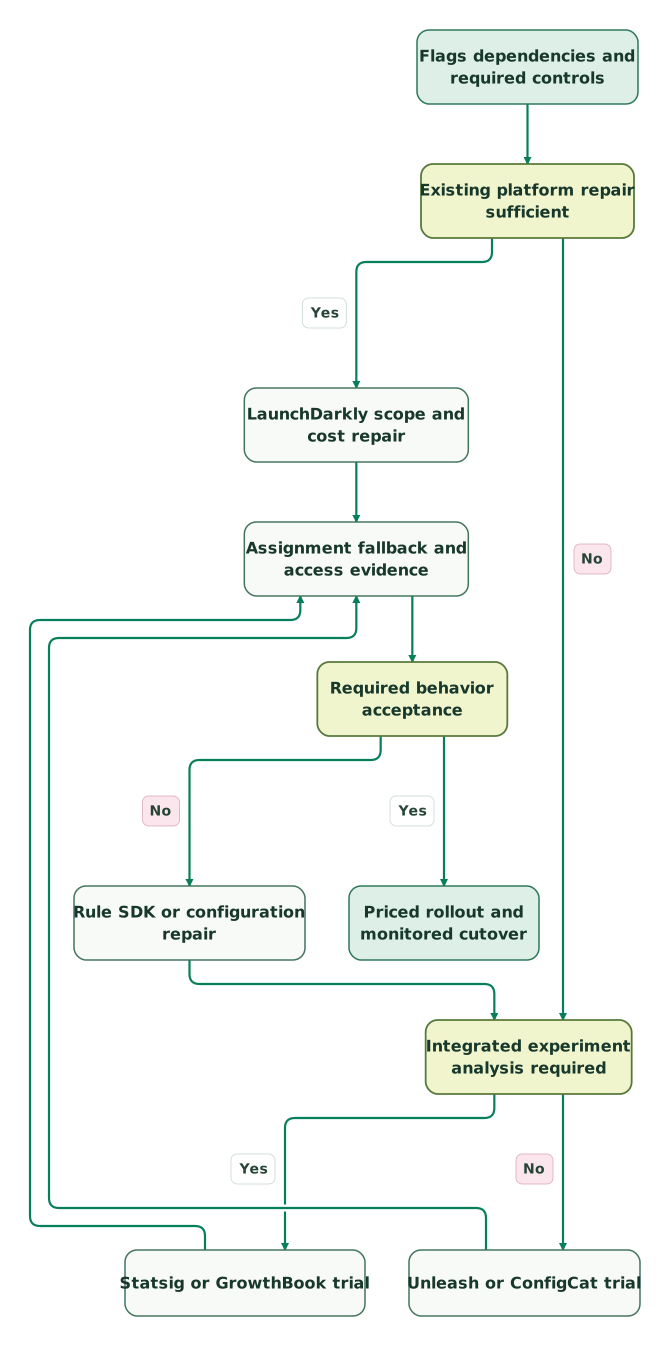
Read diagram as text
- Flags dependencies and required controls to Existing platform repair sufficient.
- Existing platform repair sufficient to LaunchDarkly scope and cost repair: Yes.
- Existing platform repair sufficient to Integrated experiment analysis required: No.
- Integrated experiment analysis required to Statsig or GrowthBook trial: Yes.
- Integrated experiment analysis required to Unleash or ConfigCat trial: No.
- LaunchDarkly scope and cost repair to Assignment fallback and access evidence.
- Statsig or GrowthBook trial to Assignment fallback and access evidence.
- Unleash or ConfigCat trial to Assignment fallback and access evidence.
- Assignment fallback and access evidence to Required behavior acceptance.
- Required behavior acceptance to Rule SDK or configuration repair: No.
- Rule SDK or configuration repair to Integrated experiment analysis required.
- Required behavior acceptance to Priced rollout and monitored cutover: Yes
Checklist
- Flags, environments, defaults and dependencies have an inventory.
- Current usage maps to each candidate's actual billing units.
- Required approvals are enforced in the proposed edition.
- Reference customers receive the accepted variations.
- Cold startup, cached operation and rollback behavior are tested separately.
- Experiment assignments and exposure history have a continuity plan.
- Mobile and background workloads are included in compatibility checks.
- Cutover, monitoring and stale-flag cleanup have named owners.
Use the analytics tool selector skill for the experiment and measurement requirements. Request an implementation scope when the migration needs coordinated exposure tracking, trustworthy metrics and a controlled product release.
Keep reading
Browse all Product Analytics guides
 Product Analytics
Experimentation Platforms in 2026: 15 Tools Compared by Price, Stats and Team Fit
Pick an experimentation platform by who runs tests and where metrics live. 15 tools compared on price, free limits and stats, plus cost at 3 traffic levels.
Jafrin Akter AloLast updated 54 min read
 Tracking & Attribution
Tracking Plan: Free Template, Examples by Business Type and How to Build One
A tracking plan defines each event: when it fires, its properties, IDs, owner and tools. Get a free two-tab template, six examples and an approval checklist.
Jafrin Akter AloLast updated 42 min read
 Product Analytics
PostHog Pricing: Estimate Each Product Separately
Estimate PostHog costs by event type, web and mobile recordings, flag requests and add-ons. Includes tier calculations and billing-limit consequences.
Jafrin Akter AloLast updated 13 min read
Product analytics
See the implementation scope, deliverables and acceptance checks.
Questions people ask
Will copying a fifty-percent LaunchDarkly rollout preserve the same customers elsewhere?
The percentage alone cannot preserve the cohort. Assignment depends on the context, key and bucketing implementation, which can differ between providers. Compare reference assignments and define whether continuity is required. For an active experiment, preserve the assignment or establish an explicit new analysis boundary so the provider change does not silently mix two different treatment populations.
Are Statsig's unlimited flag checks equivalent to unlimited experiment events?
No. Statsig separates flag and configuration checks from metered events used by its analytical features. Its pricing definition includes relevant experiment or Metric Lift exposures alongside logged events and other units. Forecast the actual exposure and event stream, including the applicable deduplication behavior, before treating the free flag-check allowance as a complete experiment budget.
Does GrowthBook's unlimited traffic remove its CDN and managed-warehouse charges?
The pricing matrix includes separate CDN request, bandwidth and managed-warehouse allowances. Usage beyond those included quantities can add charges even when the platform advertises unlimited flags, experiments and traffic. Count the delivery and data-processing workload alongside operator seats, and distinguish an external warehouse's own bill from GrowthBook's optional managed-warehouse consumption.
Can an offline cached flag client receive an immediate remote rollback?
A client can continue using its cached state during a connection failure, but receiving a new remote value requires a working update path. Test stale-state behavior and cold-start fallback separately, and define the application response to a prolonged outage. The existence of a local cache does not demonstrate that a newly requested kill switch has reached every running instance.
Does OpenFeature make flag-provider migration automatic?
OpenFeature provides a common evaluation interface through providers, which can reduce application-code coupling. Targeting rules, context definitions, assignments, defaults and governance still need migration and testing. Keep a reference set of expected evaluations and failure cases. Swapping the provider behind a stable interface is only one part of preserving the application's production behavior.
Sources
- LaunchDarkly plans and usage rates
- LaunchDarkly percentage-rollout logic
- Statsig pricing and metered events
- GrowthBook plans and usage boundaries
- Unleash Enterprise pricing
- Unleash deployment and trial routes
- Unleash SDK and offline behavior
- ConfigCat plans and local evaluation
- ConfigCat resource limits
- ConfigCat download counting
- OpenFeature provider abstraction

Written by
Jafrin Akter AloData Engineer and Co-founder at Martechdevs and Growth and Analytics Partners
Jafrin writes practical guides to marketing technology, customer data, analytics and AI workflows. Martechdevs is a Growth and Analytics Partners company.