
LaunchDarkly vs Optimizely: Release Control, Web Tests and Cost
Pick LaunchDarkly when runtime feature control and engineering release ownership lead the requirement; pick Optimizely when a web experimentation workflow or broader digital-experience program leads it. LaunchDarkly vs Optimizely needs a product-scope decision before a price comparison. Both can support experiments, but the team must establish who changes the experience, how it reaches users and how the resulting business outcome is measured.
On this page
LaunchDarkly vs Optimizely comparison
The USD figures below describe LaunchDarkly's stated usage lines; Optimizely's complete package needs an individual offer.
| Decision | LaunchDarkly | Optimizely |
|---|---|---|
| Entry route | Free Developer usage; Foundation adds paid usage beyond allowances | Individually packaged commercial scope |
| Published usage example | Five service connections and 1,000 client-side MAU included; Foundation monthly rates $12/additional connection and $10/additional 1,000 MAU | Confirm products, usage units and implementation in the proposal |
| Primary pilot | Application feature and release behavior | Web editor workflow or the qualified feature-testing product |
| Operator decision | Engineering ownership of flags and application behavior | Marketing, product and engineering responsibilities across chosen products |
| Main acceptance boundary | Correct experience during ordinary and failure states | Correct page delivery, audience and outcome measurement |
See LaunchDarkly pricing and Optimizely plans. The comparison does not assume that one Optimizely product includes every web, feature, analytics or personalization capability listed across the platform.
We would begin with two real jobs: a controlled application release and a representative website experiment. Decide whether the company needs one, the other or both. A shared experimentation label does not establish that the same operator can perform both jobs through the selected package.
At Martechdevs, product analytics implementation connects delivery decisions to accepted identity and business events. The pilot should show a correct customer experience and a reproducible outcome count before the organization compares experiment dashboards.
LaunchDarkly and Optimizely decisions
LaunchDarkly
- Best for: Engineering-led teams that need maintained runtime controls, targeting and a release process around application changes.
- Pros: The current platform includes flags, targeting and experimentation. Approval requests can bring another reviewer into changes to flags and experiments. See platform pricing and approvals.
- Cons: Requesting a review is different from enforcing a required approval. Runtime behavior also depends on SDK initialization, cached data and the fallback implemented in the application.
- Free plan and startup offer: Developer includes five service connections and 1,000 client-side MAU, with unlimited seats. Foundation extends usage beyond the included amounts. No startup credit is assumed in the ordinary budget. See free and paid scope.
- Choose it if: The application team can own flags, failure behavior and retirement while the release controls solve a recurring operational requirement.
- Skip it if: The buying requirement is primarily a marketer-operated page editor and the proposal leaves that operator dependent on unavailable development work.
Optimizely
- Best for: Teams qualifying a website experimentation process or a broader combination of web, feature and personalization work.
- Pros: The current platform offer includes web, feature and server-side experimentation. Its web workflow supports variation editing, audience and page configuration, metrics and previews. See product scope and experiment setup.
- Cons: The product family contains distinct delivery routes. A successful visual-editor demonstration does not validate backend feature behavior or establish that both are included in the purchased scope.
- Free plan and startup offer: The current plans page offers an individually packaged plan and demo. Agree evaluation access, duration and production entitlements with the vendor; no permanent free production allowance or startup discount is assumed. See Optimizely plans.
- Choose it if: The selected products let the intended operators create, validate and maintain the required experiences with a complete commercial scope.
- Skip it if: The proposed bundle adds work and cost without serving an identified release or experimentation requirement.
Application releases and website experiments
A release control determines which application behavior runs for an eligible context. A website experiment may instead change a headline, layout or page destination. Both need correct targeting and measurement, but their implementation and operating owners can differ.
For an application release, ask the developer to demonstrate the enabled path, disabled path and a missing-configuration case. The code must provide sensible behavior for each. A flag should not replace the application's underlying authorization checks for protected actions.
For a website experiment, ask the operator to create the intended variation and show that it reaches the right pages and audience. Optimizely's web setup requires the applicable snippet and at least one metric, with variation editing and preview as separate steps. See Optimizely experiment configuration.
| Representative job | Required owner | Acceptance evidence |
|---|---|---|
| Gradual application rollout | Application engineering | Intended context receives the correct code path |
| Emergency feature disablement | Release owner | Safe degraded behavior without a new deployment |
| Website layout test | Web experimentation operator | Correct variation on intended pages and layouts |
| Backend feature experiment | Application and data owners | Stable assignment joined to the business outcome |
| Persistent personalization | Business and technical owners | Eligibility and exit behavior remain correct |
Use the two jobs to expose hidden dependencies. A web editor can still need developer support for a dynamic application. An engineering feature platform can still require product analysts to define the metric. Include those responsibilities in the operating decision rather than treating them as a temporary setup inconvenience.
Operator independence and change review
Operator independence means the person responsible for the work can make an appropriate change, validate it and obtain the required review. It does not mean every change should bypass engineering or approval.
Give the intended operator a bounded task during evaluation. A marketing specialist might adjust a page variation and inspect its targeting. An engineer might update a rollout rule and demonstrate the application's fallback. A reviewer should then be able to understand the exact change without reconstructing it from chat messages.
LaunchDarkly Foundation includes review-style approval requests, while mandatory approval requests for specified environments require Enterprise scope. Confirm the enforcement requirement rather than equating an optional request with a release gate. See LaunchDarkly pricing and approval behavior.
For the selected Optimizely package, document who can create, preview, publish and stop a change. Include the actual production permission arrangement in acceptance. A demo performed by an administrator is weak evidence for a process that an ordinary marketer or developer must operate later.
Keep responsibility for emergency action explicit. If a variation breaks checkout, the team needs a named person who can stop or change it and verify recovery. A review workflow is incomplete if nobody knows how it behaves outside normal working hours.
SDK initialization and failure behavior
An existing SDK instance and a new instance can behave differently during a network failure. LaunchDarkly documents that initialized instances can continue using cached flag data, while a fresh instance unable to initialize serves the code-defined fallback for the relevant variation call. The exact SDK and method matter. See LaunchDarkly network resilience.
Test both states. First initialize the application normally, interrupt the relevant connection and observe the accepted experience. Then start a fresh instance without that connection and verify the fallback. Record the code path and business consequence instead of concluding that a successful cached run covers every failure.
Distinguish an ordinary off variation from a code fallback. The first is a configured result from the flag system; the second is supplied for conditions in which the requested evaluation cannot produce its ordinary result. They may intentionally return the same value, but that should be a design choice.
For an Optimizely implementation, qualify the failure cases for the actual selected delivery route. A browser snippet and a server SDK have different initialization and page-behavior concerns. Do not infer the behavior of one from a successful test of the other.
The LaunchDarkly and Statsig comparison provides another feature-platform evaluation. It is useful when runtime control remains the central job after the web-workflow requirement has been separated.
Browser delivery and dynamic pages
Client-side experimentation changes the page while it loads or updates. A timing error can briefly show the original content, miss a late-rendered element or apply a variation more than once. The site remains part of the implementation, regardless of the editor used to configure the experiment.
Optimizely's loading guidance discusses snippet placement and synchronous versus asynchronous loading, including the risk of content flicker. Treat these as implementation choices with measurable consequences on the actual page. The guidance is not a guarantee of a particular performance result for every site. See Optimizely page loading.
Include the first page load, a route transition, back navigation and a returning visit in the pilot. A page that appears correctly in a preview can still fail when the customer enters through a different route or the relevant element arrives later.
Keep one authoritative delivery path for each live change during migration. Two active systems changing the same element can produce a combination that neither experiment was designed to test. Inventory existing snippets, SDK calls and persistent personalizations before expanding the new setup.
Assignment, exposure and outcome populations
Agree what the analysis is intended to estimate. A metric over all assigned eligible users answers a different question from a metric restricted to people who reached a particular feature. Neither denominator should be silently substituted for the other because one produces a more attractive rate.
Consider a hypothetical release with 1,000 assigned eligible users, of whom 800 reach the feature. Suppose forty-eight of those exposed users complete the agreed outcome within the completed observation window. This illustration assumes no additional outcomes among the unexposed users and exists only to show the denominator distinction.
| Synthetic measure | Calculation | Result | Interpretation |
|---|---|---|---|
| Assigned eligible population | Given | 1,000 | Scope of the assignment |
| Exposed population | Given | 800 | Users reaching the defined feature point |
| Outcome rate among exposed users | 48 ÷ 800 | 6.00% | Exposure-conditioned population |
| Outcome rate among all assigned users | 48 ÷ 1,000 | 4.80% | Broader assigned population under the stated assumption |
The 1.20-percentage-point difference is caused by the denominator, not a demonstrated treatment effect. There is no treatment-versus-control comparison in this table. A real analysis also needs the randomization unit, outcome definition, observation window and treatment of eligibility or exposure filtering.
Use the sample ratio mismatch guide to investigate unexpected allocation before reading lift. An A/A test can help qualify changed collection and analysis, while a nonsignificant result remains limited evidence rather than proof that every component is correct.
LaunchDarkly and Optimizely cost scope
LaunchDarkly's service-connection unit is one server-side SDK connected to one environment, counted by time and averaged across the month. Replicas, workers and non-production environments can contribute. Client-side MAU is a separate measure of unique client-side users or devices. See LaunchDarkly usage definitions.
Assume a hypothetical steady configuration has six production service connections, four worker connections and two staging connections throughout the month. The total is twelve. Also assume 8,000 client-side MAU and no other billable usage lines in this narrow calculation.
| Monthly-billing input | Calculation after included usage | Amount, USD | Scope |
|---|---|---|---|
| Twelve service connections | (12 minus 5) × $12 | $84 | Constant monthly-equivalent connection count |
| Eight thousand client-side MAU | (8,000 minus 1,000) ÷ 1,000 × $10 | $70 | Client-side usage line |
| Stated subtotal | $84 + $70 | $154 | Two usage lines only |
| Twelve unchanged months | $154 × 12 | $1,848 | Monthly-rate annualization |
The example uses the published monthly rates, not the discounted annual rates. It excludes AI runs, observability and any other applicable charges. Autoscaling or changing connection duration changes the measured service-connection quantity; a raw count of repositories or employees is not a substitute.
For Optimizely, request a complete offer for the chosen web and feature products, licensed properties, traffic or other usage units, analytics, support and implementation. No universal public dollar amount is assumed from the individually packaged plans page. See Optimizely commercial scope.
Add an operating allowance separately. For example, assume a hypothetical $900/month covers the planned release administration and experiment implementation, or $10,800 across twelve unchanged months. These are planning amounts rather than vendor fees or a claimed staffing requirement. Replace the allowance with the cost of the ownership and tasks the pilot establishes.
The software pricing tool helps compare the qualified scope. Keep temporary evaluation access and promotional allowances separate from the ordinary operating-year budget.
Best fit by delivery organization
| Company or operating model | Best fit | Runner-up | Decision reason |
|---|---|---|---|
| Engineering team managing application rollout and recovery | LaunchDarkly | Qualified Optimizely feature product | Runtime behavior and release ownership lead the decision |
| Website team operating visual page experiments | Optimizely web scope | A qualified web-testing alternative | Operator workflow matters alongside delivery timing |
| Organization requiring web and backend experiments | Complete scoped evaluation | Either partial package plus additional tooling | One platform label does not establish full coverage |
| Team requiring enforced review before production changes | Qualified approval-enforcing plan | Alternative with demonstrated enforcement | Optional review is insufficient for the stated policy |
| Existing platform with incorrect outcome counts | Measurement repair first | Qualified replacement | A different delivery system can retain the same bad definition |
The Optimizely alternatives guide broadens the web and product shortlist. Preserve the distinction between buying an experience-delivery route and maintaining trustworthy experimental evidence.
Delivery-platform selection workflow
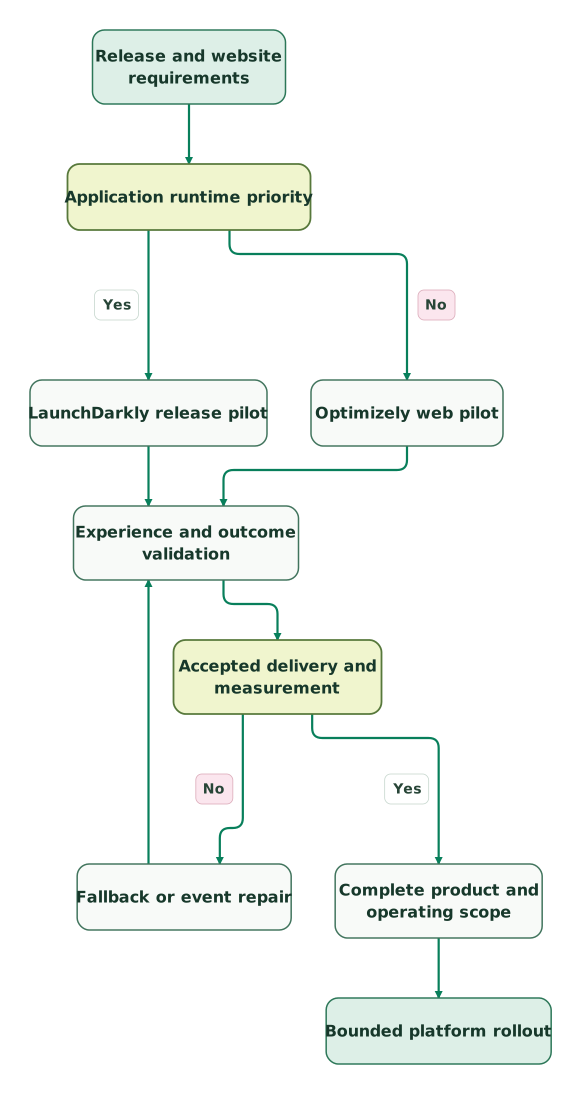
Read diagram as text
- Release and website requirements to Application runtime priority.
- Application runtime priority to LaunchDarkly release pilot: Yes.
- Application runtime priority to Optimizely web pilot: No.
- LaunchDarkly release pilot to Experience and outcome validation.
- Optimizely web pilot to Experience and outcome validation.
- Experience and outcome validation to Accepted delivery and measurement.
- Accepted delivery and measurement to Fallback or event repair: No.
- Fallback or event repair to Experience and outcome validation.
- Accepted delivery and measurement to Complete product and operating scope: Yes.
- Complete product and operating scope to Bounded platform rollout
LaunchDarkly and Optimizely checklist
- Separate application-release and website-experiment requirements.
- Name the operator, reviewer and emergency owner for each route.
- Qualify the exact products and production permissions.
- Test initialized and fresh-start failure behavior where applicable.
- Verify page loading, route transitions and returning visits.
- Preserve stable assignment and the intended analysis population.
- Reconcile business outcomes before interpreting experiment lift.
- Count connection duration, environments and client-side usage correctly.
- Include implementation, support and ongoing operating effort.
- Retire superseded flags, snippets and persistent variations deliberately.
The tracking plan audit skill helps retain the exposure and outcome contract. Keep the failure cases with the release procedure so later changes can repeat the same acceptance checks.
Keep reading
Browse all Product Analytics guides
 Product Analytics
LaunchDarkly vs Statsig for release control and experimentation
Compare LaunchDarkly and Statsig by release control, experiment health and current usage pricing, with fallback, approval and exposure checks.
Jafrin Akter AloLast updated 11 min read
 Product Analytics
Optimizely Alternatives for Web Tests, Product Experiments and Costs
Compare Optimizely alternatives by delivery, measurement and cost. Review GrowthBook, Statsig, PostHog and Wingify with billing examples and migration checks.
Jafrin Akter AloLast updated 12 min read
 Product Analytics
Sample Ratio Mismatch: Diagnose an A/B Test Before Reading Lift
Diagnose sample ratio mismatch across assignment, exposures and analysis filters, with a checked Python example, missing-user scenario and recovery criteria.
Jafrin Akter AloLast updated 9 min read
Product analytics
See the implementation scope, deliverables and acceptance checks.
Questions people ask
Does an Optimizely web-editor trial qualify its backend feature product automatically?
An Optimizely web-editor trial does not automatically qualify its backend feature product. The delivery route, SDK behavior, operating owner and purchased scope need their own acceptance cases. A page variation preview demonstrates only part of the requirement. Map each application and website job to the exact product and configuration before treating the trial as complete replacement evidence.
Can LaunchDarkly service connections be estimated from the number of code repositories?
LaunchDarkly service connections should not be estimated from repository count alone. The published unit concerns a server-side SDK connected to an environment, measured over time. Replicas, workers and staging can contribute even when they share one repository. Inventory the running configuration and duration, then compare it with the account's actual usage. See LaunchDarkly pricing.
Does a successful cached flag evaluation cover a fresh application start during an outage?
A successful cached flag evaluation does not cover a fresh application start during an outage. LaunchDarkly documents different behavior for already initialized instances and instances unable to initialize. Verify the code-defined fallback for the exact SDK method alongside the cached case. Both must leave the application in an accepted state. See network-resilience guidance.
Can an exposed-user conversion rate replace the assigned-user rate in an experiment report?
An exposed-user conversion rate cannot silently replace the assigned-user rate. The populations answer different questions, and conditioning on exposure can affect interpretation. Define the intended analysis population before reading outcomes, preserve identity and observation-window rules, and explain any eligibility filtering. A higher rate produced by a smaller denominator is not itself evidence that the treatment improved the product.
Should two platforms modify the same live page element during migration?
Two platforms should not independently modify the same live page element during migration. Their combined changes can create an experience that neither experiment intended and make the measured result difficult to interpret. Assign one authoritative route for each variation, use bounded validation and retire the old route only after delivery and outcome checks pass for the accepted configuration.
Sources

Written by
Jafrin Akter AloData Engineer and Co-founder at Martechdevs and Growth and Analytics Partners
Jafrin writes practical guides to marketing technology, customer data, analytics and AI workflows. Martechdevs is a Growth and Analytics Partners company.