
Freshdesk Pricing: Plans, Freddy AI Costs and Team Budgets
Freshdesk pricing starts at USD 19 per agent per month billed annually, with Pro at USD 55 and Enterprise at USD 89. Freshdesk Omni has separate rates for a wider channel workflow. Freddy Copilot licenses, AI Agent sessions and other add-ons can increase either bill. Choose the product and required plan first, then price the people and usage needed to run the support queue. Freshdesk prices.
On this page
Freshdesk plans and prices
USD list prices per full-time agent before tax and add-ons; annual figures are monthly equivalents of annual billing. Freshdesk rate card.
| Freshdesk plan | Monthly billing | Annual monthly equivalent | Main purchase reason |
|---|---|---|---|
| Growth | $23 | $19 | Ticketing, shared inbox, knowledge base and standard reporting |
| Pro | $66 | $55 | Intelligent routing, multiple SLA policies and custom reporting |
| Enterprise | $107 | $89 | Skill-based routing, sandbox and audit controls |
Freshdesk is the email-first support product. Freshdesk Omni manages a broader set of channels in one workspace. Compare the required workflow before choosing a tier with the same name. Product distinction.
The Omni prices below use the same USD and billing basis. Voice subscription and usage charges can be additional. Freshdesk Omni pricing.
| Freshdesk Omni plan | Monthly billing | Annual monthly equivalent | Main purchase reason |
|---|---|---|---|
| Growth | $35 | $29 | A unified omnichannel support workflow |
| Pro | $95 | $79 | Advanced analytics and routing across teams |
| Enterprise | $143 | $119 | Enterprise controls, custom objects and sandbox |
An annual price is not a monthly cancellation arrangement. Ten Freshdesk Pro agents cost USD 6,600 annually; ten Omni Pro agents cost USD 9,480. The USD 2,880 difference needs to buy a channel or operational capability the team actually uses.
Our customer support automation service starts with the queue, customer context, permitted actions and human handoff. That defines the product and integration scope before seats or AI capacity are purchased.
Freshdesk billing units
A full-time agent is the licensed person handling support work. AI Agent sessions, Copilot access and occasional-agent day passes are separate units. A customer contact is not automatically another paid agent.
| Bill component | What to count | Cost-control question |
|---|---|---|
| Full-time agents | Licensed support operators | Who needs continuous helpdesk access? |
| Freddy Copilot | Agents assigned the paid assistant role | Which operators actually use the assistance? |
| Freddy AI Agent | Chargeable interaction sessions | How many sessions occur within the billing cycle? |
| Day passes | Occasional-agent login days | Would a regular seat cost less for that workload? |
| Voice and messaging | Required add-ons and channel usage | Which provider and destination charges remain separate? |
| Connectors and MCP | Purchased task or action capacity | Which workflow operations consume the allowance? |
Full-time agents require licenses; occasional agents consume a day pass when they log into the support portal. A pass ends at the applicable day's end, rather than lasting twenty-four hours from login. Agent and day-pass definitions.
Keep these quantities in the purchasing worksheet. “Ten agents with AI” is incomplete because it does not specify how many Copilot licenses, how many AI Agent sessions or which channels the quote covers.
Freshdesk cost by company type
These hypothetical teams use annual seat prices, with no negotiated discount. Company headcount is context; the assumed paid-agent count determines each base bill. Tax, AI add-ons, voice usage, integrations and migration are excluded.
| Company scenario | Assumed configuration | Monthly equivalent, USD | Annual seat payment, USD |
|---|---|---|---|
| Five-person startup | 2 Freshdesk Growth agents | $38 | $456 |
| Twenty-person SaaS | 5 Freshdesk Pro agents | $275 | $3,300 |
| One hundred-person business with several channels | 10 Omni Pro agents | $790 | $9,480 |
| Five hundred-person company requiring enterprise controls | 30 Omni Enterprise agents | $3,570 | $42,840 |
A bigger company does not automatically require Enterprise. A small regulated or contract-bound support operation might need a specific control that changes its edition. Use a trial ticket set to establish the requirement rather than treating the vendor's team-size label as a purchasing rule.
Before comparing alternatives, record the same agent count, channel scope, routing requirement and reporting job for each product. Our Zendesk versus Freshdesk comparison covers the platform choice; this guide calculates the Freshdesk side of the budget.
A ten-agent Freshdesk Pro budget with AI
Assume ten Freshdesk Pro seats, five Copilot licenses and 6,000 paid AI Agent sessions used across a year. The complimentary session benefit has already been exhausted. The following is a hypothetical annual-billing configuration, before other charges.
| Component | Calculation | Annual cost, USD |
|---|---|---|
| Freshdesk Pro | 10 × $55 × 12 | $6,600 |
| Freddy Copilot | 5 × $29 × 12 | $1,740 |
| AI Agent capacity | 60 packs × 100 sessions at $49 per pack | $2,940 |
| Total | $6,600 + $1,740 + $2,940 | $11,280 |
The monthly equivalent is USD 940. This is an annual budget, not a claim that sixty annual-cycle packs replenish every month. Match purchased sessions and their expiry to the account's actual payment cycle. Copilot prices, session pack rules.
On monthly billing, the same ten Pro seats cost USD 660 and five Copilot licenses USD 175 each month. At an assumed 500 paid sessions every month, five packs add USD 245. Twelve unchanged USD 1,080 monthly bills total USD 12,960, a USD 1,680 difference from the annual illustration.
Budget the peak workload separately. More tickets can increase session purchases even when paid-agent count is unchanged. A seasonal team can also need additional licensed agents, occasional access and channel capacity at the same time.
Freddy AI Agent and Copilot costs
Freddy AI Agent serves customers through automated interactions; Freddy Copilot assists licensed human agents. Their meters and buying decisions differ.
Copilot licenses
Copilot costs USD 35 per assigned agent monthly, or USD 29 per month with annual billing. The current Freshdesk and Omni rate cards list it as an add-on for Pro and Enterprise. You can purchase it for a subset of agents, and roles determine access. Copilot rate table, license assignment.
Start with the operators handling work that benefits from summaries, drafting or assistance. Measure whether the feature changes handling effort and reply quality before assigning it throughout the team. A named license that nobody uses is a fixed recurring cost.
AI Agent sessions
AI Agent capacity costs USD 49 per pack of 100 sessions. Eligible new Growth, Pro and Enterprise customers receive 500 complimentary sessions once per account. Chat AI Agent is available in Omni, using a twenty-four-hour session window; Email AI Agent is available in Freshdesk and Omni, using seventy-two hours from the customer's first email. AI Agent scope and session definitions.
A session records an interaction window, so the USD 0.49 nominal session rate does not establish a cost per satisfactory resolution. Measure completed work independently. A hypothetical monthly workload of 850 paid sessions needs nine packs, costing USD 441 and providing 900-session capacity. If those sessions produce 350 satisfactory autonomous resolutions, the AI usage component is 441 / 350 = USD 1.26 per satisfactory resolution, before seats and human work.
Use the support AI pricing comparison when evaluating a session meter against an outcome or resolution meter. Apply each model to the same support issues and retain the human work that follows an automated response.
Complimentary balances, previews and expiry
Previewing agents or chatbots consumes sessions. The session FAQ also says buying a paid pack replaces any remaining complimentary sessions. Use the actual remaining benefit and purchase behavior rather than subtracting 500 automatically from every forecast. Unused paid sessions expire with the billing cycle; packs added mid-cycle are not prorated and renew unless their quantity is reduced. Session consumption and billing.
If the remaining trial allowance is small, finish the necessary evaluation before buying recurring capacity. If launch volume requires paid packs immediately, price the paid purchase directly and check the balance after purchase. Do not count the same complimentary sessions twice.
Other charges that change the bill
The paid-agent subscription is only one part of the operating cost. List optional products and their units before comparing plan totals.
| Add-on | Published USD price | Budget treatment |
|---|---|---|
| Freshdesk day pass | Growth $2, Pro $7, Enterprise $12 | Per occasional-agent login day |
| Omni day pass | Growth $5, Pro $10, Enterprise $15 | Per occasional-agent login day |
| Connector app tasks | $80 per 5,000 tasks | Separate purchased integration capacity |
| MCP actions | $15 per 1,000 actions | Separate action capacity |
| Omni Voice | Growth $15, Pro $39, Enterprise $69 per agent/month annually | Subscription plus applicable call usage |
Sources: Freshdesk add-ons, Omni add-ons and voice usage link.
For occasional access on Freshdesk Pro, nine USD 7 day passes cost USD 63; ten cost USD 70. A USD 66 monthly Pro license can therefore be cheaper at ten login days, assuming equivalent required access and no remaining free passes. An annual license has a different commitment, so compare it over the period the person will actually work.
A connector pack is not a promise that every external application, integration build or provider subscription is included. Record the operations that count, the allowance period and the cost of failed or repeated work. Confirm those definitions in the specific connector or MCP order before estimating transactions from ticket volume.
Keep migration and setup separate: ticket history, attachment transfer, private-note visibility, routing, knowledge-base preparation and integrations each require acceptance work. A cheaper seat bill does not compensate for losing the customer context that agents need to resolve the queue.
Seats versus AI usage
Seats move the fixed subscription bill. AI sessions and integration activity move the variable or capacity bill. Reducing one does not prove the other will fall.
For a human-heavy queue, first review full-time agents, occasional access and Copilot adoption. For a high-volume automated queue, inspect sessions by intent, repeat contact, previews and fallback. Then ask whether the automation removes work or merely adds another interaction before human handling.
Suppose an automated answer sends a customer back to the queue because required order data is missing. Lowering the AI budget may hide the symptom; connecting the correct data and restricting the agent's permitted actions addresses the operating cause. Evaluate a representative failed case before expanding session packs.
Freshdesk plan fit by support workflow
Choose the lowest edition that passes the required queue, routing and access checks. The named plans below are starting points for evaluation.
| Support situation | First option | Runner-up | Deciding requirement |
|---|---|---|---|
| Small email support queue | Freshdesk Growth | Freshdesk Free Program if eligible and sufficient | Ownership, knowledge base and required reporting |
| Several queues needing routing and custom reports | Freshdesk Pro | Growth after simplifying unnecessary rules | Required routing and SLA behavior |
| Customer conversations across chat and email | Freshdesk Omni Growth or Pro | Separate channel tools only with a workable handoff | One accountable conversation flow |
| Skill-based routing, sandbox or audit requirements | Enterprise in the appropriate product | Pro if the control is not required | Demonstrated access and operational controls |
Use the same representative tickets in both shortlisted configurations: a reopened issue, a private note, an attachment, a transferred conversation and a customer with two addresses. Confirm the result in the edition you intend to buy, because the trial can expose capabilities outside that tier.
If the required configuration still does not fit, compare Freshdesk alternatives. Keep the specific unmet job and full cost visible rather than restarting with a list of unrelated feature checkboxes.
Free Program, trial and startup budgeting
Freshdesk's Free Program supports two agents for six months and applies to standalone Freshdesk, not Omni. It provides basic ticketing, dispatch and knowledge-base capabilities. Returning from a higher-feature trial can remove trial-only features and configurations. After upgrading to a paid plan, an account cannot switch back to the Free Program. Free Program details.
Freshdesk also provides a fourteen-day trial of Enterprise functionality. Before it expires, choose the paid configuration or explicitly enroll in the eligible Free Program; do not assume trial features remain available for free. Trial and subscription selection.
For a two-agent startup expecting to move to Growth, the ordinary annual seat budget is USD 456 at current annual rates. Keep that renewal baseline beside any temporary free period. Any additional startup credit, partner award or onboarding concession needs written eligibility and expiry terms before it reduces the forecast. A six-month free period is not a permanent free subscription.
Cost controls and AI spending limits
Set a purchasing ceiling, a monitoring owner and an operating fallback. Auto-recharge improves continuity but can keep buying capacity when traffic rises; it is not itself a spending cap.
Freshworks provides online-billing auto-recharge when sessions fall below a threshold. Its public guides differ on the stated auto-recharge pack quantity, so confirm the charged quantity and threshold in checkout before enabling it. Inspect Analytics > Freddy AI Agent Session Consumption Report and the billing balance. Recharge configuration, session reporting.
A practical budget control is to buy only the approved cycle capacity, keep automatic recharge disabled unless explicitly budgeted, and require an owner to approve further purchases. Confirm a human route before the balance is exhausted. Freshworks says chat agents hand over to live agents when sessions run out, but a self-service widget stops functioning without that handoff. Exhaustion behavior.
Test the fallback for the deployed channel. A policy that prevents another purchase also needs to preserve customer access to support. For automated system actions, use the agent write-safety skill to define permitted actions, approvals and failure handling before increasing autonomy.
Contracts and the rate card in plain English
Keep the order's term, currency, taxes, seat quantity and add-on renewal separate from the displayed monthly equivalent. The public pricing page allows immediate upgrades, while downgrades and cancellation take effect at term end. The subscription guide describes prorated changes and account-admin controls. Plan management.
Freshworks' standard terms specify automatic renewal unless notice of non-renewal or downgrade arrives at least thirty days before term end. They also allow renewal fee adjustments and warn that reducing scope can remove earlier discounts or price protections. Use the signed order and applicable terms for the deadline and amount. Freshworks terms.
| Rate-card wording | Meaning for the budget | Check before purchase |
|---|---|---|
| Per agent/month, billed annually | Annual commitment expressed monthly | Full invoice and required paid agents |
| Copilot per assigned agent | Separate human-assistance license | Actual users of the feature |
| First 500 sessions included | One-time account benefit | Remaining balance and paid-pack replacement |
| $49 per 100 sessions | Whole packs of interaction capacity | Window, expiry, renewal and peak usage |
| Voice or connector add-on | A separate capability or capacity purchase | Usage charges and external provider costs |
Keep a copy of the final quote and the usage assumptions. Review the first complete billing cycle with the support owner and finance. Compare subscription quantities with assigned access, and session consumption with the work that actually reached a satisfactory outcome.
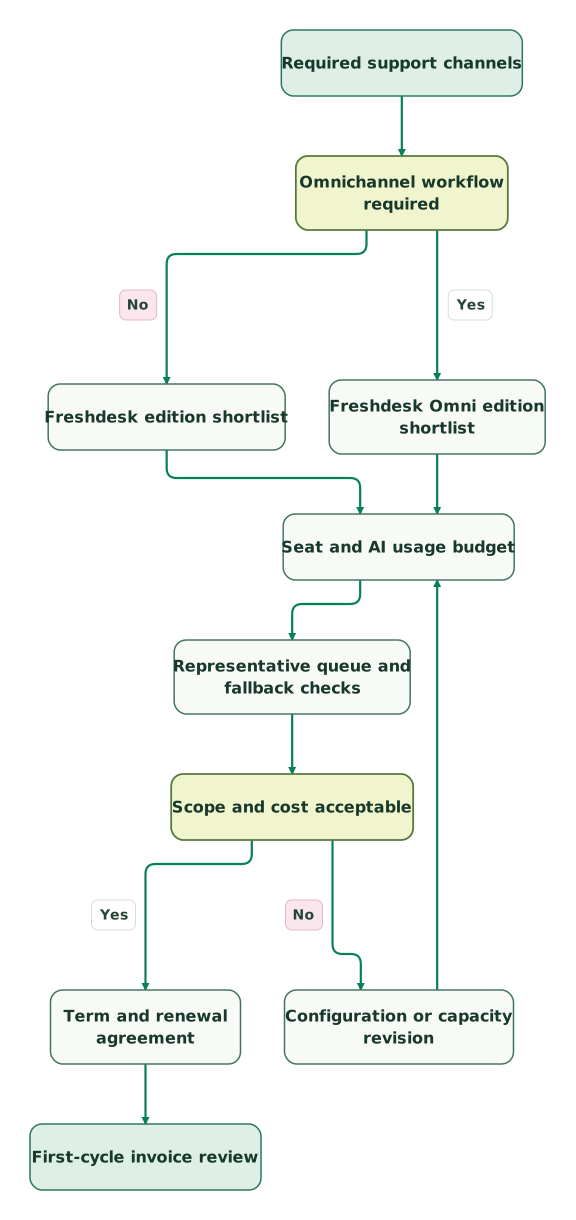
Read diagram as text
- Required support channels to Omnichannel workflow required.
- Omnichannel workflow required to Freshdesk edition shortlist: No.
- Omnichannel workflow required to Freshdesk Omni edition shortlist: Yes.
- Freshdesk edition shortlist to Seat and AI usage budget.
- Freshdesk Omni edition shortlist to Seat and AI usage budget.
- Seat and AI usage budget to Representative queue and fallback checks.
- Representative queue and fallback checks to Scope and cost acceptable.
- Scope and cost acceptable to Configuration or capacity revision: No.
- Configuration or capacity revision to Seat and AI usage budget.
- Scope and cost acceptable to Term and renewal agreement: Yes.
- Term and renewal agreement to First-cycle invoice review
Freshdesk purchase checklist
- Confirm Freshdesk or Omni and the edition that passes the required workflows.
- Count paid agents, occasional access and assigned Copilot licenses separately.
- Forecast AI sessions using the correct channel window and payment cycle.
- Record the remaining complimentary benefit and paid-pack replacement rules.
- Include voice, connector, MCP, provider and migration costs where required.
- Set purchase approval, monitoring and tested support fallback responsibilities.
- Record term, notice deadline, renewal price and the first invoice review.
If the quote is clear but the integration or AI behavior remains uncertain, bring the queue examples to a support automation review. The goal is a support process the team can operate and measure within the agreed budget.
Keep reading
Browse all CRM & Lifecycle guides
 CRM & Lifecycle
Freshdesk Alternatives: Five Competitors by Support Workflow and Cost
Compare five Freshdesk alternatives by workflow, pricing and migration limits. Check Zoho Desk, Help Scout, Zendesk, Intercom and Gorgias before switching.
Jafrin Akter AloLast updated 11 min read
 CRM & Lifecycle
Plain vs Freshdesk: Which Support Platform Fits Your Team?
Plain suits B2B support in Slack; Freshdesk suits structured ticket queues. Compare current seat costs, AI charges, SLAs and a practical selection trial.
Jafrin Akter AloLast updated 11 min read
 CRM & Lifecycle
Zendesk vs Freshdesk: Compare the Right Plans, AI Bill and Renewal Cost
Zendesk vs Freshdesk pricing: both start at $19 per agent, but Freshdesk tops out at $89 and Zendesk Suite Professional at $115. Compare plans, AI and costs.
Jafrin Akter AloLast updated 23 min read
Customer support automation
See the implementation scope, deliverables and acceptance checks.
Questions people ask
Is Freshdesk's current two-agent free offer permanent?
The current Freshdesk Free Program lasts six months and supports two agents. It applies to standalone Freshdesk, not Freshdesk Omni. Plan the paid configuration before the free period ends, and check which trial features disappear when entering the program. The ordinary Growth annual seat cost for two agents is USD 456 at the rates used here. Free Program.
Can I buy Freddy Copilot for only part of my Freshdesk team?
Yes. Freddy Copilot can be purchased and assigned to a subset of agents rather than every paid seat. The published rate is USD 35 monthly or USD 29 per agent per month with annual billing, on eligible plans. Count the people assigned the Copilot role separately from all support agents, then review adoption before expanding that purchase. Copilot licensing.
Why does a Freddy session price differ from the cost per resolution?
A Freddy session counts an interaction window, regardless of whether the customer's issue reaches your accepted end state. Whole-pack purchasing can also leave unused capacity. Divide the actual AI usage cost by satisfactory resolutions when assessing that component, then add seats, remaining human work and other operating costs. Keep vendor session counts and your quality assessment as separate measures.
Do unused Freddy AI session packs carry into the next billing cycle?
Unused sessions expire at the end of the applicable subscription cycle. Packs purchased mid-cycle are available immediately, are not prorated and renew with the next cycle unless their quantity is reduced. Match the purchase to expected remaining demand and check the renewal count after a temporary traffic spike. A low unit rate does not make unused capacity a saving. Session rules.
When can Freshdesk day passes cost more than a regular agent seat?
On Freshdesk Pro, ten paid day passes cost USD 70, compared with USD 66 for a monthly agent license. That makes a regular seat a candidate when a person needs ten or more login days, assuming the same required access and no unused free passes. Compare the actual working period and commitment before using annual seat pricing for a temporary role. Day-pass rules.
Sources

Written by
Jafrin Akter AloData Engineer and Co-founder at Martechdevs and Growth and Analytics Partners
Jafrin writes practical guides to marketing technology, customer data, analytics and AI workflows. Martechdevs is a Growth and Analytics Partners company.