
Plain vs Freshdesk: Which Support Platform Fits Your Team?
Choose Plain when B2B support happens in customer Slack channels and agents need product and account context beside the conversation. Choose Freshdesk when an email-led ticket queue, service levels and a lower seat price are the main requirements; evaluate Freshdesk Omni separately for broader messaging channels. Test the actual escalation and reporting workflow before choosing, because a conversation platform and a ticketing platform can both look capable in a feature list while creating different daily work.
On this page
Which is better, Plain or Freshdesk?
Plain is our first shortlist for a technical B2B team serving named accounts through Slack, email and in-app support. Freshdesk is our first shortlist for a structured email service desk with formal queues and cost-sensitive staffing. The deciding question is where customers ask for help and how their issue reaches the person who can resolve it.
| Team situation | First shortlist | What could change the decision |
|---|---|---|
| Customer Slack channels with frequent engineering handoffs | Plain | Required channel, governance or reporting exceeds the quoted plan |
| Mostly email tickets with a small paid agent team | Freshdesk | Important customers need a customer-facing Slack workflow |
| Messaging across web and social channels | Freshdesk Omni | Exact channel, identity or AI behaviour fails the pilot |
| Bespoke product context and developer-owned support UI | Plain | Maintaining the context integration costs more than it saves |
| Several business units with complex access rules | A configured trial of both | The actual permissions and account model decide |
Plain's integrations include shared customer Slack channels, Linear, Jira, email and live chat. Freshdesk's pricing separates its email helpdesk from Freshdesk Omni. Compare the exact product and plan, then require the same customer problem to pass in each trial.
At Martechdevs, we assess customer support automation through identity, reply ownership and access to useful context. The system should help an agent answer without asking the customer to repeat information another team already holds.
What does each platform cost for the same team size?
Plain starts at $45 per member per month on annual Foundation billing, while Freshdesk Growth starts at $19 per agent per month on annual billing. Those are entry plans with different limits. Price the edition that supplies your required channels, service levels and reporting, then add AI usage and integration work separately.
The following are USD monthly equivalents with annual billing, before tax and usage add-ons. Plain's seat limits and monthly-billing alternatives come from its plan guide; Freshdesk and Omni figures come from their separate official pricing pages linked in the table.
| Plan | Annual-billing seat price | Seat or scope boundary | Five paid seats per month |
|---|---|---|---|
| Plain Foundation | $45 | Up to 5 member seats | $225 |
| Plain Horizon | $99 | 3 to 10 member seats | $495 |
| Freshdesk Growth | $19 | Email ticketing starting point | $95 |
| Freshdesk Pro | $55 | More routing, reporting and SLA controls | $275 |
| Freshdesk Omni Pro | $79 | A broader channel package | $395 |
Plain Foundation is $55 per seat on monthly billing; Horizon is $139. For ten annual-billed Horizon members, the seat subtotal is $990 per month, or $11,880 per year. Foundation cannot be extended to ten members at its lower price. Plain Frontier has custom annual pricing. Plain plan and billing rules.
For a five-person team, annual seat totals are $2,700 for Plain Foundation, $5,940 for Plain Horizon, $1,140 for Freshdesk Growth, $3,300 for Freshdesk Pro and $4,740 for Omni Pro. These are arithmetic comparisons, not equivalent feature bundles. An omitted channel or administrator can cost more than the apparent saving.
Freshdesk Enterprise is $89 per agent per month annually; Omni Enterprise is $119. Put the exact edition on the order form. A quote labelled only “Freshdesk” does not settle whether your required messaging channels are included. Freshdesk plans, Omni plans.
How do AI credits and sessions change the bill?
Compare AI costs using each product's billable event, because Plain credits and Freshdesk sessions are different units. Estimate the actual actions your support workload will produce and include human handoffs. An apparent per-resolution advantage can disappear if another feature consumes the same credit allowance or one issue creates several billed sessions.
Plain includes 1,000 workspace credits monthly on Foundation and 2,500 on Horizon, shared across usage-based features. Plain's credit rules charge 100 credits for a Customer Agent outcome when the agent resolves a thread on its own and it stays Done for seven days. Internal notes from your team do not count as human involvement for that rule. Top-ups include 1,000 credits for $10; Sidekick actions can consume variable credits.
That means 1,000 credits could fund ten such outcomes if nothing else consumed the allowance. It does not mean ten outcomes are guaranteed or that an agent seat has its own separate pool. Model your mix of agent outcomes, Sidekick work and workflow actions. When credits run out, credit-consuming features stop; the Customer Agent hands threads to the team with an internal note instead of replying.
Freshdesk lists additional Freddy AI Agent usage at $49 per 100 sessions. Its first 500 free sessions are a one-time allowance per account, rather than a monthly entitlement. Freddy AI Copilot is separately priced at $29 per agent per month on eligible plans. Freshdesk AI pricing and allowance FAQ.
Ask both vendors for a worked invoice on the same sample: total incoming issues, which touch AI, which reach people, reopened issues and repeated contacts. Track cost per issue actually resolved with an acceptable answer. Keep the vendor's billing meter alongside that operational measure so finance can reconcile the bill.
Is Plain better for Slack and engineering-heavy support?
Plain is a strong fit when customer Slack channels are part of the service relationship and engineering participates in resolution. Its advantage is the ability to organize those conversations with other support work. The implementation test is whether the right account, owner and engineering issue stay connected when the discussion moves between teams.
Plain's setup guide describes ingesting customer Slack Connect channels as threads and using internal channels for Discussions. It also allows free viewer seats, so stakeholders can follow work without each needing a replying member seat. Review the role permissions before treating viewers as substitutes for agents.
Use a concrete pilot:
- Connect one customer channel and one support email address.
- Match both to the same customer account and confirm that the agent can see the intended context.
- Escalate an issue to the engineering tracker, with one owner responsible for the customer reply.
- Change the issue status and check how the support agent discovers that change.
- Reply through the customer's original channel and confirm that internal discussion stayed private.
The Plain integration catalogue establishes the available connection types. The pilot establishes whether their behaviour fits your queue. Record fields and actions that still require a person, especially when a linked engineering issue contains information the customer should never see.
Freshdesk can still be the right choice for a technical team whose customers mainly submit email tickets. Do not buy a Slack-first workflow solely because the internal engineering team uses Slack. Customer-facing channel management and internal agent notifications solve different problems.
How do service levels, routing and reporting compare?
Choose the platform whose service-level rules match the contract you actually sell. Specify first response, next response, resolution, business hours and pause conditions separately. Then run the same after-hours, reopened and escalated examples in both systems. A dashboard can look healthy while measuring a different promise from the one customers received.
Plain's SLA policies support first and next response plus first and total resolution targets. Policies can respect business hours and pause resolution clocks in selected statuses. Horizon adds the SLA and business-hours capability in Plain's plan comparison.
Freshdesk's SLA guide distinguishes the default policy from multiple policies, with multiple policies available from Pro in Freshdesk and Omni. Policy order and conditions need to match the actual priority, group or customer requirements. Review the guide for your account generation before reproducing settings from a screenshot.
| Trial case | What to measure | Failure that should block rollout |
|---|---|---|
| Urgent request arrives outside staffed hours | The promised clock and escalation owner | An agent is expected to meet an unstaffed deadline |
| Customer replies to a waiting issue | Next-response target and assignment | The reply sits in a completed or unowned queue |
| Engineering needs more information | Internal handoff and customer communication | Private detail appears in a public reply |
| Customer changes plan | Account tier and applicable policy | A premium account keeps the old service target |
| A resolved issue reopens | Resolution definition and reporting cohort | The dashboard counts success before the issue stays solved |
Also inspect the export behind the dashboard. A support lead needs to explain why a metric changed, including the timezone, waiting states and reopened cases. Build a small weekly reconciliation before automating the executive report.
Which platform is easier to connect to your product data?
Choose the integration you can own and recover when it fails. Plain suits teams willing to build product context into the support experience; Freshdesk exposes a ticketing API with records, conversations and fields. In either case, define stable customer identity and read permissions before introducing automation that changes a customer account.
Plain's customer-card workflow brings information from your own systems beside the customer. Freshdesk's API provides ticket, contact, company and conversation operations. Neither connection removes the need to decide which system owns the underlying truth.
For example, a hypothetical SaaS support card might show plan, workspace status, latest failed payment and recent delivery failure. Store the customer-account key with the thread and fetch only the necessary fields. A billing status copied yesterday should not silently authorize a refund today.
Use the support customer-context guide to define freshness and access. Log a failed context lookup separately from an empty result. An empty field should tell the agent whether the customer has no data or whether the lookup failed.
What should you check before migrating from Freshdesk to Plain?
Plain documents a one-click Freshdesk importer, but you still need to agree its object coverage before transferring a whole account. Preserve a representative export, test difficult histories and reconcile the destination. The migration should explicitly cover the fields, private content and reporting history your agents need. Plain migration guide.
Plain's migration guide says supported imports preserve message history, internal notes, original timestamps and customer details, while CSAT results and custom fields do not come across through that path. Export those separately and agree how any operational meaning will be represented. Test your specific Freshdesk records before accepting the import as complete.
Ask for proof of these cases: an agent who has left, a customer with multiple accounts, a private attachment, a merged ticket and a reopened escalation. Preserve the old source ID so an agent can trace an ambiguous case. Decide whether historical reporting remains in the old system, a warehouse or a separate archive.
If you are also evaluating Zendesk, compare the Zendesk and Freshdesk operating models and the broader Zendesk alternatives. Keep the same trial cases across the shortlist so a polished demo does not change the evaluation criteria.
When does Plain's higher seat cost pay for itself?
Plain pays for itself when the accepted workflow removes enough real handling or coordination work to cover its extra total cost. Measure the difference with the same issue types and staffing. Faster work has financial value when it prevents extra hiring, releases capacity for known work or reduces a defined operational loss.
Consider a hypothetical five-agent team comparing Plain Horizon with Freshdesk Pro on annual billing. Seats differ by $220 per month: $495 minus $275. Suppose Plain saves two minutes on 900 eligible issues monthly. That releases thirty hours of capacity, calculated as 900 × 2 ÷ 60.
At an illustrative internal value of $600 for that released monthly capacity, the difference is $380 before additional AI, integration and administration costs. If the team cannot use the freed capacity, the cash saving may be zero. If the workflow saves only half a minute, it releases 7.5 hours instead. Record both the observed time and how the business will use it.
Plain's startup offer advertises a $6,000 flat fee for twelve months and ten Horizon seats. Confirm eligibility, credit treatment and renewal terms in the offer. At the displayed standard annual seat rate, ten Horizon seats would be $11,880 per year before extras. Do not assume the introductory contract automatically renews at its discounted amount.
How should you run the final selection trial?
Run one small, representative queue in each finalist and decide against written acceptance criteria. Evaluate reply quality, owner handoffs, time spent finding context, service-level accuracy and the full projected bill. Preserve the results so the decision can be revisited when channel mix or team size changes.
Start with the actual customer channels
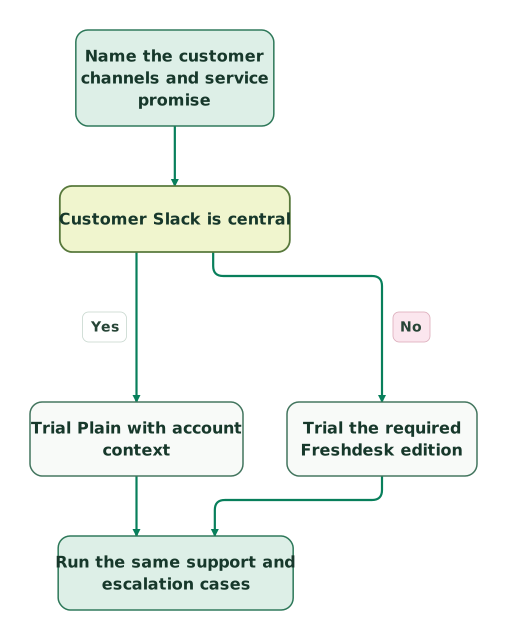
The same cases make the two trials comparable.
Approve only after the workflow passes
A failed operational case returns to configuration or shortlist repair.
Read diagram as text
- Name the customer channels and service promise to Customer Slack is central.
- Customer Slack is central to Trial Plain with account context: Yes.
- Customer Slack is central to Trial the required Freshdesk edition: No.
- Trial Plain with account context to Run the same support and escalation cases.
- Trial the required Freshdesk edition to Run the same support and escalation cases.
- Run the same support and escalation cases to Workflow access and reporting pass.
- Workflow access and reporting pass to Fix configuration or change the shortlist: No.
- Fix configuration or change the shortlist to Run the same support and escalation cases.
- Workflow access and reporting pass to Compare full cost and approve the rollout: Yes
Checklist
- The trial includes the actual customer channels, languages and account types.
- Each issue has one reply owner through escalation and handback.
- Private messages and files remain private under the tested roles.
- Service clocks behave correctly outside working hours and after reopening.
- Product context is fresh enough for the decision being made.
- The pricing sheet includes the correct edition, paid seats, AI units and integrations.
- Historical records and exports have an accepted retention plan.
- The team can explain its operating metrics without vendor assistance.
For an implementation review, bring those cases and the two proposed order forms to Martechdevs' support automation team. The useful output is a working scope with acceptance checks and owners, before the new tool becomes another disconnected inbox.
Keep reading
Browse all CRM & Lifecycle guides
 CRM & Lifecycle
Zendesk vs Freshdesk: Compare the Right Plans, AI Bill and Renewal Cost
Zendesk vs Freshdesk pricing: both start at $19 per agent, but Freshdesk tops out at $89 and Zendesk Suite Professional at $115. Compare plans, AI and costs.
Jafrin Akter AloLast updated 17 min read
 CRM & Lifecycle
Zendesk Competitors and Alternatives: 10 Help Desks Compared by Price and Fit
Freshdesk, Help Scout, Zoho Desk, Intercom, Front, Gorgias and 4 more Zendesk competitors, with prices per agent, free plans and the best pick by team.
Jafrin Akter AloLast updated 19 min read
 CRM & Lifecycle
Customer context in support: billing and product data inside Intercom or Zendesk
Connect billing and product data to Intercom or Zendesk with correct account identity, fresh context, useful fields and safe AI support workflows.
Jafrin Akter AloLast updated 14 min read
Customer support automation
See the implementation scope, deliverables and acceptance checks.
Questions people ask
Does every employee need a paid Plain seat?
Employees who reply to customers need the appropriate member seat, while Plain offers free unlimited viewer seats for visibility. Check permissions for the actual role before calculating savings. A viewer who can follow an issue should not be assumed to have all the actions needed by an agent or administrator.
Is Freshdesk Omni the same subscription as Freshdesk?
Freshdesk Omni is a separate product package with its own prices and channel capabilities. Compare the exact plan named in the proposal, because using an email-helpdesk seat price to budget a messaging operation understates the required subscription. Add voice, AI and other usage charges only where the proposed workflow needs them.
Are Plain credits charged separately for every agent?
Plain's included monthly credits belong to the workspace, rather than multiplying automatically by the number of member seats. Several AI features can consume that allowance. Forecast their combined usage, confirm the actions that count, and check how top-ups or committed usage are purchased before treating the included pool as sufficient.
Can a small B2B team choose Freshdesk instead of Plain?
A small B2B team can reasonably choose Freshdesk when customers mainly use email and the required queue, reporting and service levels work in the selected edition. B2B alone does not determine the answer. Customer channels, the complexity of account context and the amount of engineering coordination matter more than the company label.
Should an AI resolution rate decide the purchase?
An AI resolution rate should be considered alongside correctness, reopened issues, human effort and total cost. Vendors use different billable events and success definitions, so headline rates can describe different populations. Review the same representative questions, inspect the answers and follow the eventual customer outcome before rewarding a high automation percentage.
Sources
- Plain: integrations
- Freshworks: Freshdesk pricing
- Freshworks: Freshdesk Omni pricing
- Plain: plans and pricing
- Plain: credit consumption and top-ups
- Plain: quickstart
- Plain: SLA policies
- Plain: feature and plan comparison
- Freshdesk: SLA policy rules
- Plain: Slack and customer context
- Freshdesk: API reference
- Plain: migration guide
- Plain: startup programme

Written by
Jafrin Akter AloData Engineer and Co-founder at Martechdevs and Growth and Analytics Partners
Jafrin writes practical guides to marketing technology, customer data, analytics and AI workflows. Martechdevs is a Growth and Analytics Partners company.