
Triple Whale Alternatives: Four Options for Attribution, Reporting and Cost
Choose Northbeam for a media-measurement workflow, Polar Analytics for connected ecommerce reporting, and Rockerbox for a broader attribution and testing program. Choose GA4 with an owned warehouse model when the team can maintain the data and needs control over its reporting. The right Triple Whale alternative resolves a specific decision. It should preserve order reconciliation, explain its attribution rules and justify its full operating cost.
On this page
Triple Whale alternatives compared
USD references below separate published software prices from custom quotes, cloud usage and implementation.
| Alternative | Published price basis | Best fit | Main tradeoff |
|---|---|---|---|
| Northbeam | Professional $3,500/month reference; annual term and volume-specific quote | Media performance and attribution | Platform, pageview volume and measurement scope affect eligibility and price |
| Polar Analytics | Configuration-specific pricing | Ecommerce reporting and operational data | SQL access, refresh and activation scope need an itemized offer |
| Rockerbox | Custom commercial scope; no public fixed amount | Cross-channel measurement with MTA, MMM and testing | Data preparation and analytical ownership remain necessary |
| GA4 plus a warehouse model | Standard Analytics is free; warehouse and connectors add cost | Owned measurement and reporting | The team maintains collection, models and reporting semantics |
Sources: Northbeam pricing, Polar plans, Rockerbox products, Google Analytics, BigQuery pricing.
At Martechdevs, we build analytics and attribution implementations around the revenue and decisions the business needs to explain. Start with the order population, the financial definition and the action a report should support. More credited revenue on a screen is not evidence that a new platform generated additional sales.
The Triple Whale baseline
Triple Whale's paid Foundation, Automate and Enterprise packages are priced by annual GMV and package. Its current pricing page directs paid buyers to a commercial discussion and includes unlimited users and stores in the paid offer. Compare the account-specific quote rather than treating an old entry price as the cost for every business. Triple Whale pricing.
Its billing guide defines the revenue basis as Order Revenue over the preceding 365 days, distinct from a return-adjusted sales measure. Paid plans have a twelve-month subscription term even when billed monthly. Annual prepayment has its own discount and revenue-tier treatment. Revenue basis, subscription structure.
Inventory the jobs you use today: attribution, financial reporting, creative analysis, customer segments, data exports and automated actions. A replacement aimed at only one of those jobs may still be the correct choice, but the remaining work needs an owner and budget.
Repair Triple Whale first if the dissatisfaction comes from duplicated orders, incorrect campaign parameters, undefined new-customer logic or a misunderstood attribution model. Moving the same data problem to another platform can create a different answer without creating a better decision. Our attribution-model guide helps establish the credit rule before comparing vendors.
Media and measurement alternatives
Northbeam
Northbeam is our first candidate when an accountable media team needs a dedicated attribution workflow and can maintain the model settings behind its decisions. Its models distinguish clicks-only analysis from modeled-view and deterministic-view approaches. Those are different evidence and allocation choices. Northbeam models.
- Best for: a media team that will repeatedly investigate channel, campaign and customer performance.
- Pros: model and reporting-mode choices support specific media-analysis questions.
- Cons: volume, commerce platform, exports and additional measurement services affect the required scope.
- Free plan and startup offer: the current page does not publish a free plan; its agency-supported Growth route is a commercial arrangement.
- Choose it if: supported channels, order data and reporting controls answer a material buying decision.
- Skip it if: the main unresolved problem is an unverified order feed or a basic reporting task that existing tools can satisfy.
Northbeam's Starter card displays a $1,500 reference and its FAQ describes monthly usage-based pricing for Shopify. Professional displays $3,500 monthly and supports other ecommerce platforms on an annual term. Actual monthly pricing depends on pageview volume, and the contract determines billing cadence. Treat the displayed amounts as starting references for a scoped quote. Plan and contract details.
The Triple Whale versus Northbeam guide covers that narrower decision. For a replacement, also confirm that the desired export is included: Northbeam distinguishes aggregate Sales exports, row-level Touchpoints Export and its Data Export API. Its MCP interface answers scoped questions and does not perform a bulk warehouse sync. Northbeam export routes.
Rockerbox
Rockerbox belongs on the shortlist when the business needs a coordinated measurement program across attribution, marketing mix modeling and incrementality testing. Its current plans page describes a data foundation plus separately selected analytical products. It does not publish a fixed price for that complete configuration. Rockerbox scope.
- Best for: a brand with several measurement questions and a team responsible for acting on the results.
- Pros: data preparation, attribution, modeling and testing can be evaluated as connected work.
- Cons: a wider program needs sufficient data, clear decisions and an accepted implementation and service scope.
- Free plan and startup offer: no continuing free plan or startup discount is assumed from the current commercial page.
- Choose it if: the quote covers the required channels, data delivery and analytical methods with explicit deliverables.
- Skip it if: the team only needs a small set of daily reports and cannot use the added measurement program.
Ask for the exact distinction between platform access, data integration, managed analysis and experiment execution. A product name covering several methodologies does not establish that all of them are included in one subscription or that the business has enough suitable data to use them well.
Define the decision before commissioning a model. Daily campaign diagnosis, annual channel allocation and a causal test of a budget change need different evidence. The attribution, MMM and incrementality guide explains those boundaries and helps keep a broad proposal tied to useful work.
Reporting and owned-data alternatives
Polar Analytics
Polar Analytics is a candidate when the main job is joining ecommerce data into reports the team can use across marketing and operations. Its current plans include a dedicated Snowflake database, an ecommerce semantic layer and a first-party pixel, with unlimited users. The published BI scope includes custom reporting, attribution, alerts and scheduled reports. Polar pricing and scope.
- Best for: an ecommerce team consolidating reporting and maintaining common business definitions.
- Pros: a commerce-focused data foundation can reduce separate reporting processes across teams.
- Cons: direct SQL access, additional refresh requirements, connectors and activation products need explicit entitlement checks.
- Free plan and startup offer: request the relevant evaluation and commercial terms; no permanent free plan or startup reduction is assumed here.
- Choose it if: the proposed data model answers the recurring business questions and the team can verify its calculations.
- Skip it if: the primary requirement is a specialized causal measurement program outside the accepted reporting scope.
A dedicated database does not automatically mean unrestricted SQL access is part of the base BI package. Polar lists SQL access and intraday refresh among add-ons, while its separate Headless MCP offer has its own included warehouse and interface scope. Have the vendor identify the exact product and access rights in the offer. Polar product and add-on boundaries.
Test a report that crosses commercial functions. For example, compare acquisition cost with repeat-purchase contribution after refunds and fulfillment costs. If the report uses revenue from one definition and margin from another, combining them in one dashboard does not make the business calculation coherent.
GA4 with an owned warehouse model
GA4 plus a warehouse is a suitable route when the team can own the collection and modeling work and needs an explainable reporting layer. Standard Google Analytics has no software subscription charge. BigQuery has separate compute and storage billing, and other data connectors can add costs. Google Analytics, BigQuery cost components.
- Best for: a business with an analyst or engineering owner and clearly defined reporting requirements.
- Pros: explicit models can connect commerce, advertising and customer data under controlled definitions.
- Cons: implementation, maintenance and missing source coverage become the team's responsibility.
- Free plan and startup offer: standard Analytics is free; cloud allowances or credits have separate conditions and should not become permanent budget assumptions.
- Choose it if: the team can maintain the sources, reconciliations and reporting needed for its decisions.
- Skip it if: nobody can own pipeline failures or the business expects a warehouse to reproduce every proprietary attribution feature automatically.
GA4's standard daily BigQuery export has a one-million-event-per-day limit. The export contains observed event data and does not reproduce every modeled result shown in the Analytics interface. Streaming has different completeness and source-dimension caveats. GA4 export boundaries.
A warehouse model also needs an authoritative commerce feed. Use order identifiers, refunds, customer history and permitted marketing interactions as separate inputs. GA4 purchase events can support behavioral analysis, but their presence alone does not establish a complete financial order ledger.
The warehouse design guide and BigQuery implementation service cover that ownership decision. This route can be narrow and useful; it does not need to rebuild every feature in a commercial platform.
Reconciliation before attribution comparison
Establish one accepted set of orders before comparing channel credit. Include cancellations, refunds, test orders, currencies, tax, shipping and the chosen transaction date. Record the source of each value and preserve the identifiers needed to investigate a difference.
For a hypothetical month, consider $100,000 in gross order revenue, $10,000 in refunds, $40,000 in goods cost, $8,000 in variable fulfillment and payment costs, and $25,000 in advertising. Under that explicitly simplified definition, contribution after advertising is $17,000.
| Component | Illustrative amount | Treatment | Resulting measure |
|---|---|---|---|
| Gross order revenue | $100,000 | Starting commerce amount | $100,000 |
| Refunds | $10,000 | Deducted once | $90,000 net revenue |
| Goods and variable operating costs | $48,000 | Deducted from net revenue | $42,000 contribution before ads |
| Advertising | $25,000 | Deducted once | $17,000 contribution after ads |
That example excludes other costs and is not an accounting template for every business. Its purpose is to make the definition explicit. Gross-revenue-to-ad-spend is 4.0, while net-revenue-to-ad-spend is 3.6. Neither ratio equals profit.
Now compare attribution using the same order population, currency, time zone, window and model settings. Triple Attribution can credit each platform's last eligible interaction independently, so summing the platform rows can exceed actual order revenue. Triple Whale explicitly directs financial and total-revenue analysis toward other models. Triple Attribution boundaries.
For an illustrative $120 order with two eligible platforms, independent full credit can show $120 for each platform, totaling $240 across the rows. An equally divided model shows $60 per platform and totals $120. The difference comes from the allocation rule; it does not describe an extra order.
Northbeam adds another distinction: Cash Snapshot assigns credit to transaction dates, while Accrual Performance assigns it to interaction dates. A purchase after month-end can therefore affect an earlier interaction period. Align that choice before comparing a daily ROAS result. Northbeam accounting modes.
Attribution, causality and the next budget decision
Attribution allocates credit among eligible interactions. Incrementality estimates the outcome caused by the advertising under an appropriate study design. Google describes its user-based Conversion Lift by comparing treatment and held-back control groups, separately from ordinary attributed conversions. Google's lift-measurement explanation.
A tool showing a higher attributed return may use a broader window, include different views or assign overlapping credit. Before increasing spend, ask whether the result remains useful under the actual business objective and whether a causal test is needed for the decision.
Likewise, a marketing mix model needs an appropriate history, variation and treatment of external factors. A vendor's ability to run a model does not establish that your current data can identify every channel's effect precisely. Ask for the validation approach and uncertainty alongside the estimate.
Use daily attribution for the decisions its evidence supports. Use a suitable controlled test for a causal question when feasible. Keep business-wide revenue and contribution measures beside both, so a favorable channel report cannot conceal deteriorating economics.
Full cost and the minimum useful benefit
Request the next usage band and renewal terms alongside the current quote. Triple Whale's annual GMV basis, Northbeam's pageview-informed pricing and an owned warehouse's processed-data costs respond to different kinds of growth. Apply the actual contract rather than a universal percentage increase.
A hypothetical managed option with a $2,500 monthly quote and $500 in continuing operational work costs $3,000 monthly. At an assumed 35% contribution margin before that new cost, covering it through additional revenue alone requires about $8,571.43 monthly. That is a planning threshold, not a promised result.
For a warehouse illustration, suppose monthly BigQuery on-demand queries process twelve TiB in a US location priced at $6.25 per TiB, with the billing account's first free TiB still available. Query cost is (12 - 1) × $6.25 = $68.75. Storage, ingestion, connectors and operating work are additional. BigQuery on-demand pricing.
If that setup also has assumed connector costs of $200 and monthly maintenance of $600, those three lines already total $868.75 before storage or initial implementation. A low query bill should not be presented as the complete cost of owned measurement.
Triple Whale competitors by business need
| Situation | First route | Runner-up | Deciding evidence |
|---|---|---|---|
| Media team with repeated channel-allocation questions | Northbeam | Current Triple Whale model | Supported evidence, definitions and usable analysis |
| Ecommerce reporting across marketing and operations | Polar Analytics | Owned warehouse | Reconciled commerce model and required access |
| Several methods under one measurement program | Rockerbox | Scoped specialist tools | Clear data and analysis deliverables |
| Existing analytical team needing controlled models | GA4 plus warehouse | Polar Analytics | Maintenance capacity and source coverage |
| Small brand with a reliable current report | Current setup | Targeted repair | Useful benefit above new operating cost |
| Missing or duplicated orders | Collection and model repair | Vendor comparison afterward | Agreed order population before credit allocation |
Replacement acceptance checklist
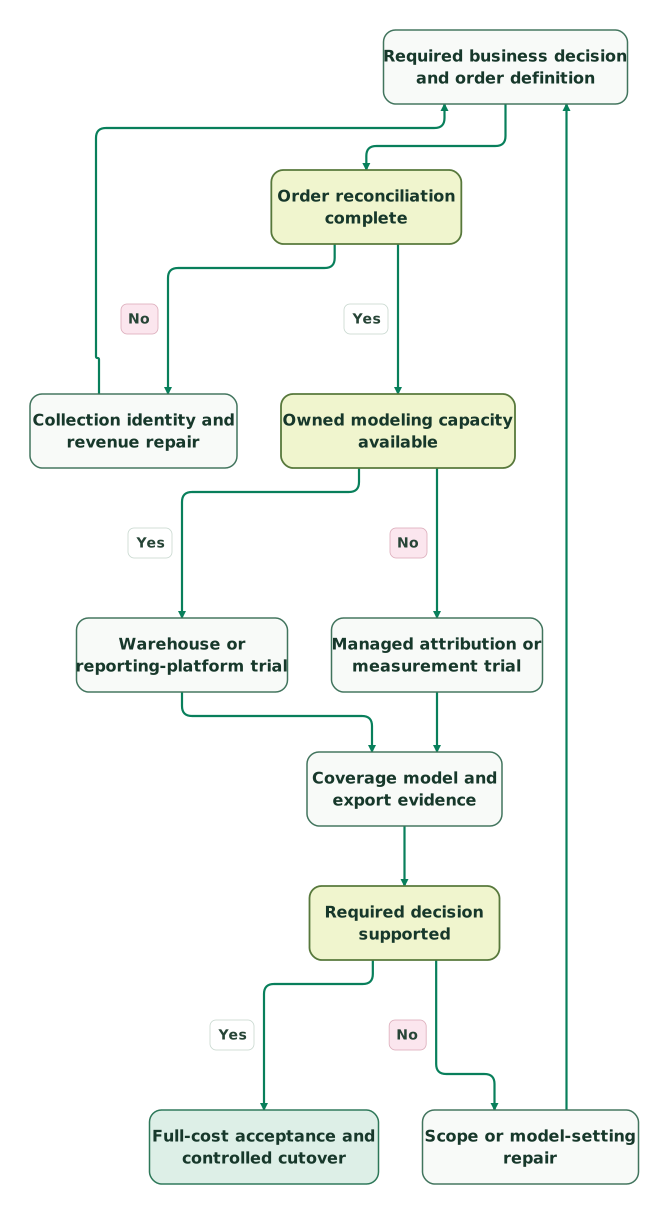
Read diagram as text
- Required business decision and order definition to Order reconciliation complete.
- Order reconciliation complete to Collection identity and revenue repair: No.
- Collection identity and revenue repair to Required business decision and order definition.
- Order reconciliation complete to Owned modeling capacity available: Yes.
- Owned modeling capacity available to Warehouse or reporting-platform trial: Yes.
- Owned modeling capacity available to Managed attribution or measurement trial: No.
- Warehouse or reporting-platform trial to Coverage model and export evidence.
- Managed attribution or measurement trial to Coverage model and export evidence.
- Coverage model and export evidence to Required decision supported.
- Required decision supported to Scope or model-setting repair: No.
- Scope or model-setting repair to Required business decision and order definition.
- Required decision supported to Full-cost acceptance and controlled cutover: Yes
Checklist
- The replacement serves a specific recurring decision.
- Orders, refunds, currencies and dates reconcile under one definition.
- Attribution windows, views and credit rules are explicit.
- Required exports and direct-data access are included in the offer.
- Causal questions have an appropriate measurement plan.
- The quote includes likely growth, renewal and operating work.
- Existing contract obligations and historical access are resolved before exit.
- Cutover prevents duplicated purchases, audience updates and ad-platform signals.
Use the analytics tool selector skill to document the reporting and ownership requirements. Request an attribution scope when the replacement needs order reconciliation, dependable collection and an operating model the team can explain.
Keep reading
Browse all Tracking & Attribution guides
 Tracking & Attribution
Triple Whale vs Northbeam: Compare Costs, Attribution and the Order Data
Compare Triple Whale and Northbeam pricing, contracts, models and exports. Use an order-revenue bridge and a reporting pilot to choose the right scope.
Jafrin Akter AloLast updated 18 min read
 Tracking & Attribution
What Is an Attribution Model? Marketing Models and Examples
Understand what an attribution model does, compare credit for the same purchase, and choose reporting rules without confusing attributed revenue with causal impact.
Jafrin Akter AloLast updated 15 min read
 Data Warehouse
Data warehouse design for a small company: layers, models and rules that prevent rework
Design a marketing warehouse around clear record grain, identity and history. Includes model examples, metric definitions and a first-project checklist.
Jafrin Akter AloLast updated 11 min read
Analytics & tracking
See the implementation scope, deliverables and acceptance checks.
Questions people ask
Can a Triple Whale alternative be judged by whichever reports the highest ROAS?
A higher reported ROAS can come from different windows, eligible interactions, revenue definitions or overlapping credit. Reconcile the order population and align the settings before comparing the result. Then choose the system that supports the actual decision and its evidence requirements. A more favorable attribution number does not establish that the business earned more revenue or profit.
Does paying Triple Whale monthly mean the subscription can end after one month?
The current paid-plan pricing describes twelve-month subscriptions with monthly or annual billing. Confirm the actual order form, remaining commitment and cancellation process before counting savings from leaving. Billing cadence and contractual term are separate. A replacement plan should include the period of overlap required to preserve access and complete the accepted migration.
Does Polar's included Snowflake database automatically include all SQL access?
Confirm the exact product and entitlement. Polar's pricing page lists a dedicated database in its platform description while SQL access appears among BI add-ons, and its separate Headless MCP product has another stated scope. Put direct-query access, refresh requirements, exports and permissions on the offer rather than inferring them from the presence of a warehouse.
Can GA4 BigQuery export reproduce every figure in the GA4 interface?
The export provides observed event data and differs from modeled results and processing in the interface. Its daily and streaming routes also have distinct limits and completeness characteristics. Build and validate the required warehouse definitions explicitly, with a separate commerce source for the agreed order ledger, instead of assuming the export is a copy of every report.
Does access through an attribution vendor's MCP replace a warehouse export?
An MCP interface can answer bounded questions without providing a bulk historical feed. Northbeam explicitly separates its MCP from Sales exports, row-level Touchpoints Export and the Data Export API. Select the supported route for the dataset and delivery requirement, confirm its entitlement, and validate identifiers, history and refresh behavior before relying on it as a pipeline.
Sources
- Triple Whale pricing and commitments
- Triple Whale billing revenue basis
- Triple Whale attribution-model definitions
- Northbeam pricing and contracts
- Northbeam attribution models
- Northbeam accounting modes
- Northbeam export and MCP distinctions
- Polar Analytics plans and add-ons
- Rockerbox product and measurement scope
- Google Analytics standard offer
- GA4 BigQuery export limits and differences
- BigQuery query and storage pricing
- Google Conversion Lift interpretation

Written by
Jafrin Akter AloData Engineer and Co-founder at Martechdevs and Growth and Analytics Partners
Jafrin writes practical guides to marketing technology, customer data, analytics and AI workflows. Martechdevs is a Growth and Analytics Partners company.