
5 Stitch Alternatives for Managed Pipelines, Custom Sources and AWS
Choose Fivetran for managed connections, Airbyte for flexible deployment, Hevo for managed event-based pipelines, Meltano for code-owned extraction, or AWS Glue for AWS engineering workloads. The best Stitch alternative fixes a specific coverage, reliability or cost problem. Compare delete handling, recovery, destination tables and the full operating bill before moving production data.
On this page
Stitch alternatives compared
US list prices in USD below show the billing basis; hosting, warehouse use and implementation can add costs.
| Tool | Starting price and basis | Best fit | Main tradeoff |
|---|---|---|---|
| Fivetran | Free plan up to 500,000 connection MAR/month; paid usage priced by connection | Managed application and database connections | Active-row counts and connection charges need a workload estimate |
| Airbyte | Standard $20/month with 5 credits; extra credits $5 each | Deployment choice and connector flexibility | Cloud volume, capacity and self-hosting have different cost models |
| Hevo | Starter $299/month monthly, or $265/month annually, for 5 million events | Managed pipelines with an event budget | Repeated changes consume events; annual fixed-price plans need a quote |
| Meltano | Self-hosted open-source software free; managed plans require sales pricing | Teams maintaining pipelines as code | Runtime, connector maintenance and incident ownership remain real costs |
| AWS Glue | Compute-based; AWS's Spark example uses $0.44/DPU-hour | AWS data engineering and transformation | A job runtime needs engineering and supporting AWS services |
Sources: Fivetran pricing, Airbyte pricing, Hevo pricing, Meltano pricing, AWS Glue pricing.
Stitch remains a reasonable candidate if it already covers the required sources and delivers correct data at an acceptable cost. Its Standard plan starts at $100/month with a five-million-row entry allowance. Advanced lists $1,500/month billed annually, with 100 million rows and three destinations. A change should recover more value than the migration consumes. Stitch pricing.
At Martechdevs, we scope warehouse and pipeline implementations from the reports and operational decisions that depend on them. The acceptance test includes an updated invoice, a deleted customer record and a failed sync. A successful first load is only the beginning of that test.
Replacement requirements and existing gaps
Write the replacement requirement as an observable outcome. “More connectors” is too broad. “The source's subscription amendments arrive within the agreed window, including deleted records and changes to existing amounts” gives both vendors and the delivery team a useful test.
| Current gap | Required evidence | Replacement implication |
|---|---|---|
| Missing source object or field | Exact object, API permission and destination mapping | Connector coverage at table level |
| Missing deleted records | Delete event reaches the destination and downstream model | Suitable replication method and deletion semantics |
| Frequent unexplained resyncs | Restart behavior and usage after a controlled interruption | Recovery and billing review |
| Row allowance grows too quickly | Replication method, nested rows and change frequency | Unit comparison before a vendor comparison |
| Several customer or business-unit destinations | Isolation, access and the price of each connection | Deployment and account structure review |
Stitch counts newly replicated rows, updates, repeated copies and rows produced by unpacking nested data. The source's current row count therefore cannot predict the monthly replicated-row total by itself. Full-table replication frequency can be a major driver. Stitch row usage.
Delete behavior also depends on the method. Stitch's key-based incremental replication cannot detect a row that has been removed completely from the source. Supported log-based methods can capture supported delete events, with destination flags and connector-specific behavior. Inspect the actual connector instead of assuming every Stitch pipeline has the same limitation. Deleted-record handling, log-based replication.
Our data warehouse design guide helps separate source extraction, loading and downstream transformation. Keep those responsibilities explicit in the shortlist.
Managed and engineering-led alternatives
Fivetran
- Best for: Teams that want a vendor to operate supported application and database connections and can forecast the active data in each connection.
- Pros: Managed connections, a free entry plan and paid-plan choices for sync frequency and access controls. The current Standard plan lists 15-minute syncs; the Enterprise plan lists one-minute syncs. Actual delivery also depends on source behavior. Plans.
- Cons: Two connections moving the same source data to different destinations count separately. Eligible paid connections also carry a $5 base charge at monthly usage from one to one million MAR. Usage rules.
- Free plan and startup offer: The free plan includes up to 500,000 connection MAR each month. New connections have a 14-day trial; evaluate the steady-state allowance separately. Free plan.
- Choose it if: The exact objects, history and deletion behavior pass a trial and reduced maintenance justifies the complete bill.
- Skip it if: A required field, deployment boundary or destination behavior remains unsupported in the quoted configuration.
A monthly active row, or MAR, is a distinct row counted within the relevant connection and table context. Repeated updates to the same ordinary keyed row in the same month generally remain one MAR, while history mode and other configurations can change the result. Use the detailed Fivetran pricing guide before translating a Stitch row allowance into a Fivetran budget. MAR definition.
Airbyte
- Best for: Teams that value deployment choice and want to evaluate managed cloud against a self-operated connector platform.
- Pros: Airbyte offers self-managed Core, fully managed cloud and hybrid options. This makes infrastructure boundaries part of the selection rather than an afterthought. Platform options.
- Cons: Connector operations still require attention. For Cloud major-version changes, Airbyte documents an upgrade cutoff after which the affected connection is disabled. Plan an owner for those notices. Connection status and upgrades.
- Free plan and startup offer: Core is free self-managed software; the Standard and Plus cloud pricing cards advertise a 30-day trial. Standard starts at $20/month with five credits, and Plus starts at $189/month for 40 credits. Pro and Enterprise Flex use custom pricing. Prices.
- Choose it if: Your source and destination pair passes tests and the team can support the chosen deployment and upgrade model.
- Skip it if: The only justification is the free software licence while nobody owns its infrastructure or recovery.
Keep Airbyte's volume-priced and capacity-priced plans separate. A credit budget for Standard or Plus does not describe a Pro Data Worker commitment. Ask for the source-specific conversion into credits and test the actual destination load before comparing the proposal with Stitch. Pricing models.
Hevo
- Best for: Teams wanting managed pipelines with an event allowance and a clear operating owner.
- Pros: Starter includes hourly scheduling and support; larger configurations offer additional pipeline and administration capabilities. The product also offers annual fixed pricing per pipeline for unlimited data volume through a custom Enterprise quote. Plan scope.
- Cons: New and updated events are billable, and source deletions count as updates during replication. A heavily changing source can consume an allowance repeatedly. Event billing.
- Free plan and startup offer: A 14-day trial is available. The entry Starter price is $299/month on monthly billing or $265/month with annual billing. Confirm the event tier in the order. Pricing.
- Choose it if: The supported connector behavior, recovery and event forecast fit, and the team wants vendor-operated movement.
- Skip it if: The proposed allowance was estimated from distinct source rows without measuring updates and deletions.
For an Enterprise fixed-volume proposal, define what constitutes one pipeline, what can change during the term and which operational limits remain. Unlimited data volume is a purchasing term; source API limits, warehouse resources and delivery requirements still need their own acceptance checks.
Meltano
- Best for: Data engineers who want connector configuration and pipeline changes maintained in code, including less common sources.
- Pros: Meltano supports Singer taps and targets, stream selection and managed incremental state. Its project model lets the team keep configuration and execution decisions under engineering ownership. Replication workflow.
- Cons: The selected tap and target determine real coverage. An available plugin still needs validation for pagination, incremental bookmarks, deletion handling and destination behavior.
- Free plan and startup offer: Self-hosted open-source Meltano is free to use. Managed plans are offered with compute-hour allowances, while the public page directs buyers to sales for pricing. Meltano plans.
- Choose it if: Engineers can maintain the chosen connectors and the custom behavior is worth owning.
- Skip it if: The team expects a free installation to remove on-call work, infrastructure or dependency upgrades.
Treat incremental state as production data. Meltano tracks state by the pipeline's state identifier, and a saved bookmark can take precedence over a configured start date. A redeployment that accidentally changes state identity can alter the next load. Back up and test the state workflow with the same care as credentials and schedules. Incremental state.
AWS Glue
- Best for: AWS engineering teams combining ingestion, transformation and cataloging inside an existing AWS operating model.
- Pros: Glue provides serverless data integration, job authoring and a shared Data Catalog integrated with AWS analytics services. It suits pipelines that need engineering control over the processing step. Glue scope.
- Cons: A job engine does not automatically replace the behavior of every managed SaaS connector. Verify extraction, authentication, checkpoints and incremental logic for the intended source.
- Free plan and startup offer: The Data Catalog has free metadata allowances. Compute jobs are usage-priced; general AWS account credits are separate from a permanent free pipeline. Pricing components.
- Choose it if: The team already owns AWS permissions, job deployment, monitoring and the required source integration.
- Skip it if: The main requirement is a low-maintenance application connector and no engineer owns its extraction behavior.
AWS's published Spark example uses $0.44 per data processing unit hour, or DPU-hour. Six DPUs running for 15 minutes cost $0.66 at that example rate. Add the applicable region, supporting services and repeated runs before using that figure in a budget. Glue example.
Best fit by scenario
| Situation | First shortlist | Runner-up | Reason |
|---|---|---|---|
| Small team with ordinary SaaS reporting sources | Fivetran | Hevo | Managed operations with connector-level validation |
| Engineers with unusual APIs and custom extraction | Meltano | Airbyte | Configuration and connector control |
| Required self-managed deployment | Airbyte Core | Meltano | Infrastructure and operations under the team's ownership |
| AWS lake and transformation workload | AWS Glue | Airbyte | Existing AWS processing and permissions model |
| Stable Stitch setup with a growing row bill | Current Stitch configuration review | Fivetran | Replication changes may resolve cost before migration |
These are starting shortlists. An unsupported source field or unacceptable delete policy outweighs the general recommendation. For a broader candidate set, use our Fivetran alternatives guide, then test the most difficult source first.
Billing-unit and migration examples
Consider a hypothetical table with 200,000 rows, fully copied once per day for 30 days. That is six million replicated rows before nested child records, other tables or additional jobs. Reducing it to one full copy per week would change the volume, but it would also change freshness. The required reporting window decides whether that tradeoff is acceptable. Stitch usage mechanics.
A separate example has 20,000 stable keyed records, each changed ten times and delivered during the month. That creates 200,000 delivered changes. In a Fivetran connection using ordinary current-state rows, the same 20,000 identities can remain 20,000 MAR. History mode, synthetic keys and repeated connections require separate treatment. This is a unit example, not a comparative invoice. MAR rules.
For Airbyte Standard, an illustrative 40-credit month costs $20 plus 35 additional credits at $5, or $195. The listed 40-credit Plus package is $189/month. That $6 difference makes the package worth comparing, but the useful plan also needs the right sync and access features. Airbyte rates.
Use migration economics separately from vendor meters. Suppose an internal planning estimate assigns $8,000 to migration work and expects $400/month of net operating savings after added hosting and support. Simple payback is 20 months. If the expected contract horizon is 12 months, savings alone do not recover that migration budget. Faster recovery or a missing business capability may still justify the project, but those benefits need their own evidence.
Destination contracts and cutover
Run the replacement into an isolated destination schema first. Compare accepted business facts, including a corrected amount, deleted record, changed timestamp and late-arriving update. Equal row counts can conceal different records or duplicate versions.
| Test | Evidence | Cutover condition |
|---|---|---|
| Initial load | Key coverage and agreed totals | Required history present |
| Repeated update | Latest accepted value and version | No stale current-state result |
| Delete | Source event and destination representation | Downstream exclusion or removal matches policy |
| Interrupted run | Saved position and replay result | No unexplained gap or duplication |
| Schema change | Expected column and type handling | Dependent model remains correct or fails visibly |
For database log replication, use a dedicated consumer position and the required retention settings. Stitch specifically warns against sharing one PostgreSQL replication slot between independent consumers. A parallel migration should preserve each consumer's state instead of making them compete for one cursor. Stitch log-replication guidance.
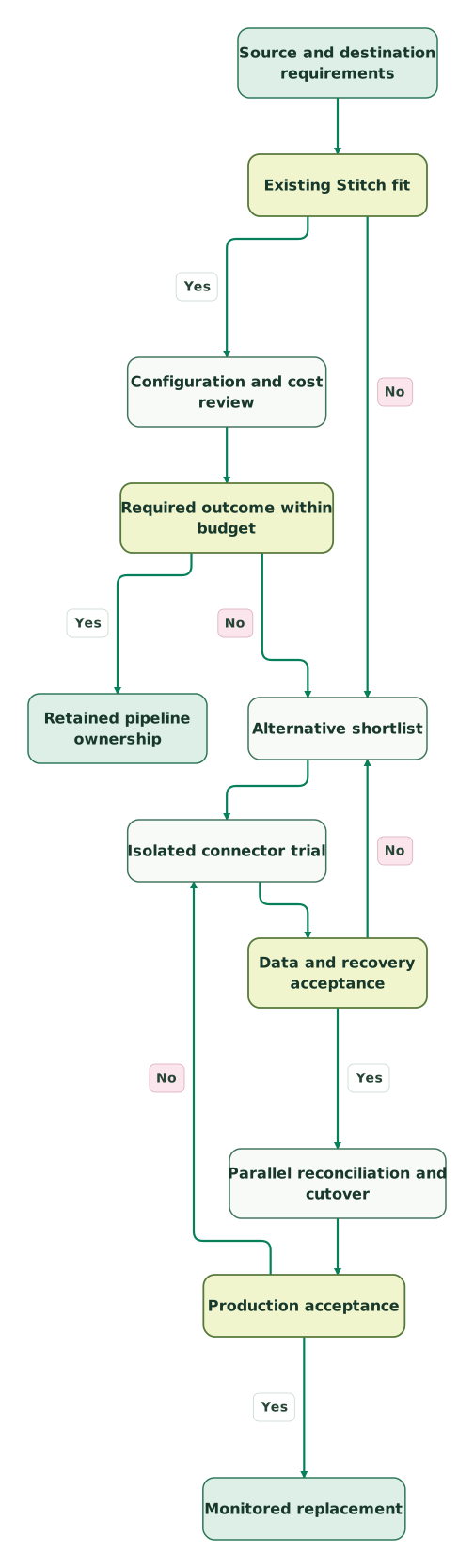
Read diagram as text
- Source and destination requirements to Existing Stitch fit.
- Existing Stitch fit to Configuration and cost review: Yes.
- Existing Stitch fit to Alternative shortlist: No.
- Configuration and cost review to Required outcome within budget.
- Required outcome within budget to Retained pipeline ownership: Yes.
- Required outcome within budget to Alternative shortlist: No.
- Alternative shortlist to Isolated connector trial.
- Isolated connector trial to Data and recovery acceptance.
- Data and recovery acceptance to Alternative shortlist: No.
- Data and recovery acceptance to Parallel reconciliation and cutover: Yes.
- Parallel reconciliation and cutover to Production acceptance.
- Production acceptance to Isolated connector trial: No.
- Production acceptance to Monitored replacement: Yes
Pipeline selection checklist
- Exact source objects, permissions and destination tables are listed.
- Updates, deletes, history and late records pass representative tests.
- Billing units include repeated movement and multiple destinations.
- Initial loads, resyncs and contract allowances have separate estimates.
- Connector upgrades, credentials, state and failure recovery have owners.
- Source load and retention support parallel migration.
- Business totals reconcile before dependent reports switch.
- Rollback criteria and old-pipeline retirement are documented.
Use the marketing data audit skill to organize the evidence. Our warehouse implementation service covers ingestion through usable models and reporting. The $99 martech audit includes a written assessment and a one-hour specialist call.
Keep reading
Browse all Data Warehouse guides
 Data Warehouse
5 Fivetran Alternatives: Choose by Source, Cost and Recovery
Compare 5 Fivetran alternatives and competitors: Airbyte from USD 20 a month, Stitch from USD 100, Hevo from USD 265, open-source dlt and Google Datastream.
Jafrin Akter AloLast updated 16 min read
 Data Warehouse
 Cost for a Small Company: Platform, Pipelines, People and Activation
Estimate what a data warehouse costs a small company each month: storage, compute, connectors, dbt, BI, activation and upkeep, with a worked example.
Jafrin Akter AloLast updated 18 min read
 Data Warehouse
ETL Tools for Managed Ingestion, Custom Processing and Reliable Pipelines
Compare Fivetran, Airbyte, AWS Glue and Meltano for ETL and ELT work, with current entry offers, billing-unit examples and source/recovery checks.
Jafrin Akter AloLast updated 12 min read
Data warehouse & CDP
See the implementation scope, deliverables and acceptance checks.
Questions people ask
Does changing from Stitch to Fivetran preserve the same billable row count?
The counts can differ because Stitch measures replicated rows while Fivetran measures active row identities within defined contexts. Repeated updates, full-table copies, history mode and multiple destinations can change the relationship. Export usage by source and table, then calculate each vendor's meter separately before comparing prices. One vendor's row allowance cannot be copied directly into the other's estimator. Stitch usage, Fivetran MAR.
Can a Stitch key-based pipeline detect a hard-deleted source record?
Key-based incremental replication cannot detect a completely removed source row through its missing replication key. Supported log-based or other deletion-aware approaches need connector-specific evaluation. During replacement testing, delete a synthetic source record and inspect both the destination representation and the downstream report. A successful sync status alone does not establish that the deletion reached the business model. Deletion behavior.
Is self-hosted Meltano cheaper than every managed Stitch alternative?
Its software licence is free, while the complete cost depends on infrastructure, connector work, monitoring and incident recovery. A team with maintained engineering operations may benefit from that control. A small team without a pipeline owner can instead inherit expensive interruptions. Compare an explicit monthly operating estimate and migration budget with the managed proposal before choosing on licence price. Meltano pricing.
Does Airbyte Cloud remove every connector upgrade task?
Airbyte manages the cloud platform, but connector changes can still require customer action. Its connection-status guidance documents major-version upgrade deadlines and disabled connections after a missed cutoff. Assign ownership for notices, test the revised output and check downstream models before the deadline. Hosting management and responsibility for the business data contract remain separate parts of the operating model. Airbyte upgrade behavior.
Is a successful first load enough to retire the old Stitch pipeline?
A first load proves only part of the migration. Require ongoing updates, deletions, recovery and downstream totals to pass as well. Keep the old production path available until the replacement meets defined acceptance and rollback conditions. The cutover should identify which destination becomes authoritative, who approves reconciled totals and when the old credentials and schedules are retired.
Sources
- Stitch pricing
- Stitch row usage
- Stitch deleted-record handling
- Stitch log-based replication
- Fivetran pricing
- Fivetran MAR and connection charges
- Airbyte pricing
- Airbyte deployment options
- Airbyte connection status and upgrades
- Hevo pipeline pricing
- Hevo event billing
- Meltano pricing
- Meltano replication and state
- AWS Glue pricing
- AWS Glue overview

Written by
Jafrin Akter AloData Engineer and Co-founder at Martechdevs and Growth and Analytics Partners
Jafrin writes practical guides to marketing technology, customer data, analytics and AI workflows. Martechdevs is a Growth and Analytics Partners company.