
Salesloft Alternatives for Revenue Teams and Smaller Outbound Programs
Choose Outreach for a governed revenue-team workflow, Apollo.io for prospect data and outreach together, or lemlist for named-seller multichannel work and a separate email-volume option. Salesloft competitors serve different operating scopes. Replace the work Salesloft actually performs, including CRM state and conversation ownership, before comparing a smaller tool's subscription with a broader platform quote.
On this page
Salesloft alternatives compared
Public entry prices are US amounts in USD; quoted platforms need the same scope and commitment terms.
| Tool | Starting price and billing basis | Best fit | Main tradeoff |
|---|---|---|---|
| Outreach | Custom seats and AI-credit quote | A maintained revenue-team process | Usage and administration must be included |
| Apollo.io | Basic $65/seat/month monthly or $49 billed annually | Data-led prospecting and outreach | The account plan and credit schedule need qualification |
| lemlist | Multichannel $109/user/month monthly; Email $69/month for 50,000 team-wide sends | Seller-led channels or an email-only team | The plan families do not represent the same work |
| Salesloft, retained baseline | Sales-led quote for selected product scope | A working Cadence and revenue workflow | Renewal should reflect actual used capabilities |
Sources: Outreach pricing, Apollo pricing, lemlist plan guide and Salesloft sales consultation. A self-service entry price is not a like-for-like price for an enterprise sales process.
Inventory Cadence, prioritized work, conversation context, CRM updates and any other Salesloft products the team uses. A replacement can simplify the stack if the required work is smaller. It can also create more manual coordination if only the sequence sender is replaced while the surrounding process remains undefined.
At Martechdevs, we scope GTM workflow implementation from the seller's action to the accepted CRM result. That makes a Salesloft replacement concrete: the correct person receives the next task, the relevant prospect stops automation and the manager can explain the state of the account.
Tool decision blocks
Outreach
- Best for: A revenue organization that needs reusable sequence policy, CRM engagement state and an administrator-owned process.
- Pros: Sequence rulesets centralize important behavior, and the CRM mapping guide describes the fields needed for engagement visibility.
- Cons: A broad replacement still needs implementation and ongoing ownership. Seats and AI consumption are separate parts of the commercial model.
- Free plan and startup offer: The public pricing route offers a custom proposal and demonstration, without a standard permanent free allowance or universal startup price. Agree evaluation access and usage explicitly.
- Choose it if: The full seller and manager workflow passes the trial and the quoted scope improves the current operating process.
- Skip it if: The business is intentionally reducing to a small prospecting program and the wider platform commitment is unnecessary.
Apollo.io
- Best for: A smaller team that wants contact discovery and outreach in one working environment.
- Pros: Basic includes sequencing and core integrations, making it a useful consolidation candidate when prospect data currently arrives through manual transfers.
- Cons: All account seats use the same plan level, and data or other actions consume credits. A small base subscription cannot be assumed to replace every Salesloft workflow.
- Free plan and startup offer: Free supplies 75 credits per seat monthly. A 14-day trial has separate limits; approved eligible startups can receive 50% off for one year on up to five Basic or Professional seats.
- Choose it if: The matched data sample and required sequence-to-CRM path work with less operational overhead.
- Skip it if: The saving relies on removing necessary governance, reporting or CRM behavior without a replacement owner.
lemlist
- Best for: Named sellers coordinating email and additional channels, or an email-only team choosing a shared volume plan.
- Pros: Its current plan families separate user-based Multichannel work from Email's unlimited-user, volume-based arrangement.
- Cons: A Multichannel seat belongs to one person, and data or optional channel products add costs. An email-only budget does not cover the broader seller routine.
- Free plan and startup offer: The standard trial lasts 14 days with 50 emails/day and limited access to some functions, then transitions to Freemium. No universal startup concession is assumed.
- Choose it if: The required channel tasks, stopping behavior and CRM handoff fit a seller-owned process that the team can maintain.
- Skip it if: The replacement requires enterprise-wide controls or reporting that the selected configuration has not demonstrated.
Salesloft
- Best for: A team with a dependable Cadence, prioritized-work and CRM operating routine that remains useful.
- Pros: Retaining the system preserves working history and integrations. Cadence and Rhythm can be evaluated as distinct parts of that routine.
- Cons: A broad proposal should be reviewed against actual use. Maintaining unused products or unclear ownership can make the arrangement harder to justify.
- Free plan and startup offer: The sales route provides a consultation and tour without a published universal free production allowance or startup price. Request specific evaluation or renewal terms.
- Choose it if: A scope adjustment or bounded repair resolves the concern with less disruption than migration.
- Skip it if: Another qualified setup preserves required outcomes and provides a material complete-cost or operating advantage.
The workflow being replaced
Separate sending from the surrounding revenue process. A team may use Salesloft to organize daily tasks, synchronize activity, provide conversation context and coordinate account work. Those functions can have different owners and may need different destinations after a move.
| Current job | Replacement requirement | Evidence before approval |
|---|---|---|
| Cadence execution | Correct next task and stopping behavior | Known prospect follows the intended path |
| Prioritized work | A usable daily queue | Seller completes the relevant work without a parallel list |
| CRM engagement state | Accurate active and completed status | CRM reflects a reply, pause and finish correctly |
| Conversation ownership | Assigned human response | Reply reaches the responsible seller with context |
| Manager review | Interpretable account and activity evidence | Manager can explain the current state from source records |
| Administration | Maintained templates, permissions and exceptions | Another administrator can investigate a saved failure case |
For a direct broader-platform comparison, use Outreach vs Salesloft. For a smaller multichannel shortlist, lemlist alternatives helps identify the relevant operating model. Add an option only when it addresses a required job.
A deliberate simplification should name the work being retired. If the company no longer needs a particular forecast or conversation feature, removing it can be sensible. If the work continues in a spreadsheet or another subscription, its cost remains part of the replacement case.
CRM synchronization and integration scope
Salesloft's CRM synchronization guide describes a Main CRM Connector and field-level choices about which application takes priority. The connector's access and field permissions influence the records that can be updated. Preserve those ownership decisions when evaluating another tool.
A replacement should be tested against an existing contact and an existing opportunity, not only a new prospect. Confirm the destination IDs, current owner, relevant activity and exclusion state. A connector can create a plausible new record while failing to update the record the sales team already uses.
Outreach's engagement field guide distinguishes active sequence information from finished-state fields. If Outreach is shortlisted, map the manager's reporting need to those specific fields. An old Salesloft status should not be copied into a field with a different meaning merely because the labels look similar.
For Apollo or lemlist, validate the selected edition's integration and the exact updates required. Keep a field ownership sheet for account status, sales owner, current engagement and preferences. The CRM property ownership guide helps prevent a new engagement tool from becoming authoritative for unrelated commercial data.
Hypothetical named-user budgets
Assume a hypothetical team needs fifteen paid users. The following calculations use published US prices, constant scope for twelve months, no startup discounts, no taxes and no extra usage. They compare licence amounts only and do not claim equivalent features or a complete Salesloft replacement.
| Candidate plan | Billing basis | Calculation | Annual amount, USD |
|---|---|---|---|
| Apollo Basic | Monthly payments | 15 × $65 × 12 | $11,700 |
| Apollo Basic | Annual commitment | 15 × $49 × 12 | $8,820 |
| lemlist Multichannel | Monthly payments | 15 × $109 × 12 | $19,620 |
| lemlist Multichannel | Annual commitment | 15 × $87 × 12 | $15,660 |
Sources: Apollo current pricing and lemlist's plan guide. Apollo's lower Basic amount is relevant only if Basic passes the required workflow. The lemlist comparison concerns Multichannel, not its shared Email-volume plan.
Annual billing reduces the stated Apollo total by $2,880 and the lemlist total by $3,960 compared with twelve monthly payments at the listed rates. It also changes the commitment and payment timing. Confirm cancellation, seat changes and the applicable offer before treating that difference as an approved saving.
Now consider a separate hypothetical replacement case with $1,000/month in complete recurring savings and $15,000 of transition work. Simple payback is fifteen months after savings begin. If two months of overlap add an assumed $1,500/month, the investment becomes $18,000 and payback becomes eighteen months. These are illustrative planning inputs, not Salesloft, Outreach or Martechdevs prices.
Use the software pricing tool to combine licences, credits, calling, data, implementation and overlap. Keep the recurring budget separate from the first-year transition cost. A full enterprise quote may also have minimums or included services that make a simple per-user comparison incomplete.
Prospect states and active memberships
A sequence or cadence template is different from the people currently enrolled in it. The migration needs both the design and each person's state. Record the current step, due time, owner, reply status, pause reason and relevant exclusion before moving the active population.
Salesloft's cadence settings reference includes reply and bounce removal, out-of-office handling after an automatic response and stage changes. Translate the intended behavior into the replacement's configuration. Do not assume a generic completed label preserves whether the person replied, finished without a reply or was excluded.
Test a person waiting between steps, a person who already replied and a person who booked a meeting outside the platform. The next action should match the approved sales process in each case. If the replacement cannot reconstruct an active state safely, finishing that cohort in the old system may be the simpler transition.
The outbound automation guide explains the stopping and ownership boundary. A new tool should not turn a live sales conversation back into an automated prospect because the import file omitted history.
Best fit by team model
| Company size or operating model | Best fit | Runner-up | Decision reason |
|---|---|---|---|
| Revenue team retaining broad governance needs | Outreach pilot | Salesloft scope review | The complete operating process remains the requirement |
| Small team consolidating data and outreach | Apollo | lemlist | Accepted prospect data and execution belong in one trial |
| Named sellers coordinating several channels | lemlist Multichannel | Apollo qualified tier | Human task and channel ownership deserve direct testing |
| Existing Salesloft team with a narrow sync problem | Salesloft repair | Outreach | A bounded field or connector fix may avoid migration |
| Email-only team retiring wider platform scope | lemlist Email evaluation | Apollo | The smaller workload changes the appropriate buying model |
The runner-up should address a concrete failed requirement. A team can prefer a smaller tool while discovering that an important report or access boundary needs extra work. Record that gap and its owner before approving the lower subscription.
Replacement and repair workflow
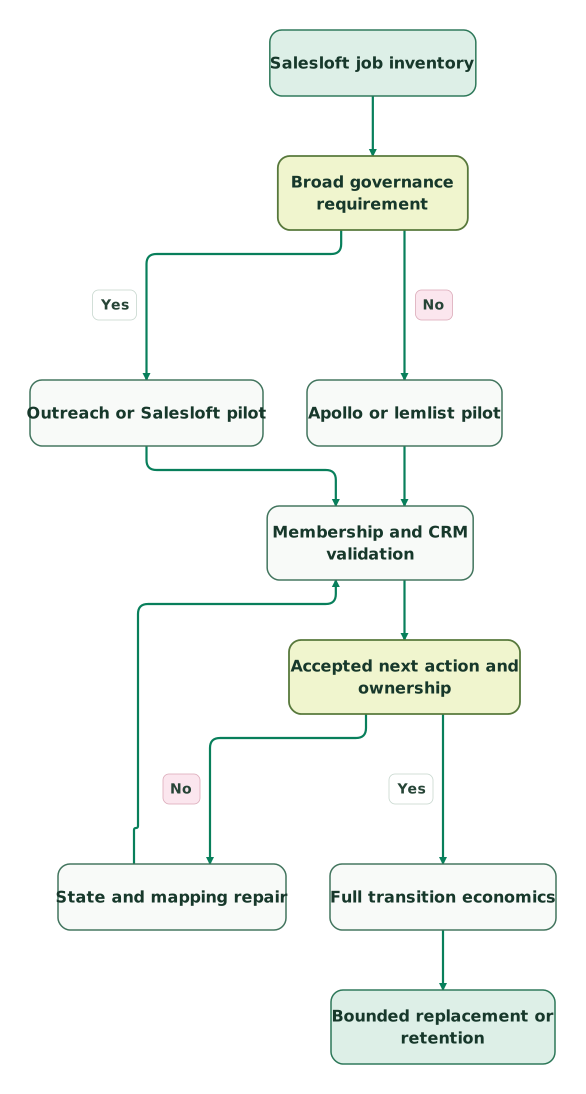
Read diagram as text
- Salesloft job inventory to Broad governance requirement.
- Broad governance requirement to Outreach or Salesloft pilot: Yes.
- Broad governance requirement to Apollo or lemlist pilot: No.
- Outreach or Salesloft pilot to Membership and CRM validation.
- Apollo or lemlist pilot to Membership and CRM validation.
- Membership and CRM validation to Accepted next action and ownership.
- Accepted next action and ownership to State and mapping repair: No.
- State and mapping repair to Membership and CRM validation.
- Accepted next action and ownership to Full transition economics: Yes.
- Full transition economics to Bounded replacement or retention
Repeat membership and CRM validation after repairs. A corrected owner mapping can change task assignment; a corrected stage mapping can change future enrollment. Keep the same test records so the team can compare the result rather than relying on a fresh demonstration each time.
Roll out to a bounded group of users and prospects first. Assign an administrator to failed updates, a sales owner to conversations and a manager to the outcome review. Keep the old system's required history accessible until the agreed retention and reporting needs are satisfied.
Salesloft alternatives checklist
- Inventory each Salesloft job, owner and required outcome.
- Separate deliberately retired work from work moving to another tool.
- Qualify the production edition and integration behind each requirement.
- Test an ordinary seller day and the manager's view of the same records.
- Preserve CRM field ownership and the designated connector responsibilities.
- Export active membership state separately from cadence templates.
- Validate reply, pause, meeting and exclusion behavior on controlled records.
- Include data, credits, calling, implementation and overlap in the budget.
- Repeat affected state and CRM checks after every repair.
- Approve the small rollout and the historical-access plan before expansion.
The CRM data hygiene audit skill helps prepare the record and ownership review. The lead-routing guide helps define the ownership and next-action rules a replacement must preserve.
Keep reading
Browse all GTM Engineering guides
 GTM Engineering
Outreach vs Salesloft for Sequences, CRM State and Revenue Teams
Compare Outreach and Salesloft through seller workflows, stopping rules, CRM state and complete quoted scope, with an explicit annual planning example.
Jafrin Akter AloLast updated 10 min read
 GTM Engineering
lemlist Alternatives for Email Operations and Sales Workflows
Compare lemlist alternatives including Instantly, Smartlead and Apollo by current plan families, contacts, sends, reply handling and full transition cost.
Jafrin Akter AloLast updated 10 min read
 GTM Engineering
Outbound Automation: What to Automate and What to Keep Human
Build outbound automation with evidence-based research, eligibility checks, approved messages, reliable suppression, human reply ownership and clear costs.
Jafrin Akter AloLast updated 12 min read
GTM engineering & outbound
See the implementation scope, deliverables and acceptance checks.
Questions people ask
Can Apollo Basic be treated as a complete low-cost Salesloft replacement?
Apollo Basic can be treated as a replacement only after the required sales workflow fits its actual entitlements. The entry seat price does not establish parity with every Salesloft product, integration or governance rule. Test prospect data, sequences, CRM updates and manager reporting together, then include any higher plan, credits or retained tools needed to complete the operating scope.
Does lemlist's shared Email plan replace Multichannel seats?
lemlist's shared Email plan replaces Multichannel seats only when the business no longer requires the additional named-user channel workflow. Email is volume-based with unlimited users, while Multichannel is priced per person. List the calls, channel tasks and integrations that must remain, then select the plan family that actually supports them before comparing the annual subscription.
Is a Salesloft cadence template enough for a migration export?
A Salesloft cadence template is insufficient for migrating active prospects. Each person's membership, step, timing, owner, reply and pause state also matters. Preserve those details or decide that the existing cohort will finish in Salesloft. Test the replacement's next action on a small sample before importing the remaining active population or retiring the old sender.
Can a Salesloft alternative retain the old CRM field meanings automatically?
A Salesloft alternative should not be assumed to retain old CRM field meanings automatically. Similar status names can describe different engagement states or update rules. Map the business meaning, authoritative source and permitted direction for each field. Validate an active, replied and finished prospect in the CRM so the manager's report remains accurate after the change.
Should an unused Salesloft feature count as a benefit in the renewal case?
An unused Salesloft feature should count as a future benefit only when the team has a concrete use case, owner and adoption plan. Otherwise, compare the capabilities that support current accepted work and review whether the commercial scope can be reduced. Keep speculative future value separate from demonstrated operating value and from the cost of maintaining the existing setup.
Sources
- Salesloft sales consultation and product scope
- Salesloft Cadence engagement
- Salesloft Rhythm workflow
- Salesloft CRM synchronization
- Salesloft cadence settings
- Outreach pricing and AI-credit model
- Outreach sequence rulesets
- Outreach CRM engagement mapping
- Apollo current prices and credit scope
- Apollo trial limits
- Apollo startup program
- lemlist current plan families
- lemlist trial and Freemium terms

Written by
Jafrin Akter AloData Engineer and Co-founder at Martechdevs and Growth and Analytics Partners
Jafrin writes practical guides to marketing technology, customer data, analytics and AI workflows. Martechdevs is a Growth and Analytics Partners company.