
HockeyStack Alternatives for B2B Attribution, Account Signals and Cost
Choose Dreamdata for a B2B attribution and activation program, Ruler Analytics for connecting website leads and closed sales, or Factors.ai when account signals and account-based marketing drive the requirement. HockeyStack alternatives should reproduce the business decision behind the report. Compare revenue definitions, identity, history and operating cost before treating a different dashboard as a replacement.
On this page
HockeyStack competitors compared
The public entry amounts below are USD; monthly and annual commitments are shown separately and cover different product scopes.
| Alternative | Starting commercial scope | Best fit | Main tradeoff |
|---|---|---|---|
| Dreamdata | Free foundational analytics; advanced attribution through a custom quote | B2B journeys, stage models and paid activation scope | The free plan is not the full attribution package |
| Ruler Analytics | Small from $400/month, or $360/month equivalent on an annual deal, up to 10,000 monthly visits | Website leads connected with closed-sale revenue | Published prices are indicative and integration scope affects the proposal |
| Factors.ai | Lite $199/month after trial; Basic $6,000/year | Company identification, account signals and a qualified ABM workflow | Entry identification scope should not be priced as the entire replacement |
Dreamdata pricing, Ruler pricing and Factors.ai pricing define those routes. HockeyStack's current pricing page directs the buyer into a scoped conversation; retain the actual renewal terms in the comparison.
At Martechdevs, we would start with the CRM outcomes and the report a team uses to make a spending decision. Our analytics and attribution implementation service connects that report to identity, events and reconciled revenue before software selection.
The existing HockeyStack job
List the decisions HockeyStack currently supports. A board-level revenue report, an account-prioritization workflow and a conversion feed to an advertising platform have different acceptance conditions. Replacing the report without replacing the downstream workflow can leave a team with more manual work despite a lower subscription.
Keep the definition of the current metric with the report. HockeyStack distinguishes linear attribution, which divides value among touches, from uniform influence, which assigns the full value to each touch. Its documentation also explains that the selected report breakdown affects which touchpoints qualify. A replacement using a different definition can produce a plausible number that answers another question. HockeyStack attribution models
Write down the opportunity population, stage timestamp, value field, currency, account relationship and lookback window. Identify whether the report uses an opportunity's current value or a value captured at a particular point. A later CRM correction should have a defined effect on historical reporting.
Give every existing output a destination: reproduce, deliberately change, retain for reference or retire. Record the owner accepting each change. Preserve the old report's definition so a new number does not appear to be an unexplained change in marketing performance.
Alternative decisions
Dreamdata for B2B stage and journey analysis
- Best for: B2B marketing teams that need account journeys, stage-based attribution and a separately qualified activation scope.
- Pros: Stage models let the team define the CRM object, timestamp, value and journey population used in the analysis.
- Cons: Those choices affect the result. A company-level journey can include activity beyond the contacts attached to one opportunity.
- Free plan and startup offer: Free includes five seats and two months of user history for foundational analytics. Advanced attribution has custom pricing and a guided trial route; no startup discount is assumed. Dreamdata plan scope
- Choose it if: The agreed stage models and account relationships reproduce the required revenue story and the team can maintain them.
- Skip it if: The buying case relies on the free offer while requiring the full paid attribution or activation scope.
Dreamdata distinguishes contact-, company- and opportunity-level journeys. Company-level attribution includes activity associated with the company, while opportunity-level attribution restricts the population to contacts connected directly to that opportunity. That is a material choice for businesses selling several products to a large account. Dreamdata stage models
A company with two opportunities should appear in the acceptance sample. Decide whether activity about one purchase belongs in the other opportunity's journey. The existing HockeyStack versus Dreamdata guide covers the deeper two-platform comparison when those are the final candidates.
Ruler Analytics for lead-to-revenue reconciliation
- Best for: A business whose useful attribution path begins with website visits, forms, calls or chat and ends with a recorded sale.
- Pros: Its integration guidance connects captured leads with closed-sale data so revenue can be associated with the marketing source.
- Cons: A working website tag alone does not establish that forms, calls, CRM outcomes and amounts have been connected correctly.
- Free plan and startup offer: The pricing route offers a demo and scoped onboarding. It does not publish a permanent production free allowance or a startup discount; agree evaluation access and any concession in the proposal. Ruler commercial scope
- Choose it if: A controlled lead can be followed through the intended conversion and CRM sale, with the agreed value returned to reporting.
- Skip it if: The requirement is a wider account-intelligence program and the proposed scope does not cover those additional jobs.
Ruler's integration guide separates website tracking, form and call capture, and the later closed-loop revenue connection. Use that separation in the trial. A recorded form completion establishes the lead event; a CRM sale must still be passed back with the correct identity and amount. Ruler integration guide
Qualify any call-tracking or integration requirements in the commercial proposal. Ruler labels its listed prices as indicative and tied to traffic, product, data and integration needs. A site under the published visit threshold can still need a wider configuration.
Factors.ai for account signals and ABM
- Best for: Teams prioritizing active target accounts, account-based marketing and qualified attribution or activation workflows.
- Pros: The current product scope joins website activity, CRM information and account signals, with reporting and workflow capabilities that can be specified in the package.
- Cons: Identification, enriched people, account credit, reporting and activation are different capabilities and can have different limits.
- Free plan and startup offer: Lite advertises a no-card trial before its $199 monthly charge. The pricing page advertises startup discounts without a universal amount; obtain the eligibility, evaluation duration and package terms before assuming savings. Factors.ai pricing
- Choose it if: Account activity is the operational requirement and the selected modules support the intended report or downstream action.
- Skip it if: A basic identification subscription is being used as the budget for a complete attribution, enrichment and activation replacement.
Factors.ai's current FAQ says pricing can scale with modules, CRM volume, traffic, identification, segments, reporting and add-ons. Its identification limits also deserve attention: reaching the allowance can stop identification until more credits are purchased or the allowance resets. Factors.ai commercial and operating FAQ
Person-level enrichment is a separate configuration. Its RB2B documentation describes a subset of eligible US-based B2B visitors and states that visits before activation are not enriched retroactively. Keep that scope distinct from identifying a company or observing an existing known contact. Factors.ai visitor identity enrichment
Company identity and the opportunity boundary
Matching a visit to a company does not establish the identity of the individual visitor. It also does not establish which opportunity the visit should influence. The evaluation should retain known contacts, company-level evidence and unresolved activity as distinct categories.
Dreamdata documents company mapping through matching domains. When a domain appears on several CRM companies, the same anonymous activity can be linked to several matching records. A duplicate-company issue can therefore affect the journey before an attribution model distributes any value. Dreamdata anonymous-company mapping
Use a sample containing a duplicate company, a parent and subsidiary, a contact with more than one opportunity, an unknown visitor and a corrected deal amount. Require the candidate to show where each record lands and which rule explains that result. A higher apparent match rate is useful only when the matches fit the business entities.
Historical availability needs a separate acceptance condition. A new website collector cannot prove that previously uncollected visits occurred. Ask which source records can be imported, which historical timestamps are retained and what remains outside the reconstructed journey. Keep those gaps visible in comparisons across the transition period.
A hypothetical attribution reconciliation
Assume three closed deals in USD with exactly the listed eligible touches. Use equal credit per eligible touch for this fixture only. The example does not assert that equal weighting is the best model or that the channels caused the deals.
| Deal | Closed value | Eligible touch sequence | Equal-credit result |
|---|---|---|---|
| A | $20,000 | Paid search, content | $10,000 paid search; $10,000 content |
| B | $30,000 | Paid search, partner | $15,000 paid search; $15,000 partner |
| C | $50,000 | Content | $50,000 content |
The accepted deal population totals $100,000. Under this defined credit rule, paid search receives $25,000, content $60,000 and partner $15,000. The allocated total is also $100,000 because this fixture distributes each deal's value once.
Now use an influenced-value view that counts the full deal amount for every channel present. Paid search is associated with $50,000, content with $70,000 and partner with $30,000. Adding those channel figures gives $150,000 because deals can appear under several channels. That is an overlapping influence total, not an extra $50,000 of revenue.
Dreamdata similarly distinguishes influenced value from value distributed by the selected attribution model. Use the appropriate interpretation for each report. Do not turn an overlapping influence total into a revenue reconciliation or require every possible attribution method to satisfy the equal-credit fixture's invariant. Dreamdata influenced and attributed value
The marketing attribution models guide helps frame the model choice. For a causal question about additional sales, the attribution, MMM and incrementality comparison covers a different measurement requirement.
Subscription and migration economics
Keep the public entry budgets separate from a complete replacement quote. Ruler's illustrated Small rate is $400 per month, or $4,800 across 12 unchanged monthly payments. The annual-deal rate of $360 per month is $4,320 over the year, a $480 difference before additional scope. The annual amount is a commitment basis, not a monthly cancellation promise.
Factors.ai Lite at an unchanged $199 per month is $2,388 across a year. Basic is a separate $6,000 annual package with additional scope. Treating the difference as a discount or a simple seat upgrade would misrepresent the plans. Dreamdata's advanced attribution and the current HockeyStack renewal require their actual scoped quotes.
| Budget component | Required input | Comparison boundary |
|---|---|---|
| Subscription | Selected products, capacity and commitment | Equivalent operational jobs |
| Historical data | Available import and retention scope | Explicit missing periods |
| Integration | CRM, ad platforms, calls and forms | Supported identity and outcome fields |
| Migration | Rebuild, reconciliation and overlap | One-time cost separated from recurring cost |
| Operation | Named data and reporting owners | Continuing maintenance included |
As a hypothetical planning calculation, assume a complete recurring saving of $250 per month and $6,000 of transition work. Simple payback is $6,000 ÷ $250 = 24 months after the savings begin. The first year's $3,000 saving leaves a $3,000 net transition cost. Additional overlap or missing modules extend the recovery period.
Use the ROAS calculator only with a deliberately selected revenue measure and spend population. Changing the source of attributed revenue can change reported ROAS without changing the company's actual sales. Keep the reporting definition beside the calculation.
Replacement acceptance workflow
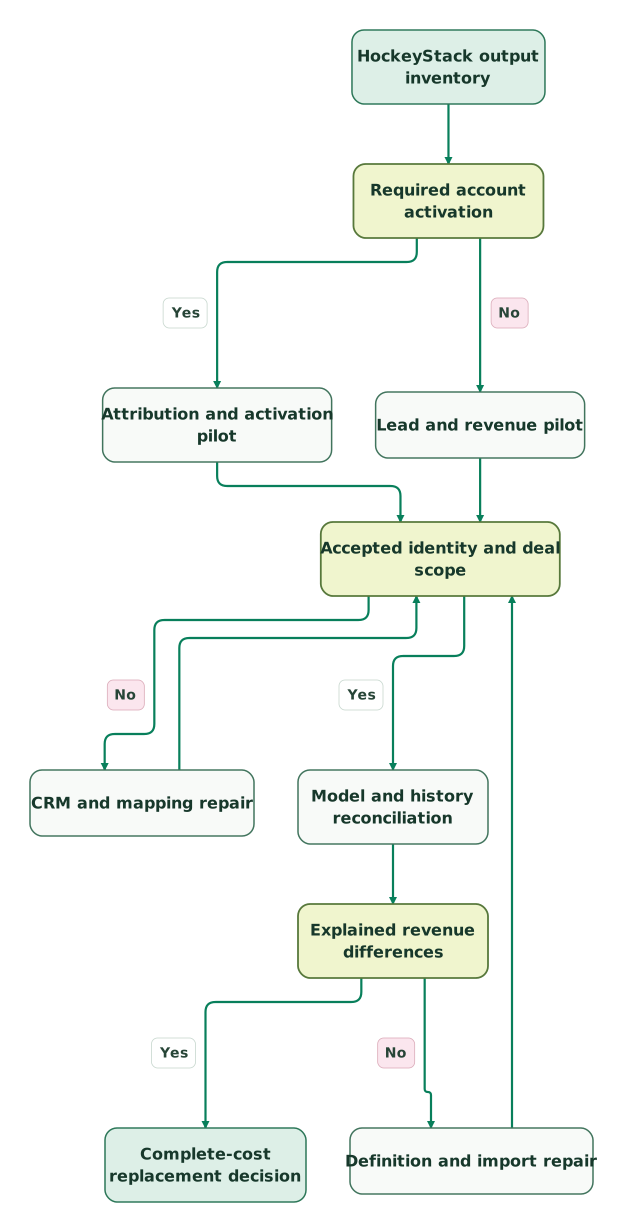
Read diagram as text
- HockeyStack output inventory to Required account activation.
- Required account activation to Attribution and activation pilot: Yes.
- Required account activation to Lead and revenue pilot: No.
- Attribution and activation pilot to Accepted identity and deal scope.
- Lead and revenue pilot to Accepted identity and deal scope.
- Accepted identity and deal scope to CRM and mapping repair: No.
- CRM and mapping repair to Accepted identity and deal scope.
- Accepted identity and deal scope to Model and history reconciliation: Yes.
- Model and history reconciliation to Explained revenue differences.
- Explained revenue differences to Definition and import repair: No.
- Definition and import repair to Accepted identity and deal scope.
- Explained revenue differences to Complete-cost replacement decision: Yes
Use the same CRM snapshot and reporting window throughout the pilot. If a source record changes, either refresh every candidate or record the difference explicitly. Repeating a report after repairing a model is meaningful only when the source population is also understood.
Best fit by operating model
| Company size or model | Best fit | Runner-up | Reason |
|---|---|---|---|
| B2B demand generation team with maintained CRM stage definitions | Dreamdata | Retained HockeyStack scope | Account journeys and stage-based reporting lead the decision |
| Lead-driven business with forms, calls and closed sales | Ruler Analytics | Dreamdata | The lead-to-sale connection is the central requirement |
| ABM team prioritizing active target accounts and activation | Factors.ai | Dreamdata | Account signals and action scope deserve a qualified pilot |
| Existing HockeyStack customer with incorrect CRM mappings | Current setup repair | Qualified alternative | A new reporting tool will still need correct source entities |
HockeyStack replacement checklist
- Every current report and downstream workflow has an agreed destination.
- Deal population, stage, timestamp, value and currency are documented.
- Known people, company-level evidence and unresolved activity stay distinct.
- Duplicate companies and multiple opportunities have accepted treatments.
- Attribution credit and overlapping influence are labeled separately.
- Historical imports, unavailable periods and retention limits are explicit.
- The complete quote includes the selected modules and operating capacity.
- A controlled reconciliation passes before the old reporting route is retired.
The attribution model selector skill can structure the decision around the question the business needs answered. Preserve the accepted reconciliation fixture so future reporting changes can be explained without restarting the entire platform evaluation.
Keep reading
Browse all Tracking & Attribution guides
 Tracking & Attribution
HockeyStack vs Dreamdata for B2B Attribution: Which Fits?
Dreamdata suits B2B account journeys and ad activation; HockeyStack adds sales workflows. Compare pricing, attribution models, sources and fit for your team.
Jafrin Akter AloLast updated 19 min read
 Tracking & Attribution
What Is an Attribution Model? Marketing Models and Examples
Understand what an attribution model does, compare credit for the same purchase, and choose reporting rules without confusing attributed revenue with causal impact.
Jafrin Akter AloLast updated 15 min read
 Tracking & Attribution
Attribution vs marketing mix modeling vs incrementality: which does a small team need?
Choose the right marketing measurement method. Compare attribution, lift tests and MMM by data requirements, statistical uncertainty and business economics.
Jafrin Akter AloLast updated 16 min read
Analytics & tracking
See the implementation scope, deliverables and acceptance checks.
Questions people ask
Can one company-level journey represent two unrelated opportunities?
A company-level journey can combine activity that should be separated for two unrelated opportunities. Dreamdata's stage-model options distinguish company activity from contacts connected to a particular opportunity. Include both deals in the evaluation and agree which population answers the reporting question. A shared company name should not automatically make every recorded touch relevant to every purchase.
Does Factors.ai Lite establish the price of a full attribution replacement?
Factors.ai Lite does not establish the price of every capability needed to replace HockeyStack. Its entry scope focuses on identification, traffic analysis and alerts, while broader requirements depend on the selected modules and allowances. List the reports, integrations and activation jobs being replaced, then obtain a package covering that work before calculating a recurring saving.
Can duplicate CRM domains alter Dreamdata's anonymous account journeys?
Duplicate CRM domains can alter Dreamdata's anonymous account journeys because its documented mapping can associate the same anonymous activity with several companies sharing that domain. Include that case in the evaluation and confirm the intended business entity. Repairing company records or mapping rules may be necessary before comparing attribution outputs, even when the incoming activity itself is accurate.
Can Ruler's website tag alone reconcile a closed-sale amount?
Ruler's website tag alone does not complete the closed-sale reconciliation. The integration must also connect the relevant lead or conversion with the later sale data and agreed value. Follow a controlled case from website entry through the CRM outcome, then inspect the returned amount and source. A visible visit or form event confirms only one part of that path.
Does a twenty-four-month payback make a replacement worthwhile?
A twenty-four-month payback does not by itself establish that a replacement is worthwhile. It reflects the stated transition cost and recurring saving under a simplified calculation. Consider the expected contract horizon, continuing operating effort, missing capabilities and risk of historical disruption. A migration can still be justified by a necessary capability, but that benefit should be stated separately from subscription savings.
Sources
- HockeyStack pricing
- HockeyStack attribution models
- Dreamdata pricing
- Dreamdata stage models
- Dreamdata anonymous-company mapping
- Dreamdata influenced and attributed value
- Ruler Analytics pricing
- Ruler integration guide
- Factors.ai pricing
- Factors.ai commercial and operating FAQ
- Factors.ai visitor identity enrichment

Written by
Jafrin Akter AloData Engineer and Co-founder at Martechdevs and Growth and Analytics Partners
Jafrin writes practical guides to marketing technology, customer data, analytics and AI workflows. Martechdevs is a Growth and Analytics Partners company.