
Are ChatGPT Ads Worth It? A Budget Test for SaaS and DTC Brands
ChatGPT ads are worth testing when your likely buyers can see them, the offer fits a real buying decision and the acquisition economics leave room for the cost. Fund a bounded experiment before moving a dependable channel's budget. Judge qualified customers and contribution after operating costs, not cheap clicks, impressive reach or a platform's attributed revenue alone.
On this page
A founder can spend a modest amount and learn something useful. The expensive mistake is calling the first batch of clicks proof that the channel works, then increasing spend before anyone checks whether the visitors became suitable customers.
OpenAI says ChatGPT Ads has no established performance benchmarks across advertisers, industries or campaign types. A public result is a reason to investigate a particular hypothesis, not a forecast for your business. OpenAI's performance FAQ.
Start with the financial threshold and the conversion tracking that makes the test interpretable. The technical OpenAI Ads Pixel and Conversions API guide covers implementation; this article covers the decision to spend, the evidence to collect and the rules for what happens next.
Who can actually buy and see ChatGPT ads?
Advertiser access, permitted targeting and the audience that sees ads are separate eligibility checks. An available Ads Manager account does not establish that you can reach your intended market.
Self-service access depends on the country of the legal entity advertising and being billed. OpenAI's current list includes the US, UK, Bangladesh and many other countries. Use the actual list rather than assuming access follows your personal ChatGPT subscription or website location. Ads Manager availability.
Some new self-service accounts can initially advertise only in their home country. International eligibility depends on approved identity verification and required home-country advertising spend; selecting another country does not override that restriction. If that market is irrelevant to your business, do not buy unsuitable traffic merely to make the campaign deliver. Campaign location eligibility.
Ads may appear to Free and Go users. Plus, Pro, Business, Enterprise and Edu are ad-free, and accounts identified as belonging to under-18 users do not receive ads. Ads are separate from answers; buying a placement does not buy influence over the response. Who sees ChatGPT ads.
For B2B software, ask whether the specific buyer and buying situation are represented in that audience. “Our customers use ChatGPT” is insufficient. Equally, do not assume every professional pays for an ad-free plan. Interview suitable customers and use the test's actual qualified outcomes to challenge that assumption.
Which format and message fit the buying decision?
The standard ad includes a title, description, image, advertiser identity and landing page below a response. OpenAI also describes a test of multi-image ads during image generation. Availability of a placement test is not a promise that every advertiser can select it. Ad components, Current ad experiences.
Context hints describe useful situations for the offer. They are not exact-match keywords or guaranteed conversation targeting. Build around a recognizable task, such as preparing a client report, rather than a list of broad terms such as “AI, growth, productivity.” Context hints.
Check the whole creative-to-landing-page experience against OpenAI's policies. Some categories need specific approval, and eligibility for one product does not authorize a different restricted offer behind the landing page. Advertising policies.
What do ChatGPT ads cost, and what does a bid cap mean?
ChatGPT ads use auction-based pricing. The objective tells the system what to optimize; the billing method tells you what you pay for.
| Campaign choice | Billing unit | What the team should evaluate |
|---|---|---|
| Views | Per thousand served impressions, or CPM | Reach with a separate outcome or brand-measurement plan |
| Clicks | Per valid click, or CPC | Useful visits and downstream customer quality |
| Conversions | Valid clicks or impressions, according to the selected billing option | The chosen supported conversion and its commercial value |
A conversion objective does not mean payment only when a customer converts. OpenAI's conversion guide supports click and impression billing, and says a conversion-oriented Bid Cap is not a guaranteed achieved acquisition cost. The selected standard event cannot be changed after campaign creation. Conversion-optimized campaigns.
OpenAI recommends a starting maximum CPC of USD 3–5 for Clicks campaigns and describes a relevance-weighted second-price auction. That recommendation is neither a minimum price nor an average you should forecast. Your economically affordable bid can be lower. Auction and CPC guidance.
How much budget do you actually expose?
The daily-budget floor depends on billing currency. The published table lists USD 25 for USD accounts and EUR 15 for EUR accounts. Those are minimum budget settings, not amounts required to obtain a useful result. A campaign-total budget provides a stricter control over total campaign spend. Campaign budgets and currency minimums.
A fixed-bid campaign can require a larger daily budget when an effective ad-group bid exceeds the currency minimum. A daily budget is an average, not a hard daily cap. With an unchanged USD 25 setting, the documented ceiling is USD 50 in an account-local day and USD 175 across the Sunday-to-Saturday budget week. Budget changes have additional rules and proration. Check the limits displayed in the account rather than treating any rolling seven days as the budget week. Daily-budget rules.
Do not rely on a low displayed spend to protect the test. OpenAI says spend insights can lag about seven to eight hours, while attributed conversions can take twenty-four to forty-eight hours. Set the spending controls before launch. Reporting delay and customer decision time are separate reasons that an early result can be incomplete. Reporting freshness.
For a first campaign, scheduling controls may not appear before publication. OpenAI warns against publishing just to expose those controls because the ads could begin running first. Treat campaign activation as the spending decision, not another setup step. First-campaign scheduling.
What do the public tests actually establish?
Public tests show that results vary materially by offer, audience and setup. They do not establish a reliable market-wide CPC, signup rate or return.
The following are first-hand operator reports. Their measures are different, so the rows are not a performance ranking.
| Operator and test | Reported observations | What the evidence does not establish |
|---|---|---|
| SE Ranking: roughly two weeks, three campaigns and 48 ads across four countries | More than 97,000 impressions, 1,263 clicks and few signups; the team stopped | No exact signup count in the cited result, so a defensible signup CPA cannot be calculated |
| Grafista: three staggered campaigns in Greece, Cyprus and the UK | EUR 213.74 spend, 1,082 clicks and 35 signups; approximately EUR 6.11 per signup | Paying customers, retained contribution and causal lift are not established by signup counts |
SE Ranking's own test used manual CPC bidding and lacked in-platform conversion data for optimization. Its account of the outcome is useful, but it does not evaluate every current conversion-optimized setup. The separate prompt-observation study on the same page is a different dataset from the paid campaign. SE Ranking's campaign results and limitations.
Grafista varied country, objective, creative count and run duration. Its cheaper clicks in an impressions campaign therefore do not prove that impressions buying causes better results. The practical lesson is to inspect what happened after signup, not choose a billing method from one small uncontrolled comparison. Grafista's test.
A report becomes more useful when it states the offer, markets, objective, spend, conversion definition, observation window and later customer quality. Treat missing fields as missing. A rounded CPC with no customer count cannot answer whether your company should increase its budget.
Which acquisition economics must the test meet?
The test must produce customers at a cost your business can afford within a defined contribution and cash-recovery window. Revenue alone does not set that limit.
Customer acquisition cost (CAC) includes the costs assigned to acquiring the customer. For this experiment, keep media cost separate from creative, implementation and operating effort so both the campaign and the full test can be assessed.
For a direct-to-consumer brand, start with first-order contribution after discounts, product cost, fulfillment, payment fees and expected returns or support costs. Add repeat-purchase value only when the relevant cohort supports it.
For SaaS, use a stated contribution window and actual retention assumptions. A six-month contribution allowance is more actionable than an unlimited lifetime-value estimate for a product whose retention is still changing. The LTV-to-CAC guide explains that boundary in more detail.
How do you calculate an affordable click price?
Multiply the allowable media cost per acquired customer by the probability that a click produces that customer. If you start from an all-in CAC allowance, first leave room for non-media costs.
These are hypothetical planning assumptions in USD, not ChatGPT prices or expected performance:
| Business model | Contribution before acquisition | All-in CAC allowance | Assumed click-to-paid rate | CPC ceiling before non-media allocation |
|---|---|---|---|---|
| DTC first order | 28 | 20 | 2.5% | 0.50 |
| SaaS over six months | 240 | 180 | 0.4% | 0.72 |
The DTC example starts with USD 80 net revenue, then deducts USD 36 product cost, USD 8 fulfillment, USD 3 payment fees and USD 5 expected returns/support. That leaves USD 28. Reserving USD 8 leaves USD 20 for all acquisition costs.
The SaaS example assumes USD 240 contribution over six months and reserves USD 60, leaving USD 180. Its click-to-paid rate is an assumption built from 8% click-to-signup, 25% signup-to-qualified activation and 20% activated-to-paid: 0.08 × 0.25 × 0.20 = 0.004, or 0.4%.
Media CPC ceiling = allowable media CAC × click-to-paid probability

DTC upper bound before non-media costs = USD 20 × 0.025 = USD 0.50
SaaS upper bound before non-media costs = USD 180 × 0.004 = USD 0.72
Those ceilings already sit below OpenAI's suggested starting maximum bid. That is a reason to test delivery at an affordable level, improve the offer or choose another channel. It is not a reason to raise the bid beyond the business case.
Suppose the DTC test spends USD 600 on media and USD 240 on creative, setup and operation, producing 28 acquired customers. Media CAC is USD 21.43; all-in test CAC is USD 30. Both exceed the USD 20 allowance. Moving the setup cost out of the dashboard does not make the test profitable. If the test produces no customers, report the spend and zero outcomes; do not display a zero CAC.
For a repeat run, separate one-time work from recurring operating costs. Report both the full initial experiment and the credible recurring-cost view. Do not erase the learning cost or charge it to every future customer indefinitely.
What would qualify as incremental return?
Incremental return concerns customers or contribution that would not have occurred without the ads. Platform attribution allocates credit under reporting rules; it does not directly answer that causal question.
Where a valid comparison is feasible, define the treatment, comparison group, outcome and observation window before spending. Check spillover, market differences, seasonality and concurrent campaigns. A simple before-and-after comparison can be distorted by a sale, product launch or changes to another channel.
For a small test without a credible control, report observed qualified outcomes and attributed contribution with that limitation. Use them to decide whether a larger test is justified. The attribution and incrementality guide separates these decisions without turning a platform ROAS figure into a causal claim.
How should a small team design the experiment?
Design one test around a specific audience, offer, landing page and primary outcome. Keep enough structure to explain the result without splitting a small budget across dozens of underexposed variations.
- Name the buying situation. Define the customer problem and why this offer helps at that moment.
- Confirm feasibility. Check account, market, policy, billing and available objective before allocating production work.
- Choose the commercial outcome. Define the customer or qualified action and its evidence in the CRM or order system.
- Set the economic limit. Record the contribution window, allowable CAC, non-media cost and maximum test spend.
- Prepare distinct messages. Test a few meaningful angles linked to the same decision, with landing pages that fulfill their promises.
- Prove the measurement. Check a real permitted business action through collection, deduplication, campaign setting and the source record.
- Declare the review rule. Choose the evidence window, spending stop and conditions for repair or expansion before delivery starts.
OpenAI recommends specific, useful ad copy and a relevant destination rather than defaulting to the homepage. Review any suggested draft against the offer and landing page; its presence is not an approval of your commercial promise. Creative and landing-page guidance.
For a SaaS reporting tool, one hypothetical angle could address preparing a weekly client report; another could address explaining a discrepancy between two platforms. Those are different tasks with different landing-page expectations. “Grow faster with AI” does not tell the buyer what they can accomplish.
Use the deepest supported standard event that represents a useful outcome and supplies enough signal for the chosen objective. Keep a separate business-quality check even when the platform goal is a signup. Conversion optimization supports one selected standard event, while custom events cannot serve as that optimization goal. Supported optimization goals.
A useful experiment record separates these stages:
| Stage | Count one of these | Evidence | Why it matters |
|---|---|---|---|
| Ad delivery | Recorded impression or valid click | Ads Manager export | What the platform delivered |
| Landing | Observed permitted visit | Analytics and relevant server evidence | Whether the destination loaded |
| Qualified action | Suitable signup, lead or activation | Product or CRM record | Whether the audience fits |
| Customer | Confirmed paying customer or accepted paid order | Billing or order record | Whether demand became commercial |
| Contribution | Value after the chosen variable costs and adjustments | Finance model and refunds | Whether acquisition can be sustained |
Do not treat one person submitting a form twice as two opportunities. A refund, cancellation or unsuitable lead should remain visible in the outcome cohort. The B2B form tracking guide helps preserve the evidence between the landing page and sales.
How do you separate weak demand, tracking problems and invalid traffic?
Investigate the failure stage before changing the bid. An unattributed sale, an irrelevant visitor and an automated landing request can all produce a low reported conversion rate for different reasons.
Compare aligned time ranges and account timezones. Ads Manager clicks and analytics sessions count different things; page loading, redirects, consent and browser controls can create legitimate gaps. OpenAI also says ad-review crawlers may visit URLs with tracking parameters, but those visits are not billable ad clicks. Reporting differences, Ad-review crawler distinction.
TrafficGuard reports flagging 1,592 of 40,021 ChatGPT ad clicks landing on 78 websites across 47 advertisers during a three-week window. That is approximately 4.0% of the pooled clicks; advertiser rates ranged from 0.1% to 34%. It also reported a higher share of hosting/proxy/malicious-IP traffic than in the same advertisers' Google Ads sample. TrafficGuard's analysis.
TrafficGuard sells invalid-traffic protection and applies its own classifications. The report does not establish which flagged visits OpenAI billed. Do not multiply the worst advertiser's rate by your spend to claim a loss, or treat every hosting/VPN address as fraudulent. The useful response is to reconcile suspicious activity with your own delivery and business records.
| Symptom | First evidence to inspect | Useful next action |
|---|---|---|
| Clicks but few observed landings | Redirects, loading, consent, browser and crawler traffic | Repair collection or loading before judging demand |
| Visits but unsuitable signups | Offer, market, role and product-use evidence | Tighten the message or reconsider audience fit |
| Qualified actions but no reported conversions | Source record, event setting, report window and processing lag | Repair or reconcile the measurement |
| Repeated suspicious requests | Timing, repeat patterns and multiple traffic-quality signals | Preserve evidence and investigate billing separately |
| Customers but weak contribution | Discounts, refunds, support, fulfillment and full acquisition cost | Change the economics or stop the offer |
Do not send customer conversations or sensitive form contents into advertising tools to improve a match. Preserve only the permitted identifiers and outcome evidence needed for the implementation.
Which attribution view belongs in the decision?
Use a fixed reporting view and show its assumptions alongside the result. Ads Manager supports click windows of 7, 14 or 30 days and view windows of zero or one day. Eligible view-through outcomes can enter the total; a zero-day view window gives a click-only view. Changing reporting windows does not change optimization or billing. Attribution settings.
Compare both views when relevant, then reconcile unique customers in your own records. Do not add OpenAI, Meta and Google attributed conversions together. Do not change the window after seeing which one makes the test pass. Keep paid ChatGPT acquisition separate from unpaid AI referrals.
When should you stop, repair or expand the test?
Stop spending when the predefined budget or an operational failure requires it. Expand only after mature, credible outcomes meet the economic threshold and a further test can answer a useful question.
A reporting defect calls for repair. A poor offer calls for a different hypothesis. Neither justifies spending indefinitely while waiting for the dashboard to improve.
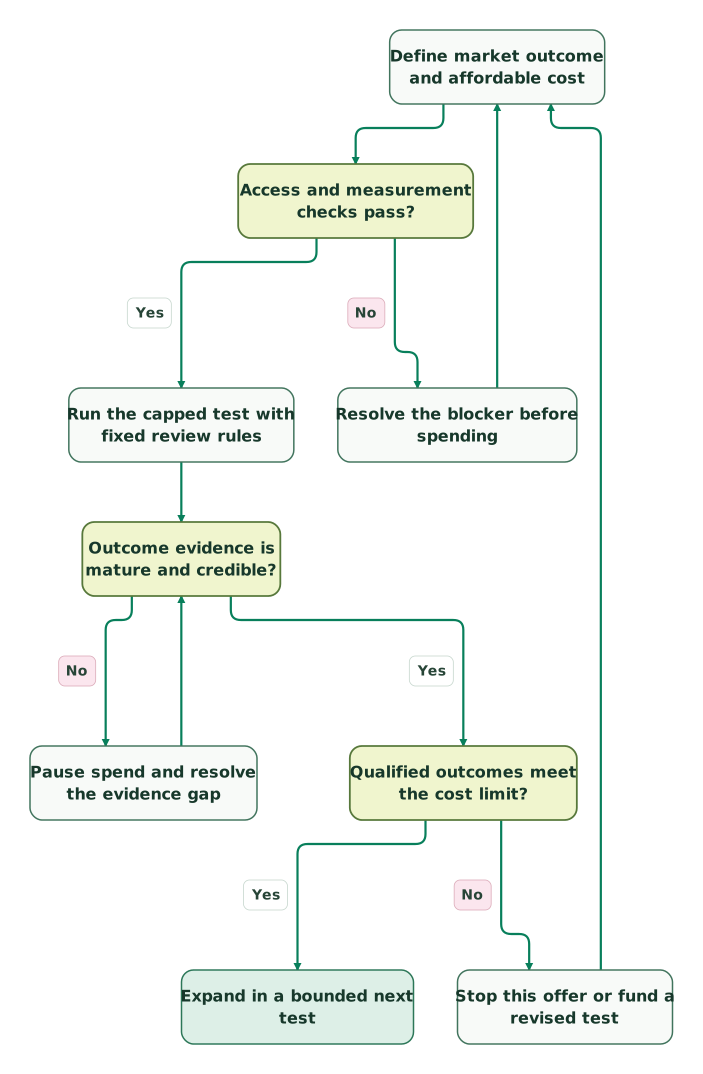
Read diagram as text
- Define market outcome and affordable cost to Access and measurement checks pass?.
- Access and measurement checks pass? to Resolve the blocker before spending: No.
- Resolve the blocker before spending to Define market outcome and affordable cost.
- Access and measurement checks pass? to Run the capped test with fixed review rules: Yes.
- Run the capped test with fixed review rules to Outcome evidence is mature and credible?.
- Outcome evidence is mature and credible? to Pause spend and resolve the evidence gap: No.
- Pause spend and resolve the evidence gap to Outcome evidence is mature and credible?.
- Outcome evidence is mature and credible? to Qualified outcomes meet the cost limit?: Yes.
- Qualified outcomes meet the cost limit? to Stop this offer or fund a revised test: No.
- Stop this offer or fund a revised test to Define market outcome and affordable cost.
- Qualified outcomes meet the cost limit? to Expand in a bounded next test: Yes
Waiting for a cohort to mature does not require more ad spend. Recheck the same evidence after the wait or repair. If you revise the offer, target market, event or cost allowance, record a new test. Keep the earlier result; do not blend it away by renaming the campaign.
How much does a zero-outcome test tell you?
A zero-outcome result can challenge a required conversion rate, but only after the outcome window has matured and measurement is dependable.
Suppose a plan requires a 2.5% click-to-paid rate. Under a simplified model of independent, comparable clicks with a stable conversion probability, the probability of observing zero customers in 120 clicks is:
Probability of zero customers = (1 - 0.025)^120
Probability of zero customers ≈ 4.79%
That makes zero out of 120 a useful warning against the assumed rate. It does not prove the true rate is zero, establish why the test failed or measure incremental lift. Repeated visitors, changing delivery and delayed purchases weaken the model.
Choose the checkpoint before looking at the data. Repeatedly checking many variants until one looks convincing changes the interpretation. If the spend cap arrives first, stop there; do not purchase more traffic merely to complete this illustrative sample.
For a long sales cycle, use qualification and pipeline evidence as interim observations, while keeping customer economics unresolved until the agreed window closes. “Promising” can justify another bounded experiment. It cannot justify recording unpaid pipeline as realized return.
Before committing to another round:
Checklist
- The target market and account remain eligible.
- Spend and conversion reports have passed their processing windows.
- Qualified outcomes agree with product, CRM or order records.
- Repeat events, refunds, cancellations and poor-fit leads are visible.
- The contribution window and all assigned costs are unchanged or explicitly revised.
- The cost threshold passes without relying on an unsupported repeat-purchase assumption.
- Any causal claim has an appropriate comparison and uncertainty statement.
- The next budget buys a defined learning outcome, not just more exposure.
If the event-to-customer handoff prevents a clear decision, bring the campaign export and a few representative outcomes to the $99 martech audit. At Martechdevs, we connect the tracking and business records so the team can decide what deserves more budget.
Keep reading
Browse all Tracking & Attribution guides
 Tracking & Attribution
OpenAI Ads Conversion Tracking: Set Up the ChatGPT Ads Pixel and Conversions API
Track ChatGPT ads conversions with the OpenAI Measurement Pixel and Conversions API: load it through GTM, share event IDs, pass oppref and test each event.
Jafrin Akter AloLast updated 15 min read
 Martech AI
Connect Marketing Data to ChatGPT: Four Ways and How to Check the Answers
Connect GA4, Google Ads, Meta, HubSpot or a warehouse to ChatGPT with files, plugins, marketing connectors or MCP, then check the numbers before anyone acts.
Jafrin Akter AloLast updated 18 min read
 Tracking & Attribution
HubSpot Google Ads Integration: 7 Checks for Missing Leads and Conversions
Fix HubSpot Google Ads integration problems across account access, tracking templates, native lead forms, lifecycle events, conversion values and campaign goals.
Jafrin Akter AloLast updated 12 min read
Analytics & tracking
See the implementation scope, deliverables and acceptance checks.
Questions people ask
Is the minimum daily budget enough to prove the channel works?
No. The minimum is a platform setting, while useful evidence depends on your conversion rate, buying cycle and cost threshold. A small budget can expose a broken landing page or clearly unsuitable demand without establishing stable customer acquisition cost. Set a maximum affordable learning cost, then decide whether the available outcome volume can answer the question you actually need resolved.
Will paying for ChatGPT ads improve our organic citations?
No. OpenAI states that advertising does not influence ChatGPT's answers. A paid placement and an organic mention are separate routes with different evidence. Track the ad's qualified outcomes independently from visibility work, and do not attribute every later brand mention to the campaign. Buying traffic does not purchase a recommendation or a preferred position inside the generated answer.
Should B2B companies rule out ChatGPT ads because paid users see no ads?
No, but they should test the audience assumption before committing substantial spend. Some intended buyers may use an ad-supported plan, while others use an ad-free subscription or workspace. The relevant question is whether the campaign reaches suitable buyers in the required market. Qualified leads and subsequent sales outcomes are better evidence than a general claim about what all professionals use.
Should we stop immediately when Ads Manager shows zero conversions?
Pause immediately for a known tracking, billing or policy problem, but interpret an early zero with the reporting and sales-cycle delays in mind. Check confirmed outcomes in your own records and whether the campaign uses the intended event. Keep the spending cap active while investigating. A missing dashboard result is not automatically proof of no customers or permission to continue spending.
How should ad credits or agency discounts affect the test decision?
Report the actual cash paid and the undiscounted recurring economics separately. A credit can reduce the cost of learning without proving the channel remains attractive when the subsidy ends. Include the operating work your team would still need to perform, and model a repeat run at the costs you would actually face. Do not scale solely because the first test was subsidized.
Sources
- OpenAI: Performance FAQ
- OpenAI: Ads Manager availability
- OpenAI: Campaign creation and budgets
- OpenAI: Ads in ChatGPT
- OpenAI: Ads basics and auction
- OpenAI: Context hints and ad groups
- OpenAI: Advertising policies
- OpenAI: Conversion-optimized campaigns
- OpenAI: Daily budgets
- OpenAI: Reporting and attribution
- SE Ranking: Own campaign test and limitations
- Grafista: Small-budget campaign test
- OpenAI: Creative and landing-page guidance
- TrafficGuard: Invalid-traffic analysis

Written by
Jafrin Akter AloData Engineer and Co-founder at Martechdevs and Growth and Analytics Partners
Jafrin writes practical guides to marketing technology, customer data, analytics and AI workflows. Martechdevs is a Growth and Analytics Partners company.