
AppsFlyer vs Branch: Attribution, Deep Links and the Full Cost
Start with AppsFlyer when the buying decision centers on paid-app measurement and a conversion-based commercial model. Start with Branch when the immediate problem is connecting links, web journeys and app destinations, then evaluate its attribution package too. Both require mobile implementation and reporting discipline. Choose the configuration that passes your actual channels, privacy states, revenue reconciliation and data-export requirements.
On this page
AppsFlyer and Branch comparison
AppsFlyer's published Growth rate is USD $0.07 per measured conversion after its Welcome Package; Branch's current attribution plans require a quote.
| Decision | AppsFlyer | Branch | Buyer check |
|---|---|---|---|
| Entry allowance | 12,000 conversions or one year in Welcome, whichever ends first | Basics trial; no universal dollar tariff on the current pricing page | Trial expiry and ongoing entitlements |
| Paid attribution | Growth and Enterprise measurement plans | Basics, Essentials and Enterprise attribution plans | Required ad partners, events and postbacks |
| Deep linking | OneLink with app routing and deferred journeys | Branch Links and NativeLink for supported deferred journeys | Installed, uninstalled and privacy-restricted paths |
| Raw data | Premium APIs and Data Locker | Export APIs with package and access requirements | Required fields, history, delivery and permissions |
| iOS measurement | Privacy-preserving and other supported attribution views | Privacy-preserving and other supported attribution methods | Supported partner, framework and reporting grain |
| Migration | SDK, partner and reporting changes | SDK, link, partner and reporting changes | Historical continuity and one accountable optimization feed |
Sources: AppsFlyer pricing, AppsFlyer account plans, Branch pricing, AppsFlyer OneLink, and Branch NativeLink.
The two buying decisions
Attribution and deep linking need different acceptance tests. Attribution assigns credit to a campaign or source. Deep linking delivers a person to a specific app destination. A link can open the correct product screen while attribution remains unavailable or aggregated. A campaign can receive credit while the customer lands on the wrong screen.
Separate the requirements before evaluating either platform:
| Requirement | Useful acceptance result | Responsible owner |
|---|---|---|
| Campaign measurement | Defined installs and conversion events attributed under agreed windows | Growth and analytics |
| Customer journey | Correct content after app opening, installation or authentication | Product and mobile engineering |
| Ad optimization | Approved event reaches the correct partner once | Growth and integration owner |
| Revenue reporting | Orders and refunds reconcile with the transaction source | Analytics and finance |
| Warehouse access | Required fields arrive with known restrictions and freshness | Data engineering |
An existing AppsFlyer customer with broken email links should first test the current OneLink setup. An existing Branch customer with a reporting gap should first confirm attribution and export entitlements. Changing vendors is most useful when it resolves a demonstrated requirement. Our analytics and tracking implementation service can scope the event contract, partner feeds and reconciliation work behind that requirement.
Platform fit and boundaries
AppsFlyer
AppsFlyer Growth provides paid attribution with a published conversion-based rate; Enterprise is custom-priced. Its OneLink Standalone offering has separate packages and supports owned-media attribution without partner attribution integrations. Treat that standalone linking scope separately from a paid-acquisition measurement purchase. AppsFlyer plan definitions.
The reporting configuration also affects the answer. AppsFlyer's My Dashboards distinguishes Classic, SKAN, Single Source of Truth and cross-platform views. Its Single Source of Truth combines and deduplicates relevant attribution sources; cross-platform reporting uses a customer identity and its own setup requirements. Agree which view supports the decision before comparing totals. AppsFlyer reporting methods.
- Best for: A team buying paid-app measurement with explicit partner and revenue requirements.
- Pros: A public Growth unit price and linking within the same broader platform.
- Cons: Raw-data access, fraud protection and other requirements can add premium scope.
- Free plan and startup offer: Welcome includes 12,000 conversions or one year and thirty days of selected premium features. The ongoing Zero plan does not provide attribution measurement.
- Choose it if: The required partner feeds, reports and OneLink journeys pass the implementation pilot at the full quoted cost.
- Skip it if: The purchase assumes a temporary API trial remains part of the basic ongoing price.
Our AppsFlyer pricing guide covers the commercial model in more depth.
Branch
Branch offers both linking and mobile attribution. Its current pricing page presents Basics, Essentials and Enterprise; the entry partner table limits Basics to three ad partners, three partner webhooks and three ad-partner postbacks. Higher plans expand those allowances. CTV and OTT attribution is an Enterprise capability. Obtain a quote covering the actual products and export access. Branch pricing and package limits.
Branch's attribution explanation distinguishes its matching methods and Apple's campaign-level privacy frameworks. That distinction matters when a buyer expects every attributed conversion to contain a device-level identity. Confirm the method and available fields for each important channel. Branch attribution methods.
- Best for: A team prioritizing connected app journeys while evaluating its measurement and activation requirements.
- Pros: Linking, attribution and data delivery can be evaluated within one platform.
- Cons: A quote and feature-level confirmation are needed; a link product does not establish every attribution entitlement.
- Free plan and startup offer: The current attribution page offers a Basics trial. Confirm ongoing linking and measurement terms rather than assuming an old free-plan allowance applies.
- Choose it if: The customer journey, partner configuration and exported data work under the selected package.
- Skip it if: A successful link demonstration is being used as proof of complete paid-media measurement.
Deep linking and iOS privacy
For an installed app, the test is whether the link opens the intended content with valid app-domain configuration. For an uninstalled app, deferred deep linking must carry the intended destination through the store and first launch. Login, expired content and unavailable products need explicit fallback behavior.
AppsFlyer requires Android or iOS developer work for deep and deferred linking. Its OneLink guidance describes App Clip and clipboard approaches for Private Relay cases. The clipboard approach requires additional app code and user participation, and AppsFlyer explicitly says that this approach does not help attribution. A recovered destination and recovered campaign credit remain separate outcomes. OneLink requirements and Private Relay behavior.
Branch NativeLink uses a user-selected clipboard handoff: a landing-page action copies the link, installation follows, and the app processes it. Its documentation notes the iOS pasteboard permission experience and requires a premium plan for deferred deep linking. Test refusal and alternative integrations alongside the successful path. NativeLink implementation.
Neither platform changes Apple's tracking rules. Apple's guidance requires ATT permission for covered tracking and prohibits device fingerprinting. AdAttributionKit can support privacy-preserving attribution without an ATT prompt for that mechanism, but other tracking in the app still requires the applicable authorization. Apple user privacy guidance, Apple ad attribution.
Attribution and revenue reconciliation
Compare the same business outcome under the same definitions. A larger install count can result from a different lookback window, reinstall rule or date assignment. It does not by itself establish better accuracy.
Before the pilot, agree on:
- Conversion definition: New install, re-engagement, re-attribution or a named business event.
- Reporting date: Engagement date, install date or event date.
- Attribution window: Click-through and view-through periods for each partner.
- Data grain: Device-level records, campaign aggregates or modeled reporting.
- Revenue basis: Currency, tax, refunds and transaction deduplication.
- Partner behavior: Event mapping, consent state and the destination used for optimization.
For a hypothetical reconciliation, suppose the transaction system has 1,000 paid orders. The mobile event export contains 1,020 purchase rows, including twenty retry duplicates. Deduplicating by the agreed transaction key yields 1,000 orders. If only 700 can be linked to an attributed campaign under the available permissions and reporting method, the other 300 need an explicit unattributed or restricted category. Reclassifying them as missing purchases would confuse transaction completeness with attribution coverage.
Keep these checks in the warehouse model: one transaction key, preserved original currency, a consistent refund treatment and separate fields for event and attribution dates. Our AppsFlyer implementation mistakes guide covers common instrumentation failures.
Data access and retention
AppsFlyer Data Locker is a premium delivery capability with report-specific freshness and a fourteen-day availability window. Historical backfill is not supported through Data Locker; some historical reports may be available through the Pull API. Restricted media-source fields can be unavailable, and Data Locker's timestamps use UTC regardless of app-specific timezone settings. AppsFlyer Data Locker.
Branch distinguishes Daily Exports, Custom Exports and aggregate APIs. Its API index lists rolling seven-day Daily Export access and 120-day Custom Export access, with aggregate products covering longer windows. These are different data products, not interchangeable retention promises. Branch API overview.
Branch's Daily Exports guide requires a Data Feeds subscription, enabled export access and administrative permission. It documents live-key data, delayed daily availability and hashing of several fields after seven days. Schedule collection within the relevant window and verify readiness before treating an empty response as zero activity. Branch Daily Exports.
Give both vendors a small required-output specification:
| Required output | Acceptance criterion | Contract question |
|---|---|---|
| Campaign totals | Same dimensions and time basis as the selected report | Included API and query limits |
| Purchase events | Transaction key and revenue fields usable for reconciliation | Restricted fields and event coverage |
| Historical data | Defined start date and recoverable export | Backfill and retention scope |
| Agency access | Only approved apps and campaigns visible | Permission model and credential scope |
| Failed delivery | Alert, retry and recoverable missing period | Delivery window and support responsibility |
Worked pricing and quote comparison
AppsFlyer defines billable conversions to include attributed installs, re-engagements and re-attributions; organic conversions are not billed under the stated definition. The Growth rate after Welcome is $0.07 each. AppsFlyer pricing definition.
For a hypothetical established app with its Welcome allowance exhausted:
| Monthly input | Count | Growth calculation |
|---|---|---|
| Attributed new installs | 80,000 | $5,600 |
| Billable re-engagements | 15,000 | $1,050 |
| Billable re-attributions | 5,000 | $350 |
| Total measured conversions | 100,000 | $7,000 |
This is the basic conversion charge before premium features, tax or contract adjustments. At that constant volume, twelve months cost $84,000. A new eligible account using all 12,000 Welcome conversions within the first year would instead have a calculated first-year conversion charge of $83,160. The allowance is one-time; it is not a recurring monthly deduction.
Branch requires a quote for the selected package. Compare the quote's full charge, included volume, overage, exports and support with the complete AppsFlyer configuration. A plan name or a number copied from an older pricing article is insufficient.
For a clearly hypothetical Branch quote of $6,000/month covering the same required scope and volume, the comparison with the $0.07 Growth base crosses at about 85,715 billable conversions. At 100,000 conversions, the simple difference is $1,000/month. If switching costs $9,000 and adds $250/month of maintenance, simple payback is twelve months. These assumed Branch and implementation amounts are planning inputs, not published vendor prices or a feature-equivalence claim.
Best fit by app scenario
| Situation | First evaluation | Runner-up | Decisive result |
|---|---|---|---|
| New paid-acquisition program | AppsFlyer Growth | Branch attribution quote | Partner events, reporting and the ongoing bill |
| Established app with broken owned-channel journeys | Existing provider's link configuration | Branch or OneLink alternative | Correct destination through install and login |
| Product-led app with links across web, email and QR | Branch | OneLink Standalone | Link management and fallback behavior at the required scope |
| Warehouse-led measurement team | Both with explicit export packages | Existing provider repair | Usable fields, recoverable delivery and consistent revenue |
| Existing MMP with a narrowly missing capability | Existing provider upgrade | Full replacement | Benefit exceeding migration and continuing operating cost |
The first evaluation is a practical starting point. The pilot and complete quote decide the result.
Migration and partner ownership
Running two SDKs during a transition requires separate control over partner postbacks. AppsFlyer documents that media sources differ in support for multiple MMPs and warns about duplicate optimization data. Its guidance identifies partners such as TikTok as allowing one MMP postback route. Assign one owner for each optimization event and verify current partner requirements before enabling overlap. Multiple-MMP measurement guidance.
Branch's migration guide recommends phased links, existing-user planning and a period of dual SDK coverage. It warns that existing users can appear as new installs if the historical-user import is skipped; complete the agreed import before releasing the new SDK when continuity is required. That coverage recommendation does not authorize duplicate partner feeds. Inventory owned links, paid links, custom domains, optimization events and data exports, then agree which component changes at each release. Branch migration guide.
A mobile release also has a long tail: some customers keep an older app version. Preserve the old link destination and relevant handling until the supported-version policy allows retirement. The current customer journey should remain usable during the transition.
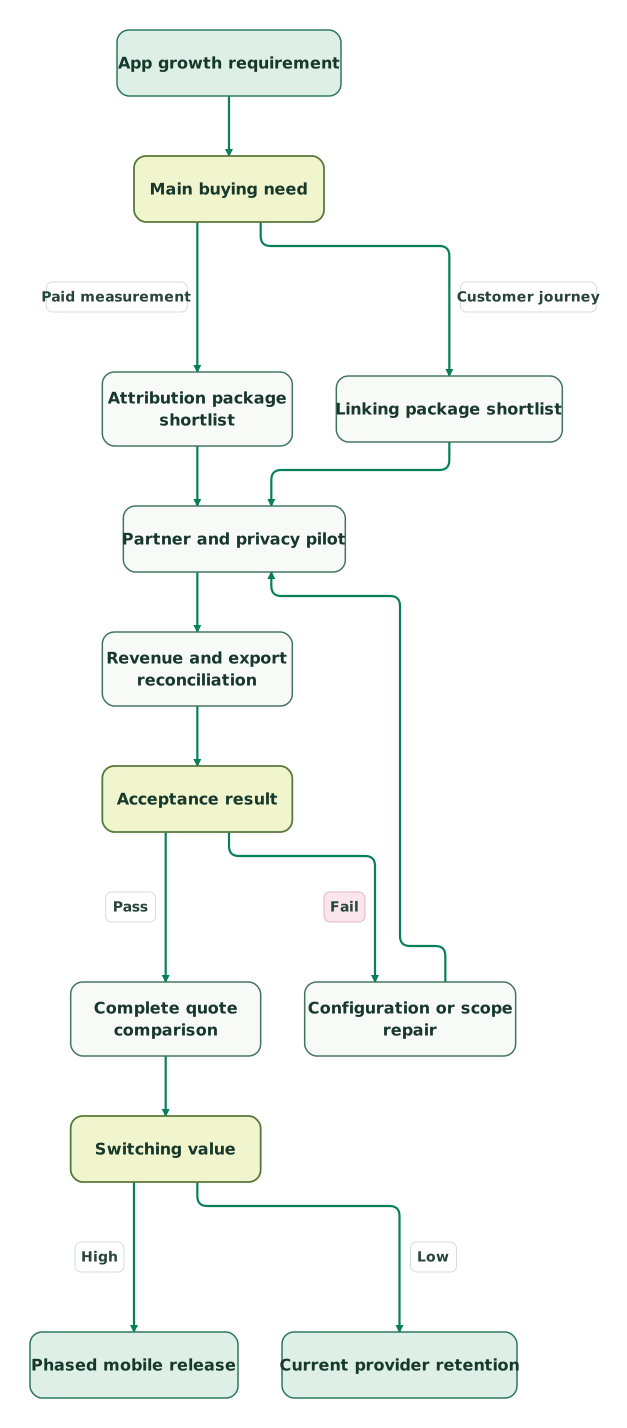
Read diagram as text
- App growth requirement to Main buying need.
- Main buying need to Attribution package shortlist: Paid measurement.
- Main buying need to Linking package shortlist: Customer journey.
- Attribution package shortlist to Partner and privacy pilot.
- Linking package shortlist to Partner and privacy pilot.
- Partner and privacy pilot to Revenue and export reconciliation.
- Revenue and export reconciliation to Acceptance result.
- Acceptance result to Configuration or scope repair: Fail.
- Configuration or scope repair to Partner and privacy pilot.
- Acceptance result to Complete quote comparison: Pass.
- Complete quote comparison to Switching value.
- Switching value to Current provider retention: Low.
- Switching value to Phased mobile release: High
Implementation acceptance checklist
- Paid and owned-channel requirements separated before package selection.
- Installed and uninstalled journeys checked on supported iOS and Android versions.
- Safari, relevant in-app browsers and email-link wrapping included in the sample.
- Login, missing content and expired campaign fallbacks defined.
- ATT states and Private Relay paths tested under the approved privacy design.
- Conversion windows, timezone, revenue and refund definitions recorded.
- Required events reach each ad partner through one approved route.
- Export entitlements and restricted fields confirmed after trial expiry.
- Existing-user treatment, historical access and link-domain ownership agreed.
- Crash, duplicate-event and broken-link checks included in the mobile rollout.
Use the tracking plan audit skill to define events and acceptance evidence. Our AppsFlyer versus Adjust comparison covers another MMP shortlist. Analytics and tracking implementation can connect the mobile event contract, partner mapping and warehouse reconciliation when the selection becomes an implementation project.
Keep reading
Browse all Product Analytics guides
 Product Analytics
AppsFlyer vs Adjust vs Branch vs Airbridge for a Small App Team
Compare AppsFlyer, Adjust, Branch and Airbridge on billing units, entry plans, SKAN and AdAttributionKit, deep links, AI agents, MCP, exports and exit terms.
Jafrin Akter AloLast updated 19 min read
 Product Analytics
AppsFlyer Pricing: What a Conversion Costs, Plans and Contract Terms
AppsFlyer charges $0.07 per attributed conversion after 12,000 free in year one; Zero is free but has no attribution. See worked bills, add-ons and renewal terms.
Jafrin Akter AloLast updated 14 min read
 Product Analytics
AppsFlyer Implementation Mistakes: SDK Start, ATT, Postbacks and Revenue
Fix the AppsFlyer setup errors that distort ROAS: SDK start order, ATT waits, missing SKAN and AdAttributionKit postbacks, duplicate revenue and deep links.
Jafrin Akter AloLast updated 16 min read
Analytics & tracking
See the implementation scope, deliverables and acceptance checks.
Questions people ask
Is Branch only a deep-linking alternative to AppsFlyer?
Branch offers attribution as well as linking, and its current plans include different partner and measurement capabilities. Evaluate the actual package against your paid channels, optimization events and reporting needs. AppsFlyer also provides OneLink, so the decision should not rely on a simple attribution-versus-links label. Give both vendors the same journey and measurement acceptance tasks.
Does AppsFlyer Growth include permanent raw-data API access?
Selected premium capabilities are available during the Welcome trial, but ongoing raw-data access and other premium features require the relevant subscription. A successful trial export therefore does not prove the final paid configuration includes it. Ask for the named APIs, report fields, retention and delivery method in the quote, and test access with the intended ongoing entitlements.
Can either platform guarantee deferred deep linking for every iOS user?
Deferred deep linking depends on the supported journey, browser, app implementation and user choices. Branch NativeLink uses a clipboard-based handoff with a permission experience; AppsFlyer documents App Clip and clipboard approaches for Private Relay cases. Test declined permissions, interrupted installs and missing content. Provide a usable fallback instead of assuming every user will complete the successful demonstration path.
Should AppsFlyer and Branch send the same purchase event to ad networks during migration?
Only the approved partner route should send an optimization event unless that partner explicitly supports the intended deduplication setup. Two SDKs can be present for transition coverage while outbound feeds remain controlled separately. Record the owner for each event, compare received totals with the transaction source and inspect duplicates before increasing traffic or removing the old configuration.
Which number should finance use when AppsFlyer and Branch disagree?
Finance should start with the transaction system for purchases and refunds, then use an agreed attribution model to allocate the eligible revenue. Match event definitions, currency, timezone, attribution windows and reporting dates before comparing platforms. Separate transaction completeness from attribution coverage. Restricted or aggregate data can limit campaign assignment without indicating that the underlying purchase is missing.
Sources
- AppsFlyer pricing
- AppsFlyer account plans and billing
- Branch pricing
- AppsFlyer OneLink
- Branch NativeLink
- AppsFlyer reporting methods
- Branch attribution methods
- Apple user privacy and data use
- Apple ad attribution
- AppsFlyer Data Locker
- Branch API overview
- Branch Daily Exports
- Multiple-MMP measurement
- Branch migration guide

Written by
Jafrin Akter AloData Engineer and Co-founder at Martechdevs and Growth and Analytics Partners
Jafrin writes practical guides to marketing technology, customer data, analytics and AI workflows. Martechdevs is a Growth and Analytics Partners company.