
Amplitude vs Pendo for product analysis and in-app adoption
Pick Amplitude if behavioural analysis and experiment-informed product decisions are the main job; pick Pendo if an ongoing adoption program needs analytics and targeted in-app guidance together. Amplitude vs Pendo is no longer a simple analytics-versus-guides choice because both offer those capabilities. Compare the actual audience rules, identity model, operational ownership and current billing units before choosing a plan.
On this page
Amplitude vs Pendo comparison
The table separates event volume from monthly active users because those are different commercial measures.
| Decision | Amplitude | Pendo |
|---|---|---|
| Free production entry | 2 million events/month; unlimited seats | Up to 500 monthly active users |
| Replay in the entry offer | 10,000 monthly replays on Free | Confirm replay in the selected plan; Core includes it |
| Paid starting scope | Plus starts at $0 with first 2 million events free; event-based scaling | Base and higher plans use quoted custom MAU volumes |
| Guides | Available across plans with limited entry scope | Free includes in-app guides; paid scope varies |
| Main buying emphasis | Behavioural analysis and connected product decisions | Adoption programs and guide operations |
Sources: Amplitude pricing, Amplitude guides and Pendo pricing. Advanced features and add-ons need a plan-specific check; the presence of a product name in a package does not establish identical entitlements.
At Martechdevs, we build the event and identity foundations for product analytics implementation. We would start an Amplitude pilot with a product question that needs a dependable cohort or funnel. We would start a Pendo pilot with an adoption journey, its eligible audience and the guide that helps that audience complete a task.
The comparison should end with an operating decision. Name the person who owns event definitions, the person who approves guide content and the person who investigates a discrepancy. A platform can connect those activities while leaving their responsibilities distinct.
Tool decisions
Amplitude
- Best for: Product teams making recurring decisions from activation, retention, behavioural cohorts and experiments.
- Pros: The platform combines analytics, replay and guides, and guide audiences can use properties or cohorts. The same analysis can therefore inform a targeted product message. Pricing, guide targeting.
- Cons: Event meaning and identity need maintenance. A cohort visible in an analytical report is insufficient evidence that a time-sensitive guide will reach the intended users immediately.
- Free plan and startup offer: Free includes 2 million events and 10,000 monthly replays without a credit card. The startup offer advertises one Growth year for companies below $10 million funding and fewer than 20 employees, subject to acceptance. Current plans.
- Choose it if: A product or analytics owner can define the decision, maintain the event contract and evaluate the resulting audience and action.
- Skip it if: The main need is a guide publishing operation and the team has no capacity to maintain the behavioural model supporting it.
Start with a question whose answer changes a product decision. For example, identify the steps between account creation and a useful completed task, then define the eligible users and completion event. The tool should help the team locate a meaningful difference, inspect its context and decide what to change.
Amplitude's guides include in-product messages such as tours, announcements and tooltips. Their existence means the shortlist should compare the intended guide workflow directly, rather than dismiss Amplitude as analytics-only. Confirm the exact template, targeting and limit requirements in the selected plan. Guide overview.
Pendo
- Best for: Product and customer teams maintaining a recurring adoption program with in-app education and measurable completion.
- Pros: Visitor and account metadata can support segments used for analytics and eligible guide targeting. This helps connect adoption work to the customer's role and account context. Segment rules.
- Cons: Some analytical segment rules cannot be used for guide targeting. Stable visitor and account identifiers also need agreement before installation.
- Free plan and startup offer: Pendo Free supports up to 500 MAUs and includes analytics and guides. The pricing FAQ describes a 30-day platform trial. Novus is a separate free beta offer; this comparison assumes no startup discount on the paid Pendo quote. Pendo offers.
- Choose it if: A named team owns guide content, targeting, release timing and the product outcome each guide is intended to support.
- Skip it if: The primary requirement is analysing broad event data and the guide operation would remain unused or unowned.
A Pendo pilot should include content maintenance. Ask someone other than the original author to update a guide, confirm its audience and explain its completion measure. A guide that works on launch day can become misleading after the interface changes, so a repeatable update process belongs in the selection criteria.
Treat a guide as part of the product experience. It needs a clear reason to appear, a useful action and a reasonable stopping condition. A high impression count does not establish that the message helped users complete the intended task.
Analytics and adoption responsibilities
An analytical question and a guide campaign may share a population but serve different jobs. Agree their definitions before trying to reuse the audience.
| Workstream | Main owner | Required definition | Acceptance evidence |
|---|---|---|---|
| Activation analysis | Product analytics | Eligible users and successful activation | Counts match a known sample |
| New-user education | Product or customer team | Audience, trigger and stop condition | A qualifying user sees the correct message |
| Feature adoption | Product owner | Meaningful feature use | Repeated accidental clicks do not become success |
| Account expansion | Customer team | Account identity and role context | A user in another account receives the correct treatment |
| Product experiment | Product and analytics | Assignment and outcome measure | Exposure and completion connect consistently |
A practical pilot keeps one successful journey and several difficult cases. Include an anonymous visitor who signs in, a user who already completed the task, a user in an ineligible role and a person switching between accounts. The expected message and analytical identity should be written down for each case.
The tracking-plan guide helps define events and properties. The identity-resolution guide helps the team agree which user and account a record represents. A tool change cannot repair a shared identifier that refers to different entities in different systems.
Audience targeting boundaries
Amplitude separates targeting from triggering: targeting determines the user audience, while triggering determines the place and moment the experience appears. Its guidance also warns that cohort membership can update with a delay, so a cohort-based new-user filter can miss a first visit. It recommends the First Seen property for that particular targeting need. Amplitude targeting.
That distinction changes the test. An analyst can correctly count new users in a report while a guide still arrives too late for the first-session task. Test the new-user experience from a fresh identity, then repeat after the user returns. Match the evidence to the moment the guide is intended to help.
Pendo marks some segment rules as ineligible for guide targeting because their calculation or time-bound usage cannot support responsive activation. Its guide eligibility indicator identifies those cases. Pendo segment eligibility. A useful audience may therefore need a different implementation from the analytical segment that inspired it.
Avoid simplifying an audience just to make it eligible without documenting the change. If an analysis describes accounts with no recent activity but the guide instead targets every account with a certain plan, the population has changed. The content owner should approve the revised audience and the analyst should understand the difference in measurement.
The Fullstory alternatives guide adds replay-focused options when the immediate problem is understanding friction. Hotjar vs PostHog is more relevant when the task centres on website research or an engineering-led event and replay workflow.
Identity and account context
Amplitude uses device IDs, user IDs and its own Amplitude IDs to associate events with profiles. Its guidance calls for a stable user ID after authentication and advises against assigning a user ID to an anonymous person. Amplitude identity.
The operational requirement is consistency. The same authenticated person should have the intended identifier on every relevant platform. A shared device needs a deliberate sign-out and sign-in policy so one person's activity does not become another person's history. Confirm that behaviour in the sample before analysing cross-session conversion.
Pendo uses visitor and account IDs supplied by the implementation. Those IDs are case-sensitive and should remain stable; changing one creates a new record with separate usage and guide history. Pendo also allows a visitor to be associated with several accounts. Pendo ID choices.
For a B2B application, define the active account context at the moment of an event or guide. A user can be an administrator in one account and a viewer in another. Passing an account role without its account context can produce an incorrect audience even when the visitor ID is stable.
Keep test and production activity distinguishable. Pendo warns that environments using the same IDs can aggregate usage and guide activity. Environment and identity guidance. A development visit should not accidentally count as a customer's activation or stop a production guide.
Event and MAU budget examples
Amplitude's current public entry offer uses events, while Pendo's pricing combines MAUs and functionality. The same audience can generate very different event volumes depending on the implementation. Avoid converting MAUs to events with an unstated average.
These hypothetical monthly cases assume the stated distinct active users, sessions per user and events per session. They illustrate capacity only, with no tax, paid add-ons or discounts.
| Scenario | Active users | Sessions/user/month | Events/session | Events/month |
|---|---|---|---|---|
| Small product with restrained capture | 400 | 8 | 100 | 320,000 |
| Pendo Free boundary example | 500 | 8 | 200 | 800,000 |
| Same users with verbose capture | 500 | 8 | 600 | 2,400,000 |
| Larger audience with modest capture | 5,000 | 4 | 50 | 1,000,000 |
The 500-user restrained example produces 500 × 8 × 200 = 800,000 events. The verbose version produces 2.4 million events, crossing Amplitude Free's 2-million-event allowance while leaving the assumed Pendo MAU count at 500. The larger-audience example remains at one million events but exceeds Pendo Free's 500-MAU allowance. Amplitude allowances, Pendo allowances.
These comparisons cover only the named quantities. Required guides, permissions, replay and other features can require paid scope even when a workload fits a free headline allowance. Pendo's paid plans need a quote, and Amplitude's Plus or custom plans should be priced using the applicable event volume and entitlements.
Use the software pricing tool to record event and MAU assumptions, guide requirements, replay, implementation and renewal. If a startup offer applies, obtain the ordinary post-offer quote before treating the first year as the full business case. A free year can help cash flow while leaving a material renewal decision.
Outcome measurement
A guide view, a guide completion and a successful product task are separate events. Decide which event represents the intended outcome and verify that it occurs after the user completes the task. A click on the final guide button may only mean the user dismissed the instructions.
For a hypothetical cohort of 300 eligible users, suppose 120 complete the intended task during the agreed window. The completion rate is 120 ÷ 300 = 40%. If another group has 150 completions among 300 eligible users, its rate is 50%, a difference of 10 percentage points. Those observed rates alone do not prove the guide caused the difference.
The groups may differ in role, plan, intent or prior experience. Use an appropriate experiment or a carefully bounded comparison before attributing an effect. Record the population, exposure rule, time window and product outcome beside the chart. Keep the interpretation narrow enough that another analyst can reproduce it.
Best fit by product team
| Company size or operating model | Best fit | Runner-up | Decision reason |
|---|---|---|---|
| Small SaaS team validating activation with owned events | Amplitude | Pendo Free | Behavioural questions define the initial work |
| Customer adoption team publishing recurring education | Pendo | Amplitude | Guide maintenance and audience operations are central |
| B2B product with several accounts per user | An identity-focused pilot of both | The other qualified plan | Account context must be correct before targeting |
| Startup below either free allowance | The plan that passes the workflow | The other free route | Feature eligibility matters alongside volume |
| Product team needing replay-led diagnosis first | A replay-focused shortlist | Either selected paid scope | The immediate investigation may have a different tool requirement |
Product-selection workflow
Both routes include an audience and identity test before a guide is released or a result is accepted.
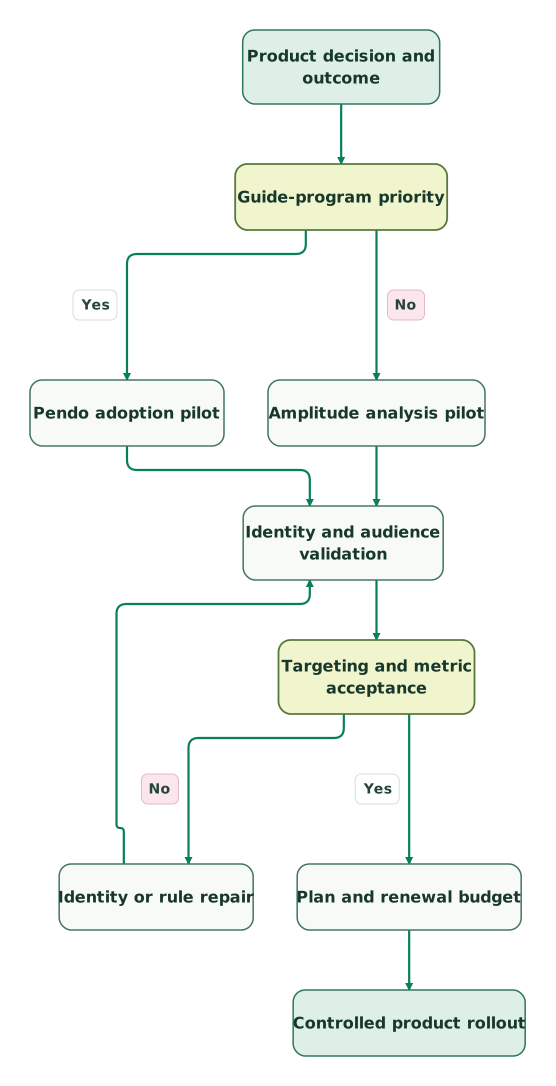
Read diagram as text
- Product decision and outcome to Guide-program priority.
- Guide-program priority to Pendo adoption pilot: Yes.
- Guide-program priority to Amplitude analysis pilot: No.
- Pendo adoption pilot to Identity and audience validation.
- Amplitude analysis pilot to Identity and audience validation.
- Identity and audience validation to Targeting and metric acceptance.
- Targeting and metric acceptance to Identity or rule repair: No.
- Identity or rule repair to Identity and audience validation.
- Targeting and metric acceptance to Plan and renewal budget: Yes.
- Plan and renewal budget to Controlled product rollout
A repaired identity or audience rule returns to validation using the same sample. Recheck both inclusion and exclusion, then verify the outcome event. A change that reaches more users can also reach the wrong users, so audience size alone is insufficient acceptance evidence.
Evaluation checklist
- Define the recurring analytical question and the product outcome.
- Assign owners for event definitions, identity and guide content.
- Separate visitor identity from active account and role context.
- Test audience eligibility at the actual moment a guide should appear.
- Confirm exclusion, dismissal and completion behaviour.
- Estimate event volume and MAUs independently using explicit assumptions.
- Revalidate the same sample after identity or targeting repairs.
- Approve production entitlements and the ordinary renewal budget.
Use the tracking-plan audit skill to organize the event and identity evidence. Keep the accepted test users and expected results with the release checklist so changes to the product or guide rules can repeat the review.
Keep reading
Browse all Product Analytics guides
 Product Analytics
Hotjar vs PostHog for website research and product analytics
Compare Hotjar’s current Contentsquare route with PostHog by research workflow, replay sampling, events, pricing units and migration terms.
Jafrin Akter AloLast updated 10 min read
 Product Analytics
Fullstory alternatives for replay, product analysis and adoption
Compare Fullstory alternatives by replay, product analysis and adoption work, with current free limits, data-use terms, billing units and migration checks.
Jafrin Akter AloLast updated 12 min read
 Product Analytics
Best Product Analytics Tools for Startups: 7 Options Compared by the Job They Do
Compare GA4, Mixpanel, Amplitude, PostHog, Heap, Pendo and Statsig on free tiers, experiments, server-side events, raw data export and warehouse options.
Jafrin Akter AloLast updated 27 min read
Product analytics
See the implementation scope, deliverables and acceptance checks.
Questions people ask
Does Amplitude offer in-app guides as well as analytics?
Amplitude offers in-app guides as well as analytics. Its guide documentation describes tours, announcements, tooltips and other formats, with plan-specific limits and capabilities. The comparison with Pendo should therefore test the intended audience, trigger and maintenance workflow directly. A product-category label is insufficient to decide whether the required guide program is supported. Amplitude guides.
Is Amplitude Free still best budgeted using monthly tracked users?
Amplitude's current public Free offer is budgeted with a two-million-event monthly allowance, rather than treating an old MTU figure as the current entry limit. Existing commercial agreements can have their own terms. Estimate captured events from the actual implementation and confirm the applicable plan, while keeping Pendo's MAU count as a separate measure. Amplitude pricing.
Can Pendo Novus beta replace the Pendo Free comparison?
Pendo Novus beta should be assessed as a separate offer from Pendo Free. The pricing page describes Novus as a free beta with its own product scope, while Pendo Free has a 500-MAU allowance and includes analytics and guides. Compare the product that performs the required job and confirm the continuing terms of any beta. Pendo pricing.
Can an Amplitude cohort target a guide during a user's first visit?
An Amplitude cohort should not be assumed to target a guide immediately during a first visit. Its targeting guide notes that cohort membership updates with a delay and recommends First Seen for the described new-user use case. Test a fresh user at the intended trigger, then verify returning-user behaviour and exclusion after completion. Targeting guidance.
Does changing a Pendo Visitor ID preserve the original guide history?
Changing a Pendo Visitor ID creates a new visitor record with separate usage and guide history, so it should not be treated as a harmless rename. Choose a stable identifier before installation and keep display names or other changeable details in metadata. Test account switching separately from visitor identity. Pendo identity guidance.
Sources

Written by
Jafrin Akter AloData Engineer and Co-founder at Martechdevs and Growth and Analytics Partners
Jafrin writes practical guides to marketing technology, customer data, analytics and AI workflows. Martechdevs is a Growth and Analytics Partners company.