
Klaviyo Review: Commerce Flows, Costs and Operating Fit
Klaviyo is a strong shortlist candidate when a business can turn reliable customer and commerce events into useful lifecycle messages. Its value depends on maintaining those events, preferences and flows after launch. This Klaviyo review focuses on that operating fit, the current email budget, and the checks that separate a promising demo from a manageable system.
On this page
Klaviyo fit assessment
Evaluate the work your team can sustain alongside the features it wants to buy.
| Operating requirement | Klaviyo fit | Main constraint | Evaluation evidence |
|---|---|---|---|
| Order-driven lifecycle messaging | Strong candidate | Reliable order and profile data | A purchase changes later message eligibility |
| Commerce platform integration | Useful starting point | Sync direction and field ownership | Accepted customer, catalog and preference mappings |
| Basic newsletter publishing | Possible, with a narrower use case | Broader capabilities may remain unused | Campaign workflow and total monthly cost |
| Coordinated campaigns and flows | Useful controls | Priority still needs deliberate design | Overlapping messages receive the intended treatment |
| Revenue reporting | Useful for message analysis | Attribution rules affect credit | Reconciled orders and documented reporting settings |
| Unowned or unreliable customer data | Weak starting condition | Automation magnifies bad inputs | Named data owner and passing acceptance cases |
The strongest case for Klaviyo is a maintained commerce messaging program: useful events, specific customer needs and someone responsible for eligibility after launch. A large library of flows is less valuable when nobody knows which ones can contact a recent buyer or an unsubscribed customer.
Our lifecycle messaging service connects the event contract, journey rules and validation plan. Those choices matter before a team compares campaign revenue screenshots or adds another channel. The existing Klaviyo implementation mistakes guide covers operational repairs in more detail.
Commerce data and integration
Klaviyo's Shopify integration provides a concrete example of its appeal: subscriber information, customer context and onsite behavior can support commerce journeys in the same platform. The configuration still deserves review. Choosing to sync all Klaviyo profiles back to Shopify can create Shopify customers for profiles from other integrations or imports, while the existing-profile option restricts that direction. Shopify integration guidance.
That distinction changes the implementation decision. A team importing an old prospect list should decide whether those records belong in its store's customer system before enabling a broad outbound sync. Assign an authoritative source to each field and record whether the integration should create, update or leave a destination record alone.
Build the evaluation around one complete journey. For example, an eligible customer starts checkout, purchases later and should no longer receive a message asking them to finish that checkout. The evidence should show the correct person, the order event, the current preference state and the subsequent message decision.
A native connector reduces custom integration work, but its presence is not an acceptance result. Inspect the events and properties your actual store produces. Product variants, canceled orders, multi-currency purchases and subscription renewals may require different definitions from a simple one-item demonstration order.
Keep the first data contract small. Include the identifiers, event times, order values, product information and preference fields needed by the initial flows. Record how late data, missing values and corrections are handled. This makes a failed message decision traceable to either the data or the rule using it.
Profile eligibility
Klaviyo's active email profile definition is broader than a list of recent subscribers. An active profile can receive email marketing through the platform, but active does not itself mean subscribed or recently engaged. Commerce activity can create profiles without an explicit ongoing marketing subscription. Consent and suppression are separate states. Active email profiles.
For an evaluation, inspect the size of the active audience separately from the audience approved for a particular message. This is both a budget question and an operating question. A raw customer export should not become a campaign audience simply because its rows contain email addresses.
Document the channel and purpose of each preference. Email permission should not be treated as permission for every mobile channel. Also decide who can change suppressions, how those changes reach Klaviyo and how the team verifies that a later import has not created an unintended exception.
The practical benefit is a clearer handoff between marketing and data owners. Marketing defines the message and intended audience; the data owner explains how the relevant state arrives and changes. The release owner checks that the actual profile matches both definitions before approving the flow.
Flow controls
For metric-triggered flows, trigger filters assess the event at entry. Profile filters are checked at entry and before actions. Failing a profile filter before an action skips that action, but the person can continue to later steps and qualify again. Custom Object trigger filters have a different repeated-check behavior, so avoid applying the metric rule to every trigger type. Flow triggers and filters.
This is a useful control set, provided the team understands the distinction. A purchase exclusion that is meant to protect every later reminder needs validation at those later decisions. A temporary profile state can behave differently from a permanent journey exit.
Write the intended behavior in business terms before translating it into filters. For example: after the qualifying purchase, no further checkout reminder for that journey should be sent. Then check the entry event, delay, exclusion and subsequent actions against that statement. Merely seeing a filter in the builder does not establish that the complete journey satisfies it.
Use a small evaluation table for the first flow:
| Scenario | Intended decision | Evidence | Release condition |
|---|---|---|---|
| Eligible new checkout | Entry into the intended journey | Trigger event and matched profile | Correct event properties |
| Purchase during a delay | No later checkout reminder | Purchase state and action decision | Exclusion remains effective |
| Preference withdrawal | No prohibited later message | Updated preference and recipient status | Channel rules respected |
| Repeated event delivery | One logical event in scope | Source event ID and destination history | Retry behavior understood |
| Historical import | No unintended live reminder | Import configuration and flow activity | Replay path accepted |
Flow messages have their own operational status. Klaviyo distinguishes Draft, Manual and Live; Manual allows review of recipients rather than automatic sending. Use status controls deliberately when moving from configuration review to a bounded live test. Flow message management.
An evaluation should include the team's ability to explain a skipped recipient. If the only available response is to clone the flow or remove a filter, the operating process is not ready. Ask the owner to identify the decisive condition and describe the safe correction before broader rollout.
Message pressure
Smart Sending can reduce overlapping marketing messages, but it is not a complete priority policy. Its windows are channel-specific; email's default is 16 hours. Messages skipped by Smart Sending are not automatically rescheduled, and a message with Smart Sending disabled can still send inside the window. Smart Sending guidance.
Consider a customer who qualifies for both a general promotion and a more relevant lifecycle message. Decide which one has priority and how the other should behave. A shared calendar, intentional exclusions and a review of skipped recipients may all be needed to implement that choice.
Avoid evaluating frequency solely from the campaign schedule. Include flow traffic and the channels a customer can actually receive. A low-volume campaign calendar can still produce a busy customer experience if several flows overlap after the same action.
The tradeoff is operational effort. Klaviyo supplies controls, but the team still owns the meaning of a good message sequence. Budget time for reviewing new flows against existing ones and for revisiting the rules when the product catalog, offer strategy or customer lifecycle changes.
Current email budget
The current USD pricing page shows Free at up to 250 active profiles and 500 emails per month. The selected Email tier is $20 per month for 500 active profiles and 5,000 monthly emails. These are email capacity figures, not a quote for unrestricted use of every product or channel. Klaviyo pricing.
Use the Klaviyo cost calculator to model audience and sends separately. For a larger purchasing exercise, Klaviyo pricing covers the broader cost structure. Confirm the selected currency, audience tier and product scope before approving a budget.
The following is a hypothetical steady-state month with 500 active profiles. It assumes all 500 are eligible for each of four campaigns and that the flow estimate already reflects expected eligibility. It excludes taxes, other products, mobile messaging and implementation work.
| Budget component | Assumption | Monthly result | Interpretation |
|---|---|---|---|
| Campaign emails | 4 campaigns × 500 recipients | 2,000 emails | Planned campaign capacity |
| Flow emails | Estimated eligible sends | 1,500 emails | Additional monthly capacity |
| Total emails | 2,000 + 1,500 | 3,500 emails | Within the selected 5,000 limit |
| Remaining capacity | 5,000 − 3,500 | 1,500 emails | Headroom, not a sending target |
| Email subscription | Selected 500-profile tier | $20 USD | Base monthly price |
| Twelve-month subtotal | 12 identical $20 months | $240 USD | Arithmetic projection, not an annual contract price |
This example uses 70% of the selected email allowance. If flow traffic rose to 3,500 emails while campaigns stayed at 2,000, the total would become 5,500, exceeding the allowance by 500. The next decision would be a capacity and billing review, not an assumption that those extra emails are free.
Klaviyo describes flexible sending, automatic send upgrades and profile downgrade preferences separately for month-to-month customers. Flexible sending can add temporary capacity, while profile changes affect plan compliance and eligible downgrades. Review the actual billing preferences and quoted incremental cost before a peak. Pricing mechanics.
A smaller newsletter may have little need for commerce event work. In that case, compare the total workflow and cost with a simpler publishing setup. A growing store may have the opposite problem: the platform price is manageable, but nobody is assigned to maintain the event mappings and message eligibility.
Custom events and historical data
Custom integrations require an explicit retry strategy. Klaviyo's Events API deduplicates on the combination of profile, metric and unique_id. Reuse the same event identifier on a retry of that logical event. For a historical replay, the current guide documents backfill: true to ingest events without triggering the associated metric flows, with time retaining the original occurrence time. Events API overview.
That API behavior does not remove the need to inspect a native integration's own import behavior. Identify the route being evaluated and retain its configuration evidence. A database export, a connector's first synchronization and a custom API replay are different operations.
For a hypothetical validation fixture, take one purchase event, resend it with the same identity tuple, then submit a different purchase with a different event ID. The expected accepted set contains two logical purchases. This is an evaluation case to run in the approved environment, not evidence that a particular account already handles duplicates correctly.
Revenue interpretation
Klaviyo defaults to a cooperative last-touch attribution model. Advanced KDP and Personalization customers can choose linear attribution as well; that capability is not included in the standard marketing application. Linear attribution distributes revenue credit across qualifying touchpoints, while conversion counts and unique converters retain last-touch treatment. Attribution model types.
Record the selected model, windows and interaction settings alongside any performance comparison. Klaviyo's current message attribution guide also distinguishes report grouping by message send date from grouping by event occurrence. Historical reporting can change after attribution settings are updated. Message attribution.
A useful evaluation reconciles store orders first, then explains how the platform assigns credit. An attributed sale does not establish that the customer would have avoided purchasing without the message. Use a suitable holdout or other causal evaluation when that is the business question, and keep the result separate from ordinary attributed revenue.
For example, a team comparing two flows should first check that both reports use compatible periods and settings. Otherwise a higher displayed revenue figure may reflect a longer eligibility window or a different date grouping rather than a better customer experience.
Evaluation workflow
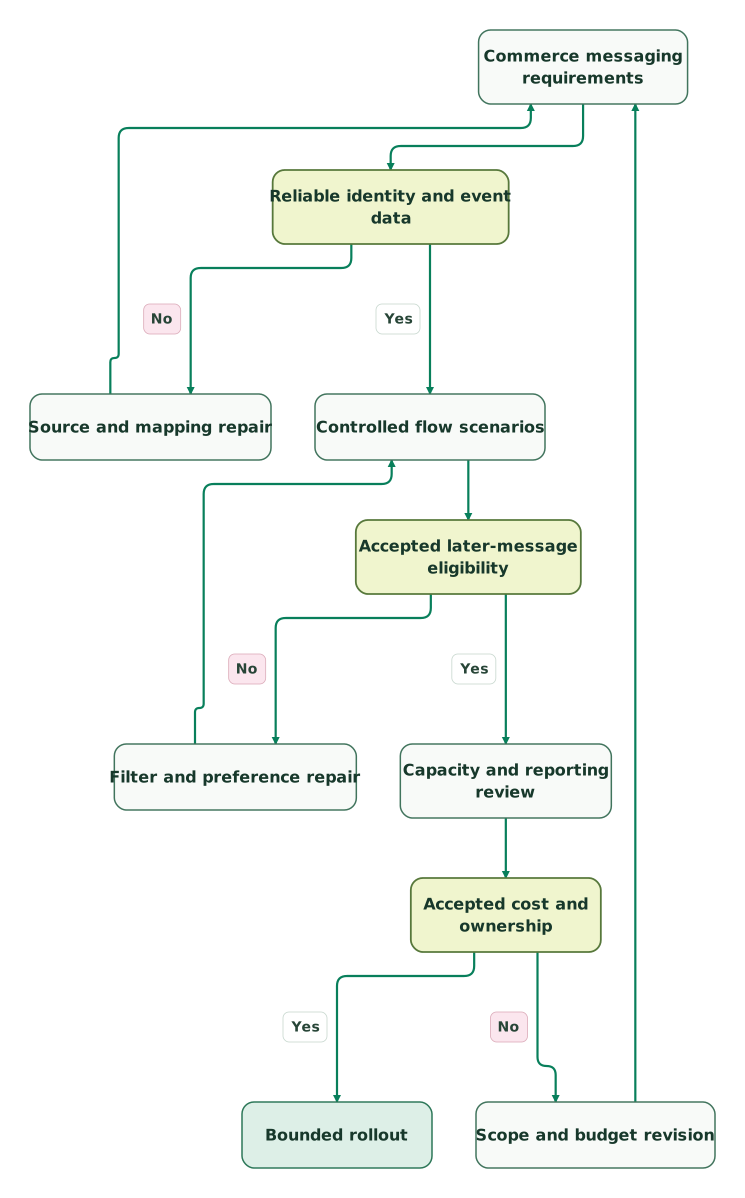
Read diagram as text
- Commerce messaging requirements to Reliable identity and event data.
- Reliable identity and event data to Source and mapping repair: No.
- Source and mapping repair to Commerce messaging requirements.
- Reliable identity and event data to Controlled flow scenarios: Yes.
- Controlled flow scenarios to Accepted later-message eligibility.
- Accepted later-message eligibility to Filter and preference repair: No.
- Filter and preference repair to Controlled flow scenarios.
- Accepted later-message eligibility to Capacity and reporting review: Yes.
- Capacity and reporting review to Accepted cost and ownership.
- Accepted cost and ownership to Scope and budget revision: No.
- Scope and budget revision to Commerce messaging requirements.
- Accepted cost and ownership to Bounded rollout: Yes
The diagram deliberately sends budget revisions back to the requirements. Removing a channel or changing the audience can change the flows worth implementing. Data repair also returns to the requirements because an unavailable event may require a different customer journey.
Evaluation checklist
- The intended business journeys have named owners.
- Customer identity and commerce events match the source system.
- Sync direction and field ownership are documented.
- Marketing preferences are separated from active-profile billing status.
- Purchase and opt-out changes affect later messages correctly.
- Smart Sending skips and campaign priorities are understood.
- Historical imports and retries have accepted behavior.
- Profile count, monthly sends and billing preferences fit the budget.
- Revenue reports have recorded attribution and date-grouping settings.
- The team can explain and repair a failed recipient case.
Use the lifecycle marketing audit skill to review these controls before rollout. Choose Klaviyo when the commerce journeys justify the ongoing work and the team can maintain the necessary data. Narrow the scope or reconsider the platform when the planned use is small, the data is unreliable or ownership remains unassigned.
Keep reading
Browse all CRM & Lifecycle guides
 CRM & Lifecycle
Klaviyo Implementation Mistakes That Distort Flows and Revenue
Find Klaviyo errors in order events, flow filters, backfills, frequency caps and attribution, with a practical acceptance test and reconciliation example.
Jafrin Akter AloLast updated 12 min read
 CRM & Lifecycle
Klaviyo Pricing: Email Plans, Active Profiles and Mobile Costs
Klaviyo Email starts at $20 a month. Compare costs at 500 to 100,000 profiles, the Marketing package, mobile spend, overages and safe ways to cut the bill.
Jafrin Akter AloLast updated 12 min read
 CRM & Lifecycle
Klaviyo Events API: Send Reliable Events Without Duplicate Flow Entry
Build Klaviyo event payloads with correct profiles, stable IDs, time and value. Test retries, bulk jobs, backfills and 202 responses before activating flows.
Jafrin Akter AloLast updated 13 min read
Lifecycle marketing
See the implementation scope, deliverables and acceptance checks.
Questions people ask
Is Klaviyo a sensible purchase for a store with only a newsletter?
It can be, but the decision should follow the actual publishing workflow and budget. A store using only a periodic newsletter may gain little from building commerce event integrations immediately. Compare the campaign experience, audience limits and maintenance effort first, then add lifecycle journeys when there is a clear customer need and an owner.
Does an active Klaviyo profile prove marketing consent?
No, active status does not by itself prove marketing consent. It describes the platform's email eligibility state, which can include people created through commerce activity who never explicitly subscribed. Review the profile's channel-specific subscription and suppression information, then apply the approved audience rules for the message you intend to send.
Will a Smart Sending skip automatically become a later email?
No, Smart Sending does not automatically reschedule a skipped message. The team should decide whether a skipped campaign or flow message needs any later treatment and review the relevant recipient activity. Do not assume that a frequency limit also provides a complete queue, message priority system or guaranteed eventual delivery.
Can the lowest paid email tier cover every Klaviyo product?
No, the selected email tier should be budgeted for its stated audience and email capacity. Other products, channels and higher usage can have separate limits or charges. Record the precise package configuration and billing preferences before approval, then rerun the estimate when profile growth or the messaging calendar changes.
Is Klaviyo-attributed revenue the same as incremental revenue?
No, attributed revenue is credit assigned under the configured attribution rules. Incremental revenue asks how much additional revenue occurred because of the intervention. Reconcile orders and reporting settings first, then use an appropriate causal evaluation for the incremental question rather than treating a campaign attribution total as proof of additional sales.
Sources

Written by
Jafrin Akter AloData Engineer and Co-founder at Martechdevs and Growth and Analytics Partners
Jafrin writes practical guides to marketing technology, customer data, analytics and AI workflows. Martechdevs is a Growth and Analytics Partners company.