
Cold Email Templates for Specific Proposals and Useful Follow-Ups
Use cold email templates as draft structures for a relevant business proposal, then replace every claim and variable with verified information. The message should explain the useful outcome, the work being offered and one reasonable next step. A cold email follow-up template should add context to the real conversation while respecting replies, exclusions and opt-outs.
On this page
Cold email template selection
The examples are illustrative drafts for eligible outreach, with placeholders that must be resolved before use.
| Message purpose | Suitable context | Required evidence | Appropriate next step |
|---|---|---|---|
| Public-change proposal | A relevant announcement creates a specific implementation opportunity | The announcement and the recipient's role | A question about the proposed scope |
| Workflow question | The role and business model make one process relevant | Verified company and role context | Confirmation that the topic belongs with the recipient |
| Bounded first project | The sender can describe a small useful starting piece | A real service and its scope | Permission to discuss that piece |
| Ownership request | The topic is relevant but the responsible team is uncertain | An honest reason for contacting the company | A simple routing response |
| Detail-led follow-up | A previous message introduced the proposal | The actual sent message and current reply state | A response to one new detail |
| Polite closure | A completed, approved sequence has no reply | Accurate conversation history | No demand for a rejection reply |
The template should follow the reason for contact. A company name, job title and tool name pasted into an unrelated paragraph do not make that paragraph useful. The cold email subject lines guide covers the short promise that introduces the message.
At Martechdevs, we build the recipient selection, data and response-handling processes behind useful outreach through our GTM engineering service. The copy works best when those processes supply reliable context and prevent inappropriate follow-ups.
Recipient context and a supported proposal
Start with a short working record: the company, the recipient's relevant responsibility, the public evidence, the outcome being proposed and the service the sender can actually provide. Keep the evidence outside the email unless a specific link is useful to the reader.
Separate facts from hypotheses. A public job posting that names a CRM can support a reference to that tool in the stated context. It does not prove that the recipient's team uses a particular field, that an integration is broken or that the company wants to replace its software.
When the internal situation is unknown, ask about it directly. “Could renewal reminders use the account's current contract date?” is a proposal. “Your renewal reminders use stale dates” is a claim requiring evidence. The template should preserve that distinction after personalization.
Choose one useful outcome. A list of tracking, warehouse, CRM, lifecycle, enrichment and AI services creates several decisions for the reader. A first message can offer one connection or workflow, with the broader scope reserved for a real conversation.
Keep the sender's commitment proportionate to what is known. Do not invent implementation dates, access assumptions or customer results to make the proposal appear concrete. A concrete starting scope can identify the records, decision and handoff without promising a delivery date.
Draft templates
These bodies omit the final signature for readability. Append the accurate sender and company identity, valid postal address and approved opt-out instructions described below. Every bracketed field is a drafting instruction, not text to send.
A verified public change
Subject: [specific program] onboarding

Hi [First name],

I saw your announcement about [verified public change].

Would a follow-up based on [specific customer action] be useful for that program? At [Company], we can connect [relevant source] to [destination] and build the agreed reminder or owner task.

We would confirm the data and stopping rule with your team before defining the implementation.

Is that relevant to the work you own?
Use this only when the announcement has been read and relates to the proposal. Replace the vague phrase “specific customer action” with something the business model supports, such as a first completed booking or an approved application. Do not claim the company lacks that workflow.
The recipient's role matters as much as the announcement. A communications employee who published the news may have no responsibility for the system. Route the proposal to an appropriate business owner without pretending that the public author invited contact.
A role-relevant workflow question
Subject: renewal reminder timing

Hi [First name],

Could renewal reminders be tied to each account's contract date and current renewal status?

We build that kind of workflow at [Company]. The work connects the agreed records to the messaging system, applies the reminder timing and stops follow-ups once the renewal is recorded.

Your team would control the messages and exceptions.

Is that already covered in your process?
This pattern offers a useful outcome without diagnosing an unseen failure. Adapt the business process rather than replacing a few nouns mechanically. A company without recurring contracts is a poor recipient for this version, regardless of how accurate the person's name is.
The stopping rule makes the proposal understandable. It explains what the implementation would do when the customer completes the action. Keep that detail specific to the service the sender can deliver and avoid promising that it will produce a particular retention result.
A bounded first project
Subject: one account-owner handoff

Hi [First name],

If [verified process] is a priority, a useful starting piece could be one handoff: [defined signal] creates a task for the right account owner.

At [Company], we can connect the source record, apply the agreed exclusions and test the task with your team. Customers already in an active conversation would follow your existing ownership rules.

Would it be useful to discuss that scope?
Use a narrow piece only when it is independently useful. A vague promise to “connect everything” becomes more credible when the first scope identifies a signal, an owner and the excluded cases. The message should still leave access, detailed requirements and timing for the scoping conversation.
If the proposal needs a CRM change, identify the intended business result rather than exposing an unnecessary implementation detail in the first sentence. A recipient can understand an account-owner task before they need to know an API endpoint or field-mapping format.
An honest ownership request
Subject: customer onboarding ownership

Hi [First name],

I'm trying to reach the person responsible for [specific customer process] at [Business].

At [Company], we implement [one relevant workflow]. The idea is to [plain outcome], with the follow-up changing when [completion or exception] is recorded.

I have not confirmed which team owns that work.

Does it sit with you, or is there a better team to contact?
Keep the uncertainty explicit. Do not imply a referral, executive instruction or earlier conversation that did not happen. The routing request should be easy to answer without requiring the recipient to investigate the sender's entire service catalogue.
An uncertain owner is not a reason to email every employee at the company. Maintain an account-level view of contact attempts and current conversations. A relevant reply should update that state before another person receives an overlapping proposal.
A useful implementation follow-up
Subject: the onboarding reminder example

Hi [First name],

For the onboarding idea, the first rule could be: [eligible customer state] has not reached [completion event], so the account owner gets a task.

We would connect the agreed source data, add the exclusions and test that no further reminder task is created after completion.

That would give your team one defined workflow to review before considering a wider build.

Would that be useful for [relevant program]?
Read the actual first message before using this follow-up. The new detail must fit the same proposal. Do not reintroduce the company, repeat the entire pitch or switch to another service merely to create another touch.
Preserve real thread behavior. A follow-up sent as a reply can remain in the genuine thread; a separate new message should have an accurate subject. Gmail's guidelines prohibit using reply or forward prefixes to disguise messages that are not actual replies or forwards. Gmail message-format guidance
A polite final note
Subject: [specific workflow] scope

Hi [First name],

I'll leave the [specific workflow] proposal here.

If it becomes relevant, the starting scope would be [one defined connection or rule], with the data, exceptions and handover agreed before implementation.

You can reply to this message if you would like to discuss it. No need to respond if the timing or topic does not fit.
Use a final note only within an approved sequence and while the recipient remains eligible. It should not manufacture urgency, demand a rejection or claim that an offer will disappear. Stop according to the real sequence policy instead of repeatedly sending new “final” messages.
Sender details and opt-out handling
Use an accurate signature and a working route for replies and opt-outs. The templates are commercial proposals, so the sender and purpose should be clear. For US commercial messages, the FTC also requires a valid postal address and an easy opt-out mechanism, and its rules cover B2B email. FTC business guidance
[Sender name]
[Company and role]
[Valid postal address]
[Clear, working opt-out instructions]
Use the applicable program's approved details rather than leaving placeholders or inserting an address that does not belong to the sender. An opt-out must update the recipient state used by future campaigns; a polite sentence that nobody processes is incomplete.
Recipient rules also vary by jurisdiction and subscriber type. The UK's ICO distinguishes corporate subscribers from sole traders and certain partnerships, and states that data-protection requirements still apply to personal data used in B2B marketing. Public availability of an address does not by itself settle eligibility. ICO B2B marketing guidance
The cold email infrastructure guide covers the sending and suppression system. Check provider terms and the approved recipient rules before moving a draft into a sending workflow.
Template variables and rendering checks
Treat missing context as a decision to repair or hold the draft. A blank company name, guessed first name or unsupported tool reference should not silently produce a ready-to-send message.
| Draft field | Acceptable input | Failure condition | Draft response |
|---|---|---|---|
| Recipient name | Verified usable name | Missing, malformed or uncertain identity | Use an approved neutral greeting or review |
| Company | Verified current business | Domain and listed company disagree | Resolve the company before drafting |
| Public context | Current source supporting the claim | Stale or unrelated announcement | Remove or replace the claim |
| Proposed outcome | One real service outcome | Unsupported promise or invented problem | Rewrite the proposal |
| Previous message | Actual sent text and reply state | Follow-up based only on an old draft | Review conversation continuity |
| Signature and opt-out | Approved complete sender details | Missing address or inactive opt-out route | Hold the draft |
Review the rendered message, not just the template. Long company names, punctuation and optional fields can change the grammar. Read it aloud as one person writing to another and remove phrases that merely announce the pitch.
Avoid spintax or synonym substitution that changes meaning without changing relevance. The useful variation is the business reason and proposed work. Several recipients with the same role may still need different messages because their companies have different business models.
For a reply link generated with the mailto link generator, verify the recipient and any prefilled subject or body before using it. The tool creates a link; it does not establish eligibility, send the message or process an opt-out.
Eligibility and follow-up states
Copy approval and recipient eligibility should be separate checks. The following hypothetical fixture illustrates the intended routing decisions for a program; it is not a claim about a live campaign.
| Recipient state | Draft treatment | Next owner | Sequence treatment |
|---|---|---|---|
| New eligible contact with verified context | Prepare and review the proposed message | Campaign owner | Eligible for the authorized queue |
| Existing customer | Hold the acquisition template | Account owner | Follow the customer communication policy |
| Open sales conversation | Hold the generic follow-up | Current conversation owner | Preserve existing ownership |
| Human reply received | Read and handle the reply | Assigned responder | Stop automated prospecting continuation |
| Opt-out received | Record suppression | Operations owner | Exclude future marketing outreach |
| Delivery failure | Investigate the recorded reason | Operations owner | Hold the failing address |
An automatic response deserves a deliberate rule too. It may indicate an absence, a changed role or a shared mailbox. Do not treat every automated message as a positive reply or automatically transfer the sequence to another address mentioned in it.
Refresh these states immediately before an authorized send operation. A list can change after the writing work is complete. A previously eligible contact who has since opted out should not receive a message simply because the draft was approved earlier.
Response quality and iteration
Define the intended response before comparing templates. A human reply, a request for information, an accepted meeting and a qualified opportunity are different outcomes. Review the content of replies so confusion or objections do not inflate a useful-response metric.
Open counts are insufficient evidence that the message was read. Mailchimp explains that open tracking relies on an image and can be affected by privacy and automated activity. Keep this technical signal separate from a person engaging with the proposal. Open-tracking limitations
As a hypothetical arithmetic example, 12 positive replies from 600 distinct contacted recipients produce 12 ÷ 600 = 2%. If those same recipients sent 30 messages during their conversations, 30 ÷ 600 = 5% would count messages rather than unique positive respondents. Keep the counting unit consistent.
Do not turn that illustrative rate into an expected result. The audience, offer, delivery conditions, timing and response definition all affect an actual campaign. Review one meaningful change at a time and keep the previous version with the decision record.
The signal-based selling guide helps define a relevant reason for contact. Use the GTM workflow design skill to connect that reason to exclusions, routing and response ownership.
Draft approval and repair workflow
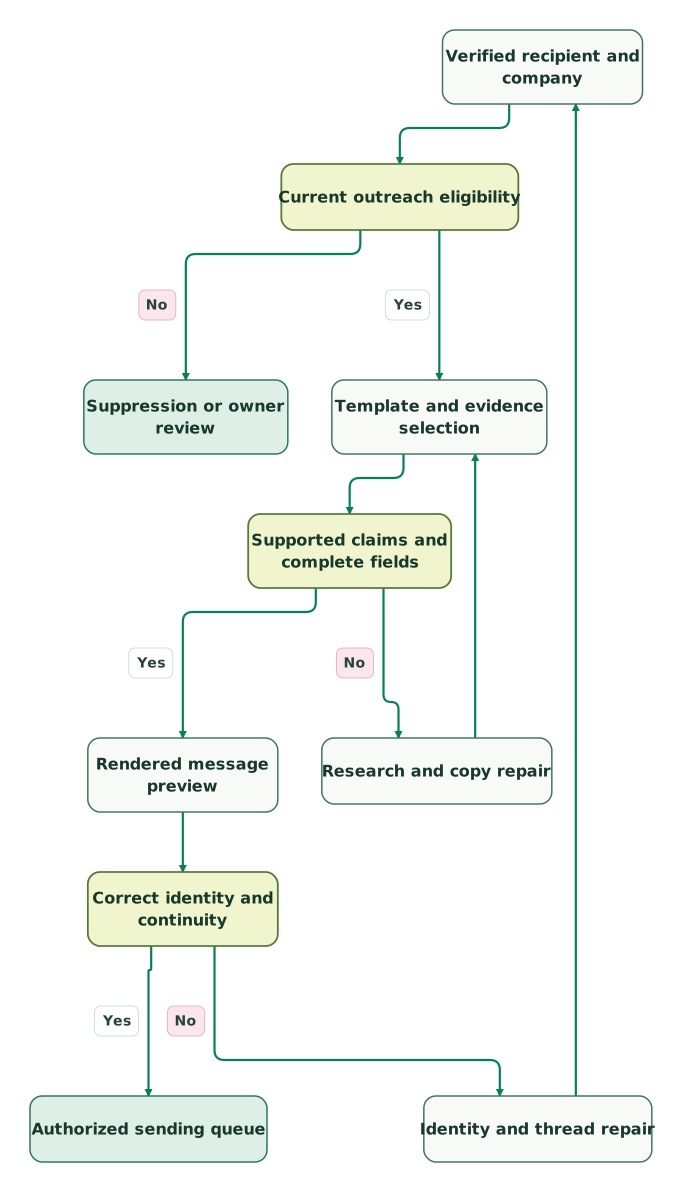
Read diagram as text
- Verified recipient and company to Current outreach eligibility.
- Current outreach eligibility to Suppression or owner review: No.
- Current outreach eligibility to Template and evidence selection: Yes.
- Template and evidence selection to Supported claims and complete fields.
- Supported claims and complete fields to Research and copy repair: No.
- Research and copy repair to Template and evidence selection.
- Supported claims and complete fields to Rendered message preview: Yes.
- Rendered message preview to Correct identity and continuity.
- Correct identity and continuity to Identity and thread repair: No.
- Identity and thread repair to Verified recipient and company.
- Correct identity and continuity to Authorized sending queue: Yes
Cold email draft checklist
- The company and recipient context are verified.
- One useful outcome and one reasonable ask define the message.
- Every factual claim has evidence, with uncertainty stated honestly.
- No invented failure, familiarity, result, urgency or delivery promise appears.
- All variables and sender details render correctly.
- The subject accurately describes the body.
- Follow-ups continue the actual sent proposal and add useful detail.
- Replies, customers, open opportunities, opt-outs and failures have current treatments.
- An authorized operator owns the sending decision and response handling.
Keep reading
Browse all GTM Engineering guides
 GTM Engineering
Cold email infrastructure: domains, authentication, sending and monitoring
Build email infrastructure around authentication, suppression and recipient expectations. Check Gmail, Yahoo and Outlook requirements and plan a measured pilot.
Jafrin Akter AloLast updated 9 min read
 GTM Engineering
Signal-Based Selling: Turn Intent Signals Into Useful Sales Actions
Build signal-based selling with product, website and company intent signals. Resolve identity, freshness, routing, costs and measurement before automating outreach.
Jafrin Akter AloLast updated 13 min read
 GTM Engineering
Cold Email Subject Lines for Relevant, Honest Outreach
Write relevant cold email subject lines with honest examples, subject-body checks, follow-up continuity and a hypothetical comparison of human and positive replies.
Jafrin Akter AloLast updated 11 min read
GTM engineering & outbound
See the implementation scope, deliverables and acceptance checks.
Questions people ask
Can a bracketed cold email template be copied directly into a campaign?
A bracketed template should not be copied directly into a campaign. Each placeholder represents information that must be verified or a wording decision that still needs review. Resolve the recipient, business context, proposal and sender details, then preview the complete message. Hold the draft when missing information would create a false claim or an unusable greeting.
Can a public hiring advert justify naming a prospect's software?
A public hiring advert can justify a carefully scoped software reference when it explicitly names the tool and is relevant to the business being contacted. It does not prove the exact production setup or an implementation problem. Keep the claim within the evidence and frame the proposal around a useful possibility rather than diagnosing a private system from a job description.
Should a follow-up repeat the original service description?
A follow-up should usually add a useful detail instead of repeating the whole service description. Read the actual sent message and connect the new detail to the same proposal. A stopping rule, limited starting scope or ownership question can make the continuation useful. A different wording of the same broad pitch creates little new reason for the recipient to respond.
Can an approved draft still be withheld because the recipient state changed?
An approved draft should be withheld when the recipient state changes in a way that affects eligibility. A new reply, opt-out, customer relationship or open sales conversation can require a different owner or treatment. Refresh the relevant state before any authorized send operation. Copy approval confirms the draft's quality; it does not freeze the recipient's status.
Do thirty reply messages mean thirty positive respondents?
Thirty reply messages do not necessarily mean thirty positive respondents. One person can send several messages, and some replies can be negative, automated or unrelated. Define the positive-response rule and count distinct recipients who meet it. In the hypothetical example, twelve positive respondents among six hundred contacted recipients produce a two-percent rate, regardless of the conversation's message count.
Sources

Written by
Jafrin Akter AloData Engineer and Co-founder at Martechdevs and Growth and Analytics Partners
Jafrin writes practical guides to marketing technology, customer data, analytics and AI workflows. Martechdevs is a Growth and Analytics Partners company.