
GEO vs AEO: What Changes in AI Search and What to Measure
GEO and AEO are overlapping labels for making useful information discoverable in AI and answer-based search. The useful distinction is between the surfaces you want to appear on, the questions your buyers ask and the evidence you can collect. Start there, then decide which pages, access problems and measurement gaps deserve work.
On this page
What is the difference between GEO and AEO?
GEO usually means generative engine optimization: improving how a business or its content appears in generated answers. AEO usually means answer engine optimization: making information useful to systems that answer questions. People use AEO for both extracted answers and generative responses, so neither acronym identifies a consistent technical specification or a universally separate service.
Google treats optimization for its generative search features as part of SEO. HubSpot uses AEO more broadly across answer surfaces. Those different conventions are a reason to define the work in a proposal before comparing its price. Google’s AI optimization guide, HubSpot’s terminology.
| Label | Common use | Specify this before buying work |
|---|---|---|
| SEO | Discovery and visibility in search | Target pages, search audience, technical eligibility and business outcomes |
| AEO | Visibility in answers, including extracted or generated answers | Which answer surface, question and visible result count |
| GEO | Visibility in generated answers | Whether success means a brand mention, linked citation or accurate recommendation |
| LLM SEO | Informal shorthand for visibility around language-model products | Whether the product searches the web, fetches a supplied URL or answers without retrieval |
“Improve GEO” leaves too much unspecified. “Help a buyer understand our implementation scope, and check whether selected search answers cite the correct scope page” gives the team a page to improve and a result to inspect.
The same discipline applies to measurement. Our analytics and tracking work connects visits and qualified outcomes to the source evidence available. A citation screenshot, a web session and a sales opportunity are different records; none should silently stand in for another.
How do Google, ChatGPT and Claude find information for answers?
Their search-enabled experiences can retrieve web information and use it in an answer, but they expose different evidence. Always record the specific product surface and search state. A response generated without web retrieval cannot tell you whether a newly updated page was found through search.
| Surface | Documented retrieval behavior | Evidence you can inspect | Boundary to preserve |
|---|---|---|---|
| Google AI Overviews and AI Mode | May issue related searches through query fan-out | The displayed answer and its supporting links | A related search sequence is a possible system behavior; you have not observed its hidden queries |
| ChatGPT search | May rewrite a request into targeted searches and make further searches | Inline citations, source links and the answer they accompany | The Sources panel can include additional relevant links that are not inline citations |
| Claude web search | Searches the web and can combine multiple sources with citations | The response, cited URLs and cited claims | Fetching a URL you supplied is a different test from discovering that URL |
These behaviors are described by Google, OpenAI and Anthropic. They do not promise that an eligible page will be retrieved or cited.
Keep two kinds of test separate. In a discovery test, ask a buyer’s question without supplying your brand or URL unless the real question is branded. In a comprehension test, provide your URL and check whether the system can extract the right limits, prerequisites or instructions. Passing comprehension is useful, but it does not establish organic visibility.
Likewise, a list of possible follow-up questions is an editorial planning tool. You can use it to find missing information. You cannot label it “the queries ChatGPT used” unless you actually obtained that evidence from the product or an authorized log.
Which page should you improve first?
Improve the page closest to a real buying or implementation question that your current content answers poorly. Select it from support tickets, sales objections, reviewed Search Console evidence and product changes. A high-volume question is not automatically the most useful first project.
| What you observe | First action | Evidence that the action was useful |
|---|---|---|
| An answer repeats your old product name or scope | Correct the canonical source and other pages that still contradict it | The corrected page is accessible; later observations stop repeating that specific error |
| Buyers cannot determine whether a feature needs a paid plan | Add the plan, prerequisite, exclusion and source beside the feature | A reader can make the decision without stitching together separate pages |
| A broad guide gets cited but cannot answer a narrow implementation question | Add the missing procedure, or create a distinct guide when it serves a separate task | The new material resolves the question and links to its prerequisites |
| A competitor is mentioned and you are absent | Inspect whether your offering actually fits the question and whether reliable evidence exists | The factual gap is closed without inventing capabilities or manufacturing endorsements |
| Visits arrive but few become qualified inquiries | Check offer fit, next steps and conversion measurement | Qualified outcomes improve for the relevant visitor group |
For example, imagine a comparison page that says a tool “supports Salesforce.” That phrase does not tell an administrator whether the integration creates records, updates an existing field, supports a required object or needs a higher plan. A useful replacement states the exact supported action, matching key, direction, entitlement and failure behavior, with a source for changing product facts.
The improvement is valuable even if an assistant never cites it: a buyer can now avoid an incompatible purchase. This is the standard to use when prioritizing the backlog. Add numbers when they answer a real question; add examples when they make a decision easier. Do not add a statistic just to make the page look easier to cite.
Create another page only when the reader’s task is materially different. Separate guides for plan selection and failed synchronization may make sense. Ten pages that restate the same answer with different prompt wording create more material to maintain without improving the decision.
Which technical checks should happen before content changes?
Verify access to the intended public page, the applicable search controls and the availability of its core content. Otherwise, you can spend weeks rewriting information that a selected retrieval route cannot use.
For Google’s AI features, the page must be indexed, eligible for a snippet and included under the effective Search generative AI control. Check the property’s setting and any inherited setting. Google’s Include or Exclude control concerns those generative search features; it is separate from AI training controls and does not remove the page from ordinary Search. Google eligibility, Search generative AI control.
OpenAI separates OAI-SearchBot from GPTBot. The former supports search; the latter concerns training. A site excluded from OAI-SearchBot can still appear as a navigational link, which is different from appearing in search answers. Check both robots rules and the hosting or CDN path using the published crawler information. OpenAI crawler reference.
Anthropic also distinguishes Claude-SearchBot, Claude-User and ClaudeBot. Their purposes are search, user-directed retrieval and training respectively. Apply the site owner’s intended policy to each purpose; do not interpret a content project as permission to change every crawler rule. Anthropic crawler reference.
| Acceptance check | Evidence to retain | Failure action |
|---|---|---|
| Public URL and canonical destination | Final status, redirect chain and the intended page body | Repair accidental authentication, errors or misleading redirects |
| Search eligibility and chosen access policy | Google URL inspection, snippet controls, effective AI inclusion and relevant robots/CDN configuration | Resolve the specific unintended restriction; preserve deliberate exclusions |
| Important facts are available | Raw response and rendered page both inspected for the answer, limitations and links | Make essential public content reliably available through the intended delivery route |
| Structured data matches the page | Visible author, title and facts compared with emitted markup | Correct discrepancies and validate the markup used |
| Alternative representations agree | HTML and any Markdown or other public export compared for important facts | Repair stale exports or remove an unsupported representation |
| A retrieved citation supports its claim | Saved answer, exact linked URL and the passage it relies on | Correct your source if it is wrong; separately record answer errors you do not control |
Google can render JavaScript. An empty initial HTML response therefore does not prove that Google cannot index a page. Inspect the rendered result and the availability of resources as well. Serving important text in the initial response can make it easier to consume across different clients, but “all AI crawlers cannot run JavaScript” is too broad a diagnosis. Google’s JavaScript guidance.
An HTTP success response alone also proves little. A consent screen, empty shell or challenge page can return a response without providing the answer. Save a small expected-content check, such as the presence of the actual plan restriction, alongside the status check. This tests delivery of the information the reader needs.
Do special files, schema or research tactics guarantee citations?
No. Google says its AI search features need no special AI text file, Markdown version or dedicated schema, and that Search ignores llms.txt. It also rejects a prescribed small-chunk format as a requirement. Keep ordinary technical quality and useful content; avoid buying a guaranteed citation recipe. Google’s AI optimization guidance.
An optional machine-readable index can still help a specific consumer that uses it. That is an integration claim you can test. It should not be sold as a universal ranking mechanism. Our llms.txt guide explains the file’s role and how to keep it consistent with the actual pages.
The original GEO research introduced a framework for measuring source visibility in generated answers and tested changes such as adding citations, quotations and statistics. Its experimental systems, query set and visibility measures bound those results. The paper’s authors also discuss the difficulty of generalizing across evolving engines. A result from that research is not a forecast for your present-day ChatGPT, Claude or Google traffic. GEO research paper.
Use a source because it supports a material claim. Use a quotation when the exact wording matters. Publish an original calculation with its assumptions when it helps someone decide. Those choices improve the work itself; a citation remains an external outcome.
How should you run a useful citation test?
Define the question set, surfaces, scoring rules and missing-data treatment before you change pages. Then retain enough evidence to reproduce what you counted. The goal is a stable observation method, not a collection of favorable screenshots.
Choose questions from actual buyer and operator tasks. Include unbranded discovery, branded clarification and difficult eligibility questions, but label them separately. A branded prompt often has a different chance of mentioning you, so mixing more branded prompts into the second round can make visibility appear to improve.
These are planning templates, not observed customer or assistant queries:
- Discovery: “Which [tool category] supports [required workflow] for a team with [constraint]?”
- Eligibility: “Does [vendor and plan] support [specific action], and what must be configured first?”
- Implementation: “How can [role] verify that [workflow] works before [business decision]?”
Record the exact prompt, product surface, visible model or mode when available, search state, locale, account context, run time and target URL set. Use fresh conversations for independent repetitions. Keep relevant settings consistent and record changes you cannot control. Do not place confidential customer information in public search tests.
Use separate observation fields rather than one “AI visibility” checkbox:
| Field | What counts | What does not count |
|---|---|---|
| Brand mention | Your business is named in the visible answer | A related company with a similar name |
| Owned citation | An answer citation resolves to an approved URL on your site | A brand mention, unlinked text or an additional source-panel link alone |
| Supported citation | The cited passage supports the specific claim attributed to it | A relevant-looking page that contradicts the answer or lacks the claimed fact |
| Complete run | The intended request returned an observable outcome, including no AI answer where applicable | Timeout, access error or interrupted response |
| Commercial follow-through | A measured visit or qualified outcome with its own source evidence | Assuming every mention created a click or every click created a sale |
Open the citation and inspect the passage. OpenAI itself notes that search responses and citations can be wrong or incomplete. A link beside an answer is an invitation to verify the evidence, not automatic proof that the claim is supported. ChatGPT search guidance.
Choose the surfaces deliberately. AI Mode and AI Overviews are distinct experiences even though both belong to Google. A proposed fourth surface might be relevant to your audience, but do not add it just to enlarge a score. The following example uses four selected surfaces as a hypothetical panel; it reports no observed assistant queries or results.
A repeatable observation register
Suppose you select 30 prompts, four surfaces and three independent repetitions for each combination. That creates 120 prompt-surface pairs and 360 planned runs. Declare that a pair counts as repeatedly cited when at least two of its three completed runs contain an owned citation. This two-of-three rule is an operating convention for this example, not an industry standard or a statistical confidence threshold.
Use one row per planned run. The compact fixture below shows the column contract; the same structure can live in a CSV or spreadsheet. Keep answer captures, citation URLs and claim checks in linked evidence columns in the real register.
prompt_id,surface,run,complete,cited
scope-question,chatgpt-search,1,true,true
scope-question,chatgpt-search,2,true,false
scope-question,chatgpt-search,3,true,true
This Python helper summarizes manually classified observations. Pass Python booleans, not CSV strings: True, False and None for an incomplete run’s citation value. expected_pairs must come from the planned register, not just the rows that happened to return. The helper does not call an assistant or judge whether a citation is accurate.
from fractions import Fraction

def citation_summary(rows, expected_pairs, repeats=3):
    if type(repeats) is not int or repeats < 1:
        raise ValueError("repeats must be a positive integer")
    pairs = list(expected_pairs)
    if not pairs or any(
        not isinstance(p, tuple) or len(p) != 2
        or any(not isinstance(v, str) or not v.strip() for v in p)
        for p in pairs
    ):
        raise ValueError("provide planned prompt/surface tuples")
    if len(set(pairs)) != len(pairs):
        raise ValueError("duplicate planned pair")
    slots = {p: {} for p in pairs}
    for row in rows:
        pair = (row["prompt_id"], row["surface"])
        run, complete, cited = row["run"], row["complete"], row["cited"]
        if pair not in slots or type(run) is not int or not 1 <= run <= repeats:
            raise ValueError("unexpected pair or run")
        if run in slots[pair]:
            raise ValueError("duplicate run")
        if type(complete) is not bool:
            raise ValueError("complete must be boolean")
        if (complete and type(cited) is not bool) or (not complete and cited is not None):
            raise ValueError("incomplete runs need cited=None")
        slots[pair][run] = (complete, cited)
    completed = sum(c for runs in slots.values() for c, _ in runs.values())
    ready = [runs for runs in slots.values()
             if len(runs) == repeats and all(c for c, _ in runs.values())]
    threshold = repeats // 2 + 1
    repeated = sum(sum(cited for _, cited in runs.values()) >= threshold
                   for runs in ready)
    return {
        "planned_runs": len(pairs) * repeats,
        "completed_runs": completed,
        "complete_pairs": len(ready),
        "repeated_cited_pairs": repeated,
        "panel_share": Fraction(repeated, len(pairs)) if len(ready) == len(pairs) else None,
    }
With the three rows above converted to dictionaries and expected_pairs=[("scope-question", "chatgpt-search")], the result has three completed runs, one repeatedly cited pair and panel_share=Fraction(1, 1). If a run is missing or incomplete, the full-panel share is None. The partial count is still visible, but it must not be presented as the completed-panel result.
A valid “no AI Overview appeared” observation can count as a completed run with cited=False when that is the surface being tested. A failed request cannot. These are different reasons for having no citation, and the register should retain that distinction.
What the worked result would mean
In the hypothetical full panel, nine repeatedly cited pairs out of 120 equal 7.5%. A later completed panel with 15 repeatedly cited pairs equals 12.5%. The difference is six pairs, or five percentage points. It is not a five-percent increase: the relative change is about 66.7%, which sounds dramatic against this small starting count.
Report the counts and percentage-point change together. Keep the repeated-citation convention unchanged, and inspect which six pairs changed. A result concentrated in branded questions says something different from broader discovery across unrelated buyer tasks.
This before-and-after comparison does not establish that your page edits caused the change. Engine changes, competitor updates and response variability remain possible explanations. Another comparable panel and a preselected unchanged comparison group can strengthen the evidence, although they do not turn an observational exercise into a randomized experiment. Three repetitions are not three independent buyers or a sample of market demand.
Which metrics show whether the work is worthwhile?
Read visibility, visits and commercial outcomes side by side. Keep each metric’s denominator and coverage explicit, then choose the next action based on the weakness you can actually observe.
| Signal | Useful question | Main limit |
|---|---|---|
| Fixed citation panel | Are selected answers citing the intended source accurately and repeatedly? | A chosen question set cannot estimate your share of all AI searches |
| Search Console Generative AI impressions | Are links to particular pages appearing in Google’s supported AI features? | No query dimension or citation-quality verdict; do not add it to Web totals |
| GA4 AI Assistant sessions | Are recognized assistant referrals reaching the site? | It excludes Google AI Overviews and AI Mode traffic |
| Qualified inquiries and opportunities | Are relevant visitors becoming potential customers? | Attribution and self-report do not establish incremental causation |
Search Console’s Generative AI report covers impressions for AI Overviews and AI Mode, with page, country, date and device dimensions. Its data is included in Web search performance. Treat it as a view of that activity rather than additional impressions to sum on top. Google’s report reference.
GA4’s AI Assistant channel excludes Google AI Overviews and AI Mode; non-ad links from those Google features belong to Organic Search. Use our AI traffic tracking guide for classification and validation. Avoid relabeling all Google organic visits as AI traffic. GA4 channel definitions.
For commercial evaluation, the AI search ROI guide explains how to connect qualified outcomes and costs while keeping attribution separate from incrementality. A growing citation panel can justify further investigation. It cannot replace that commercial check.
How do you decide what to fix, expand or stop?
Fix access first when the intended route is blocked. Fix the page when its answer is missing, outdated or misleading. Once those foundations pass, collect a complete comparable observation panel and decide whether the available customer and business evidence justifies more work.
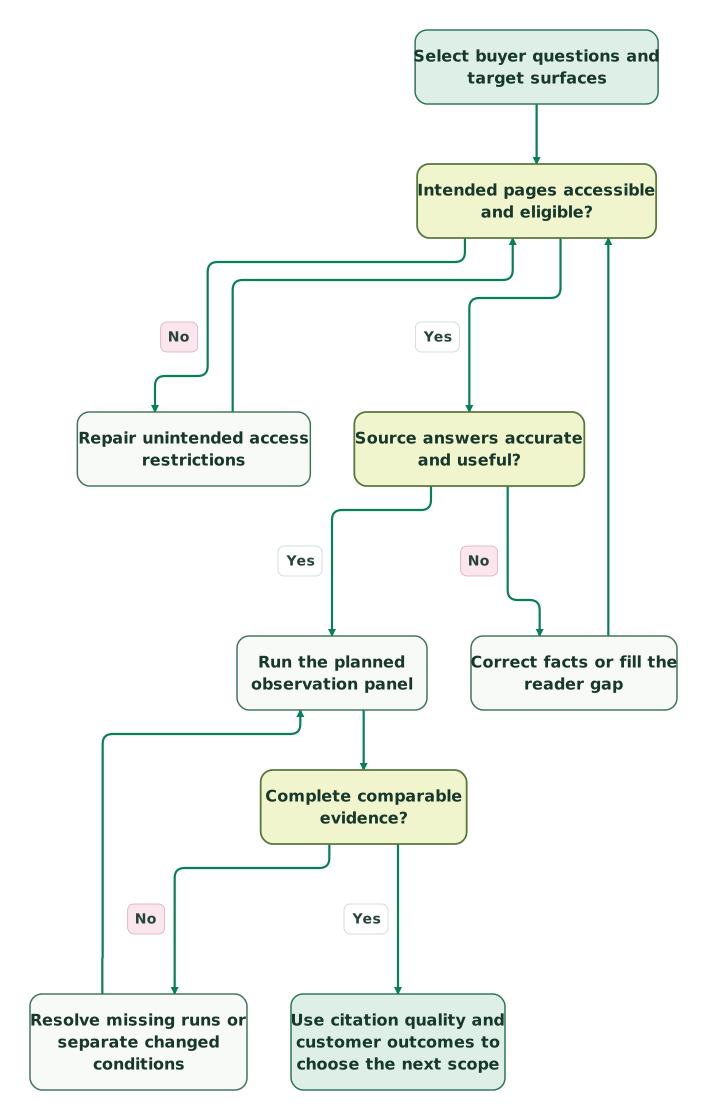
Read diagram as text
- Select buyer questions and target surfaces to Intended pages accessible and eligible?.
- Intended pages accessible and eligible? to Repair unintended access restrictions: No.
- Repair unintended access restrictions to Intended pages accessible and eligible?.
- Intended pages accessible and eligible? to Source answers accurate and useful?: Yes.
- Source answers accurate and useful? to Correct facts or fill the reader gap: No.
- Correct facts or fill the reader gap to Intended pages accessible and eligible?.
- Source answers accurate and useful? to Run the planned observation panel: Yes.
- Run the planned observation panel to Complete comparable evidence?.
- Complete comparable evidence? to Resolve missing runs or separate changed conditions: No.
- Resolve missing runs or separate changed conditions to Run the planned observation panel.
- Complete comparable evidence? to Use citation quality and customer outcomes to choose the next scope: Yes
A complete panel may show no improvement. That is a usable result. Check whether the chosen questions matter, whether the changes solved the intended gap and whether qualified visitors benefited anyway. Do not respond automatically by multiplying pages or buying more prompts.
Expand a bounded improvement when you can explain the reader benefit, preserve the evidence and afford its maintenance. Pause low-value production when it creates more outdated pages than useful answers. Keep accurate product and implementation information current regardless of the latest acronym.
Before approving the next scope:
Checklist
- Define the reader task and the specific search surface.
- Separate discovery tests from tests that supply your own URL.
- Check the intended access, indexing, snippet and AI inclusion controls.
- Verify important facts in the public response and any alternative representation.
- Record mentions, owned citations and claim support separately.
- Freeze the prompt panel, repetitions and missing-run rules before comparing results.
- Keep Google AI impressions, assistant sessions and qualified outcomes in their own denominators.
- Assign someone to maintain the facts and investigate conflicting answers.
If the pages, search controls and measurement records disagree, the $99 martech audit can identify the specific gaps and define an implementation scope. The deliverable should be a working improvement the team can verify and maintain.
Keep reading
Browse all Tracking & Attribution guides
 Tracking & Attribution
Agentic Commerce for Shopify: From Discovery to a Verified Order
Prepare Shopify for AI shopping with channel eligibility, catalog checks, checkout tests and order-level measurement across ChatGPT, Google and Copilot.
Jafrin Akter AloLast updated 16 min read
 Tracking & Attribution
What Is llms.txt? Format, Example and What It Actually Does
llms.txt is a Markdown index that points AI agents to your key pages. See the v2 format, a live example, how it differs from a sitemap and who reads it today.
Jafrin Akter AloLast updated 12 min read
 Tracking & Attribution
How to Measure AI Search ROI With GA4, Search Console and Your CRM
Work out what AI search is worth when buyers find you in ChatGPT, Gemini or AI Overviews: join GA4, Search Console and CRM data, then test the lift.
Jafrin Akter AloLast updated 16 min read
Analytics & tracking
See the implementation scope, deliverables and acceptance checks.
Questions people ask
Should you split a useful guide into a page for every follow-up question?
Usually, keep closely related questions together when the same reader needs them to finish one task. Create a separate page when the prerequisite knowledge, workflow or decision changes enough to deserve its own treatment. Otherwise, each extra page adds another place where product facts can drift. A prompt variation by itself is a weak reason to create another URL.
How should you score a citation that supports the wrong claim?
Record the owned citation and mark its claim-support check as failed. Keeping those fields separate reveals whether visibility is improving while answer quality deteriorates. Inspect the linked passage and any competing information on your site. Repair a misleading source you control, retain the erroneous answer as evidence and avoid counting that citation as an accurate recommendation in the commercial report.
Does a third-party page mentioning your business count as your citation?
It can count as a third-party mention or a third-party citation about your business, depending on the visible answer. It does not count as an owned-site citation in the register above. Preserve both categories if earned coverage matters to the programme, but never switch categories between comparison periods. Also verify whether the third-party statement is accurate before treating the mention as useful exposure.
What should you do if the assistant changes during a comparison?
Record the visible change and separate results affected by it. If the selected model, search mode or account conditions change materially, start a new comparison segment rather than presenting the combined result as a clean continuation. Preserve the earlier observations. You can still learn from them, but the changed conditions become part of the explanation for any difference you report.
What should a GEO or AEO agency commit to delivering?
Ask for a defined set of reader problems, technical checks, content improvements, observation rules and maintained evidence. Agree on who owns access settings, product accuracy and reporting. The agency can commit to those deliverables and their acceptance tests. It cannot control an assistant’s selection of sources or guarantee a citation, recommendation or sale. Review the actual scope before comparing two packages with the same acronym.
Sources
- Google: AI optimization guide
- HubSpot: AEO versus GEO terminology
- Google: AI features and your website
- OpenAI: Searching the web with ChatGPT
- Anthropic: Enable and use web search
- Google: Search generative AI control
- OpenAI: Overview of crawlers
- Anthropic: Web crawlers and site-owner controls
- Google: JavaScript SEO basics
- Aggarwal and colleagues: GEO, Generative Engine Optimization
- Google: Generative AI performance report
- Google: Default channel group definitions

Written by
Jafrin Akter AloData Engineer and Co-founder at Martechdevs and Growth and Analytics Partners
Jafrin writes practical guides to marketing technology, customer data, analytics and AI workflows. Martechdevs is a Growth and Analytics Partners company.