
How to Measure AI Search ROI With Your CRM
Data Engineer and Co-founder, martechdevs
Last updated 10 min read
Measure AI search ROI by connecting identifiable assistant visits to qualified leads, opportunities and realized customer value, then comparing that value with the cost of the work. Keep visibility, attribution and incremental impact separate. Citations show exposure; CRM records show commercial progress; neither alone proves that a content investment caused additional revenue. Preserve uncertainty instead of assigning every unexplained visit to AI.
Last updated: 25 September 2026.
A founder sees more AI citations and asks whether to expand the content budget. The marketing report shows traffic growth, while sales says the new inquiries are mostly students, job seekers and existing customers.
Both observations can be correct. The measurement system needs to connect the audience discovering the content with the audience the business can actually serve.
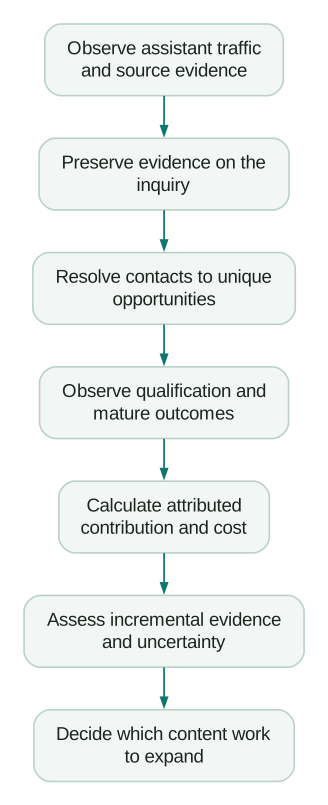
Start with analytics and tracking that preserves acquisition evidence through the form and CRM handoff. Buying another visibility score will not repair a missing lead identifier or an overwritten source field.
Separate visibility, visits and commercial outcomes
Use three layers of evidence, each answering a different question.
Visibility reports show whether a platform displayed or cited your content. Website analytics shows identifiable visits and on-site behavior. CRM and billing records show whether those visits became qualified demand and customers.
Do not divide one platform's referral visits by another platform's citation count to invent an AI click-through rate. Their populations, surfaces, reporting periods and definitions differ. A citation can also appear without producing a site visit.
For a service business, useful commercial stages might be a submitted inquiry, sales-accepted lead, qualified opportunity and signed customer. Define each stage with sales before comparing sources. A form submission is a tracking event; a qualified opportunity is a business judgment with criteria.
A smaller source with ten suitable inquiries can matter more than one with hundreds of irrelevant visits. The report should make that distinction visible rather than rewarding the largest traffic number.
What can current platform reports actually tell you?
Google now has a separate Generative AI performance report for Search. Its current help documentation describes impressions for AI Overviews and AI Mode, with page, country, date and device dimensions, and notes worldwide rollout as of 31 August 2026. This provides visibility evidence, not a CRM revenue attribution report. Google's Generative AI performance report.
Older advice that Google only provides a combined Web report is incomplete. The newer report's data is included within Web performance, so do not add the two totals together. Google's announcement also documents the rollout of the new insights. Google's updated website-owner announcement.
Bing's AI Performance reporting covers its supported AI experiences. Its June 2026 update introduced preview views for intent, topics, citation share and comparisons. Microsoft explicitly describes citation share as observational and says it does not represent traffic share or content quality. Use it to investigate visibility patterns, not to estimate sales. Bing AI visibility reporting.
For third-party prompt monitoring, preserve the exact question set, location, platform, collection date and sampling method. Changing the monitored prompts from broad educational questions to brand comparisons can improve a reported share of voice without any change in your actual audience reach. Treat the tool's sample as a sample.
Start with GA4's native AI traffic classification
Google Analytics introduced an AI Assistant default channel in May 2026 for recognized assistant referrers, along with an ai-assistant medium. Its June update added Source Group normalization, including emerging sources such as ChatGPT and Perplexity. Start with those current capabilities before copying an old regex-only setup. Google Analytics release notes.
Inspect the actual source values behind the grouped report. Keep the raw source, medium, landing URL and available referral or campaign evidence so you can investigate misclassification. A broad source string containing a vendor name can include visits that did not originate from its AI search experience.
Separate paid campaigns from organic assistant discovery. If your team distributes a tagged link in an email or advertisement, that is your campaign touchpoint even if an AI product generated the text. Do not classify traffic as AI discovery merely because AI helped create the campaign.
Use session-scoped acquisition dimensions for the question “which source brought this visit?” First-user dimensions answer a different acquisition question, and event-scoped attribution can distribute conversion credit differently. Specify the scope beside the metric so reports do not appear contradictory when they are answering different questions. GA4 traffic-source scopes.
Run controlled visits through your real funnel to verify what survives. Test the landing page, redirects, consent behavior, booking flow and form submission. A source value visible on the first page is not enough if the CRM only receives the booking provider as the source.
Preserve acquisition evidence in the CRM
Store original evidence separately from your reporting classification. The classification rules may improve later; the underlying observation should remain available.
For each inquiry, a useful record includes:
- A stable lead or contact identifier and submission timestamp.
- The original landing page and recognized acquisition source.
- The source classification rule and its version.
- The first observed and conversion-associated touchpoints, where available and appropriate.
- A separate self-reported discovery answer.
- Qualification outcome, rejection reason and associated opportunity ID.
Apply your consent and retention rules to collection and linking. Do not place personal information in analytics URLs or try to reconstruct an individual's identity from uncertain signals merely to improve attribution coverage.
Keep source fields from being silently overwritten during imports or later visits. An existing customer opening an AI-cited support article should not become a newly acquired AI-search customer. Preserve acquisition and subsequent engagement as different facts.
When several contacts belong to one opportunity, join through explicit contact-to-opportunity associations and count the opportunity once. A three-person buying committee can produce three form submissions for one deal. Summing their associated deal amounts would triple reported pipeline.
This is where CRM data hygiene becomes a measurement requirement. Duplicate records, missing account relationships and inconsistent stage dates can distort a source comparison more than imperfect referral detection.
Use self-reported discovery without rewriting observed history
Ask a brief open-ended question such as “How did you first hear about us?” at an appropriate point in the inquiry or sales process. Store the original response and a separately normalized category.
A buyer might say they first heard about the company in ChatGPT, then searched Google for the brand and booked through a direct return visit. Their answer adds useful context. It does not justify replacing all observed touchpoints with a single AI source.
Label the evidence clearly: observed assistant referral, self-reported assistant discovery, both, or neither. Avoid treating missing evidence as proof of no influence, and avoid treating all direct traffic as hidden AI traffic.
For example, suppose eighteen sales-accepted leads have observed assistant referrals and twelve report assistant discovery. Four appear in both groups. The union is twenty-six leads, calculated as 18 + 12 - 4, not thirty. Even that union describes evidence of association, not incremental leads caused by your latest content project.
Review the original responses periodically. “Used AI to compare you after a colleague recommended you” is different from “found you through an AI answer.” A single category should not erase that distinction.
Build a cohort that has had time to convert
Group leads by their acquisition or inquiry date, then observe their progression over a defined window. If your sales process commonly takes several months, comparing last week's AI inquiries with last quarter's organic inquiries produces an unfair win-rate comparison.
Choose a window based on your own sales-cycle distribution and report how many records remain open. Keep cancellations, refunds and disqualified opportunities visible. Do not convert an open pipeline amount into realized revenue just because the CRM assigns a probability.
For a recurring-revenue business, specify whether value means initial contract value, recognized revenue over a fixed period or a modeled lifetime value. Do not use a full multi-year contract in one channel and first-month receipts in another.
A warehouse can connect these stages when the relationships span analytics, CRM and billing systems. The useful deliverable is a reproducible cohort with documented joins and value definitions, not merely a dashboard labeled “AI ROI.”
Calculate an attributed result before claiming incremental ROI
Consider an illustrative mature cohort with 800 identifiable assistant sessions, forty inquiries, eighteen sales-accepted leads, six opportunities and two customers. Suppose those customers generate USD18,000 of revenue within the agreed measurement window.
Assume a 65% contribution margin before the content program's cost. The associated contribution is USD11,700. If the research, writing, design, distribution, measurement and maintenance work costs USD6,000, the attributed contribution return is:
Associated contribution = 18,000 × 65% = 11,700
Attributed contribution return = (11,700 - 6,000) / 6,000
Attributed contribution return = 95%
That is a useful accounting view under the stated attribution and margin assumptions. It is not proof of 95% incremental ROI. The customers might have arrived through existing brand demand or another channel even without the new content.
The funnel also identifies practical questions. Forty inquiries from 800 sessions is 5%. Eighteen accepted leads from forty inquiries is 45%. Two wins from six opportunities is about 33%, but a six-opportunity sample is too small to treat as a stable forecasting rate.
If visits rise but accepted leads do not, investigate query intent, page promise and offer fit before publishing more of the same material. If accepted leads rise but opportunities do not, inspect qualification and the sales handoff. The next investment should address the stage limiting useful demand.
Show how uncertainty changes the budget decision
If you cannot estimate causal lift credibly, do not hide that limitation behind a precise percentage. Show a sensitivity analysis.
Using the illustrative USD11,700 associated contribution and USD6,000 cost, assume for planning that 30% to 70% of the contribution might be incremental. These percentages are scenarios, not measured results.
At 30%, incremental contribution would be USD3,510 and return after the program cost would be negative 41.5%. At 70%, it would be USD8,190 and the return would be positive 36.5%. Break-even requires about 51.3% of the associated contribution to be incremental under these assumptions.
That range changes the decision. A founder may fund a smaller next tranche while improving measurement instead of treating the 95% attributed figure as a proven case for doubling the budget.
For a stronger test, define the content intervention and comparison before release. Matched topic groups, phased improvements or a suitable controlled design can help distinguish the work from broader platform growth. Check pre-existing trends, changes in demand, branded campaigns and spillover between groups. Search content is difficult to isolate, so an observational comparison should remain labeled as such.
The distinction is the same one covered in attribution versus incrementality: assigning credit describes a customer path; estimating lift asks what changed because of the intervention.
What should the operating report contain?
Give leadership a concise view of visibility, identifiable visits, accepted demand, mature value, program cost and the strength of causal evidence. Keep each layer's limitations beside the relevant number.
For content decisions, break the funnel down by topic and landing-page purpose. A technical guide may support evaluation across several visits, while a service comparison page may capture an immediate inquiry. Apply an explicit attribution rule rather than assigning the full deal value to every page involved.
Before presenting the report:
Checklist
- Confirm native AI traffic classifications against underlying source evidence.
- Verify that source and lead identifiers survive the complete inquiry journey.
- Count each opportunity once across associated contacts.
- Deduplicate observed and self-reported discovery evidence.
- Compare cohorts with equivalent outcome windows.
- Include production and maintenance costs using the same period as value.
- Label attributed results, modeled assumptions and measured lift separately.
Use the findings to improve the next article, its audience fit or the conversion path. A report that explains which useful content creates suitable demand is more valuable than a larger collection of unexplained AI visibility scores.
Questions people ask
Can Search Console report AI search performance separately?
Yes. Google's current Generative AI performance report provides impressions for supported Search AI features and relevant dimensions. Those visibility metrics do not directly identify individual CRM conversions, and their inclusion in broader Web totals means the totals should not be added together.
Does GA4 have an AI Assistant channel?
Yes, Google's 2026 release notes describe a native channel for recognized assistant referrers. Inspect underlying sources and your real funnel before relying on the grouping. Native classification does not make missing or ambiguous acquisition evidence complete.
Should every direct lead be treated as AI influenced?
No. Direct traffic can have many explanations, and the absence of a referrer does not identify an AI source. Keep self-reported discovery as separate evidence and leave unresolved cases unresolved.
Is AI-attributed revenue the same as AI search ROI?
No. Revenue does not account for delivery margin, program cost or whether the revenue was incremental. Define the value window and attribution rule, then distinguish an associated return from a causal estimate.
What should we do when AI traffic is too small for a reliable ROI estimate?
Report the counts, qualification evidence and uncertainty without projecting a stable win rate from a handful of deals. Use a bounded content investment and improve the measurement path while the cohort matures. Useful buyer feedback can guide the next topic even when a financial conclusion is premature.
Sources
- Google: Generative AI performance report. Accessed 25 September 2026.
- Google: New website-owner insights and controls. Updated 31 August 2026; accessed 25 September 2026.
- Bing: AI visibility reporting updates. Published 16 June 2026; accessed 25 September 2026.
- Google Analytics: 2026 release notes. Accessed 25 September 2026.
- Google Analytics: Traffic-source scopes. Accessed 25 September 2026.
Written by
Jafrin Akter AloData Engineer and Co-founder, martechdevs
Jafrin Akter Alo is a data engineer and co-founder of martechdevs, where the team has delivered 74+ martech, data and growth stack implementations.