
Snowflake Alternatives: Choose Around Your Workload
Data Engineer and Co-founder, martechdevs
Last updated 11 min read
The right Snowflake alternative depends on the work you need to run, your existing cloud, and who will operate the result. Shortlist BigQuery for a Google-centred analytics stack, Redshift for an AWS-centred one, and Databricks SQL for a lakehouse workflow. PostgreSQL or DuckDB can suit narrower reporting needs. Compare a representative workload and migration cost before committing.
Last updated: 9 September 2026.
A cheaper database can become a more expensive reporting system. The difference usually appears in the work surrounding it: rebuilding transformations, replacing data-sharing arrangements, restoring permissions, fixing dashboards and maintaining the new pipelines.
For a founder or growth lead, the useful question is whether another platform will deliver the required decisions more reliably or at a lower total cost. For the data lead, the question includes who owns the migration and what must keep working throughout it.
This guide gives you a shortlist, a workload-based evaluation and a migration decision you can defend. Our data warehouse and customer data work starts with the reports and activations the business needs, then checks the platform and operating model required to support them.
What problem are you trying to solve by leaving Snowflake?
Write the problem in observable terms before reviewing products. “Snowflake is expensive” is too broad to diagnose. “Scheduled transformations consume most of our compute bill while rebuilding unchanged history” identifies something you can investigate.
Separate these possible triggers:
- Cost: spending exceeds the value of the workloads or the agreed budget.
- Operating complexity: the team cannot maintain permissions, deployments or incident response reliably.
- Platform fit: another environment already holds the data and tools most of your work uses.
- A missing requirement: a specific workload, integration or delivery constraint is poorly served.
- Excess scope: your reporting needs are narrow enough that a full shared warehouse adds unnecessary work.
Each trigger leads to a different comparison. Moving an inefficient transformation to another engine may preserve the inefficiency. Replacing a governed shared environment with a file on one analyst's laptop may lower the bill while creating an access and continuity problem.
Collect a baseline from a representative business cycle: workload costs, refresh completion times, failed jobs, concurrent dashboard demand and engineering hours. Include a peak reporting period and a historical backfill. A quiet Tuesday is a weak basis for a platform decision.
Before a cost-driven move, inspect the current controls. Snowflake's resource monitor documentation distinguishes warehouse consumption from serverless and AI consumption, which requires budgets for monitoring. A warehouse resource monitor is therefore insufficient evidence that every category of spending is controlled. Our Snowflake pricing guide helps separate the components of that bill.
Which alternatives deserve a place on your shortlist?
Choose candidates with a plausible reason to win. The following are decision starting points based on the documented architectures, rather than a claim that any product is universally faster or cheaper.
BigQuery: evaluate it when Google Cloud is already central
BigQuery is a managed analytics platform with separate compute and storage. Google's architecture overview describes its serverless operation and SQL interfaces. That makes it a relevant candidate when your analytics team already operates in Google Cloud and your important data flows are concentrated there.
The useful pilot is a complete reporting workflow: ingest the required sources, transform them, apply access restrictions and run the actual dashboard. If a native GA4 export is central to your stack, include that dataset and its nested event structure in the test.
Cost discipline changes with the workload and pricing model. For on-demand queries, BigQuery offers a maximum-bytes-billed setting; its cost guidance explains that a query exceeding the estimated limit fails before execution. Do not assume a small result set means little data was scanned.
Put BigQuery lower on the list if the move mainly creates a second cloud operating environment without resolving a measured problem. The Snowflake vs BigQuery comparison goes deeper into that specific choice.
Amazon Redshift: evaluate it when AWS ownership matters
Redshift Serverless automatically provisions and scales warehouse capacity. AWS documents workgroups and namespaces for organising compute and data, alongside access to managed storage and S3 data.
Those capabilities make it worth testing when your source systems, data lake and engineering ownership are already in AWS. The potential advantage is operational alignment: the people responsible for network access, identity and incident response may already work in the surrounding environment.
Your evaluation still needs real queries, concurrent readers, ingestion and permissions. Ask the team to demonstrate a failed refresh and recovery, not just a successful query. An existing AWS relationship is a reason to run the pilot; it does not establish the result.
Databricks SQL: evaluate it when lakehouse work is already substantial
Databricks SQL provides a warehouse interface over a lakehouse architecture, with SQL warehouses and surrounding tools for queries, jobs and dashboards.
It belongs on the shortlist when the business already has meaningful lakehouse engineering work and wants SQL reporting to share that environment. For example, the same governed datasets may support product analysis and other data applications owned by the same team.
Make the case specific. A growth team with a few daily SaaS reports should not take on a broader platform solely because a future machine-learning project might happen. Conversely, an established Databricks team should include the cost of maintaining a second warehouse before assuming separation is worthwhile.
The Snowflake vs Databricks guide covers that decision in more detail. Your pilot should include the BI and activation tools business users depend on, including their authentication and refresh behaviour.
PostgreSQL: evaluate it for bounded reporting with clear ownership
A dedicated PostgreSQL reporting database can be a sensible candidate when the data volume, query complexity and concurrency fit the infrastructure your team can maintain. That is an operating recommendation to test, not a size threshold that applies to every company.
Keep heavy reporting isolated from the production application. A read replica may help, but it has different behaviour from an independently loaded reporting database. PostgreSQL's hot standby documentation explains that read queries can conflict with replication replay and may be cancelled.
Test the longest report while application changes are being replicated. Measure freshness as well as query time. If analysts need independent historical snapshots, transformations and source integrations, include the engineering required to build those around PostgreSQL.
This option deserves consideration when the team can clearly bound the work. It becomes a weaker choice when the proposal relies on “we will add the missing controls later” without an owner or estimate.
DuckDB: evaluate it for focused analytical jobs
DuckDB is useful to evaluate for file-based analysis, reproducible extracts and bounded analytical jobs where an embedded engine fits the delivery model. It can also be a tool within a larger stack rather than the replacement for the entire stack.
Check the exact deployment model. DuckDB's concurrency documentation distinguishes in-process operation from approaches for coordinating multiple processes. In its in-process read-write mode, writing is within one process. A shared multi-user service requires a deliberate architecture; copying a database file to a shared folder does not establish one.
Use a pilot that includes scheduling, secure data access, recovery and delivery to the people who need the result. A fast local query proves only that part of the workflow. If the business needs centrally governed dashboards, auditability and many independent consumers, account for the surrounding service you would have to provide.
What should every candidate be required to prove?
Create a workload pack that another engineer can rerun. Keep the same business definitions, source cutoff and expected outputs across candidates. Otherwise, you may compare different reports while believing you compared engines.
Include at least the following types of work when they are relevant:
Checklist
- The daily refresh: ingest representative source changes and rebuild the models used by the business.
- The important dashboard: run its actual queries with the required filters and concurrency.
- The difficult join: test the largest or most complicated customer, event or revenue relationship.
- The backfill: process a historical correction without losing newer changes.
- The outbound audience: produce the exact eligible customer set used by a CRM or messaging workflow.
- The restricted reader: demonstrate that a limited role can access what it needs and cannot access sensitive fields.
Record result correctness before evaluating speed. A query that omits refunds or duplicates subscriptions is not an acceptable faster version of the revenue report.
Treat cache conditions consistently. Record whether a query ran cold, reused a result or benefited from an already-running service. Run the concurrency scenario that resembles your users, not only a series of isolated queries.
Use a concise acceptance brief:
Business decision: Weekly acquisition investment by customer segment
Inputs: CRM deals, billing transactions and advertising spend
Source cutoff: Same completed reporting period on both platforms
Required outputs: Spend, qualified accounts and collected revenue
Correctness: Agreed totals and documented handling of exceptions
Freshness: Available before the weekly planning meeting
Load: Expected simultaneous readers plus scheduled refresh
Access: Marketing can read approved aggregates, not raw payment data
Recovery: A failed load can be replayed without duplicate records
Evidence: Saved queries, logs, totals, timings and cost records
Owner: Named person for delivery and ongoing operation
Replace qualitative requirements with your own measurable thresholds before the pilot. “Fast enough” needs a number agreed by the people using the report. “Same totals” needs a defined tolerance, with currency rounding and known source corrections handled explicitly.
How do you compare total cost rather than the headline bill?
Separate recurring cost, migration cost and the cost of interruption. This prevents a cheap compute estimate from hiding a large delivery project.
Recurring cost includes compute, storage, ingestion, data transfer, orchestration, BI connections, support and engineering time. Migration cost includes SQL changes, model testing, permission reconstruction, dashboard updates, parallel running and training.
Do not value all engineering time at zero because the engineer is already employed. That person could otherwise deliver something else. Keep the hourly cost an explicit planning assumption agreed with finance, rather than a fabricated vendor fee.
Illustrative example: a team estimates its current monthly platform cost at $1,200 and eight operating hours at an assumed $75 per hour. A candidate is estimated at $650 plus twelve operating hours. These are made-up planning inputs, not market prices or a customer result.
Current monthly cost: $1,200 + 8 × $75 = $1,800
Candidate monthly cost: $650 + 12 × $75 = $1,550
Estimated monthly saving: $250

Migration work: 80 hours × $75 = $6,000
Incremental parallel-running cost: $900
Total transition cost: $6,900

Simple recovery period: $6,900 / $250 = 27.6 months
First-year net saving: 12 × $250 - $6,900 = -$3,900
The candidate's lower platform bill produces a much smaller total saving. If it needs twenty operating hours each month instead of twelve, its monthly total becomes $2,150, which exceeds the current $1,800.
That sensitivity should influence the pilot. Ask what creates the extra operating work and whether it can be reduced. If the move also solves a material reliability or access problem, assess that benefit separately and explain the evidence. Do not bury it inside an invented monetary saving.
Our warehouse ROI guide provides a broader business-case approach. A migration estimate is strongest when the model shows which assumptions could reverse the decision.
How should you migrate if the alternative wins?
Start with a coherent business workflow and preserve a rollback path. A collection of copied tables is insufficient if nobody can use the resulting report or audience.
Inventory the dependencies behind that workflow: ingestion, transformations, identifiers, scheduled jobs, service accounts, dashboards, exports and business owners. Identify Snowflake-specific SQL or features that need a replacement, and test their intended behaviour rather than assuming a mechanical translation is equivalent.
Reconcile outputs at a common cutoff. Compare totals, distinct business keys, missing records and representative edge cases. For revenue, include refunds, cancelled subscriptions, late invoices and currency changes where relevant. An overall total can match while individual customer balances are wrong.
During parallel running, control which system can publish each outbound audience or update each destination field. Two active writers can create conflicts that a read-only reporting pilot never reveals.
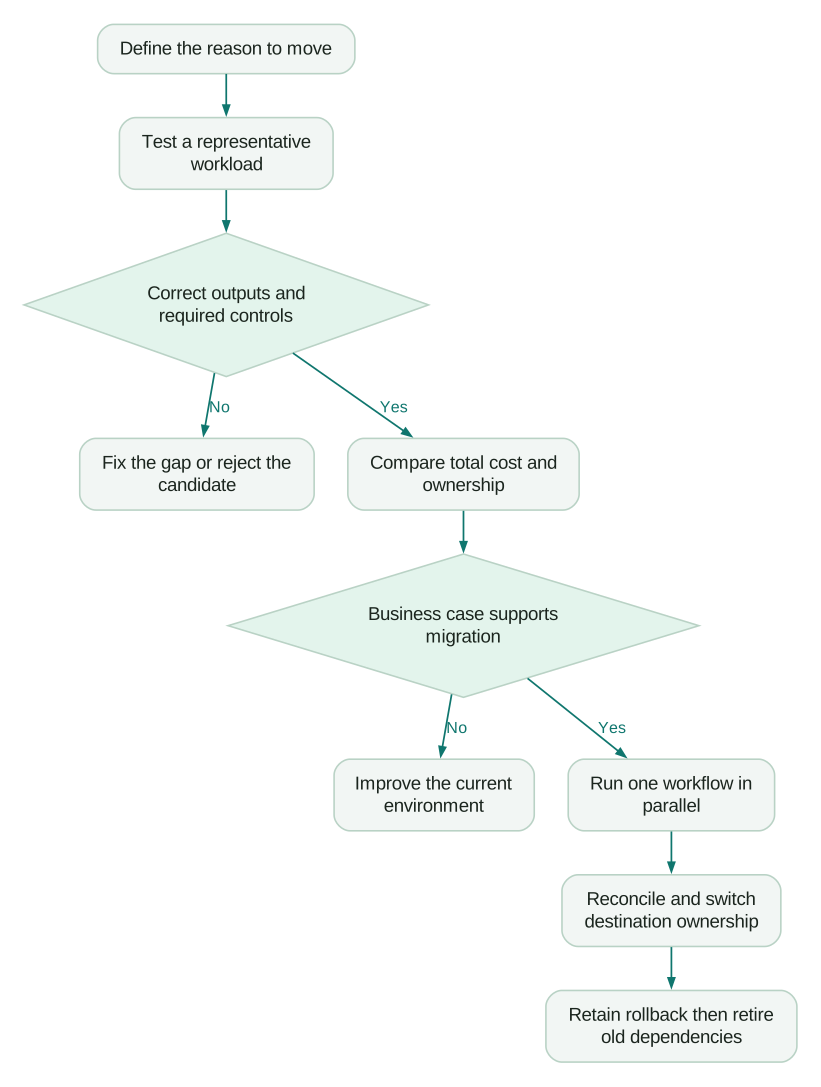
Specify the conditions for rollback before switching readers or writers. Those might include missing customer records, unacceptable report delays or a failed permission test. Keep the previous path available for the agreed validation period, with clear ownership of changes during that period.
Retire the old environment only after confirming that scheduled jobs, BI connections and downstream consumers have moved. Revisit paid commitments and retention requirements before assuming every old cost disappears immediately.
When is staying with Snowflake the better decision?
Stay when the measured problem can be resolved more cheaply in the current environment, the candidate fails an essential requirement, or the migration consumes capacity needed for a more valuable business project.
A sensible outcome can be a smaller change: rebuild an expensive transformation incrementally, isolate a workload, remove unused data or assign clear ownership to recurring failures. The Snowflake implementation mistakes guide is a useful diagnostic before funding a platform move.
If the team cannot describe the workload, its current cost or the reports that must survive, begin with a bounded assessment. A martech audit can identify that scope and the evidence needed for a platform decision. The deliverable should be a tested recommendation, an operating owner and a costed path the business can accept or reject.
Questions people ask
What is the cheapest alternative to Snowflake?
There is no universal cheapest option because workload, deployment and operating effort change the total. An embedded engine may be inexpensive for a scheduled file analysis but require substantial surrounding work for a shared reporting service. Compare the same outputs, access controls and recovery requirements, including migration cost.
Is BigQuery easier for a small marketing team?
It can be a practical candidate when Google Cloud is already part of the team's operating environment. Managed infrastructure still leaves ingestion, data modelling, permissions and cost control to organise. Test the reporting workflow and name its owner before treating platform management as solved.
Can PostgreSQL replace a data warehouse?
It can support some bounded analytical workloads when the infrastructure, models and maintenance fit the requirements. Test realistic joins, concurrent readers, historical loads and freshness. Keep reporting demand isolated from the application and distinguish a reporting database from a replica whose queries can conflict with replication replay.
Can DuckDB replace Snowflake for the whole company?
That depends on the service you need to provide around it. A local or scheduled analytical job has different requirements from a shared governed environment with multiple writers and consumers. Evaluate the deployment model, access controls, scheduling and recovery as part of the decision, rather than comparing query speed alone.
Should we migrate every report at once?
Usually a coherent workflow gives you a more manageable first cutover, provided shared dependencies are understood. Run it in parallel, reconcile the outputs and control which system writes to destinations. Move the remaining work according to dependency and business importance, with explicit rollback conditions.
Sources
- Snowflake, Working with resource monitors, documentation accessed 9 September 2026.
- Google Cloud, BigQuery overview, documentation accessed 9 September 2026.
- Google Cloud, Estimate and control costs, documentation accessed 9 September 2026.
- AWS, What is Amazon Redshift Serverless?, documentation accessed 9 September 2026.
- Databricks, Data warehousing on Databricks, documentation accessed 9 September 2026.
- PostgreSQL, Hot standby, documentation accessed 9 September 2026.
- DuckDB, Concurrency, documentation accessed 9 September 2026.
Written by
Jafrin Akter AloData Engineer and Co-founder, martechdevs
Jafrin Akter Alo is a data engineer and co-founder of martechdevs, where the team has delivered 74+ martech, data and growth stack implementations.