Server-side tracking checklist: prerequisites, launch QA and maintenance
Data Engineer and Co-founder at Martechdevs and Growth and Analytics Partners
Last updated 14 min read
A server-side tracking checklist should establish access and event rules, verify one complete delivery path, test failures before launch and assign ongoing maintenance. Each check needs an owner and evidence of the result. Start with one business event and one destination, reconcile eligible outcomes by identifier, and expand only when consent, duplicate handling, delivery and rollback behave as intended.
Use this as a quality assurance (QA) acceptance record for an internal build, an agency handover or an existing setup. A checked box should link to a test result, configuration or decision that another person can inspect. A running server and a screenshot of a fired tag are useful checkpoints, but neither proves that the business event was measured correctly.
If the investment itself is undecided, start with what server-side tracking is and when it pays. This guide owns the practical prerequisites, launch checks and maintenance record. The separate setup guide owns the configuration sequence.
What must be agreed before implementation starts?
Confirm the people who can change the system, the event being measured and the rules governing its destination. Request access for the selected route rather than collecting administrator credentials for every advertising platform.
Access and ownership
Use named accounts in the business's organization. Separate permission to inspect a configuration from permission to publish it or change infrastructure.
| Required access | Responsible owner | Minimum useful proof | Decision before work starts |
|---|---|---|---|
| Website code, theme or supported integration | Website or commerce owner | The person can change the actual production delivery path | Who reviews and releases that change? |
| Domain and routing configuration | Infrastructure owner | Access to the relevant DNS or CDN configuration | Which endpoint and hostname are in scope? |
| Google Tag Manager (GTM) containers | Tagging owner and publisher | Editing access and a named person authorized to publish | Which web and server versions are the baseline? |
| Analytics or advertising destination | Destination owner | Access to the intended property, conversion and diagnostics | Which exact destination will receive the pilot? |
| Cloud billing or managed hosting | Infrastructure and budget owners | Correct project/account and working alert recipients | Who can approve capacity or plan changes? |
| Consent configuration | Privacy and tagging owners | The approved rules and a person able to change the banner | Which states and regions must the tests cover? |
DNS, the Domain Name System, controls how a hostname resolves. A content delivery network (CDN) or load balancer can route a path on the main website instead. Confirm which team controls your chosen route; access to the website's page editor may provide neither.
For Google's Cloud Run provisioning route, the setup guide identifies a billing account and the Project Creator and Billing Account User roles. Creating a billing account requires its own role. Check the documented prerequisites against the provisioning task instead of assuming a Google login is sufficient. Cloud Run prerequisites.
Event and data decisions
Write the first event in the tracking plan template: business trigger, source of truth, occurrence time, value, currency, identifiers, destinations and allowed fields. Define the events that must not be sent, such as failed payment attempts or ineligible test activity.
Keep three identities separate: the person or account, the business occurrence and a delivery attempt. One customer can place several orders, and one order can be delivered more than once. The customer's identifier cannot serve as every purchase's duplicate-control key.
Agree how permitted browser identifiers or advertising click IDs reach the backend, where they are stored and when they may be used. Hashing a customer field does not decide whether a destination is allowed to receive it. Inspect the destination's supported field and consent requirements.
Record the hosting route and expected request volume with the people who will maintain it. Compare hosting plans by request volume, including the behavior at a limit, before choosing the cheapest visible tier.
A server-side tracking implementation should deliver these decisions and the verification evidence alongside the configuration. That makes the scope reviewable before several teams depend on the new path.
Which first event gives you a useful baseline?
Choose one event whose successful business outcome can be verified independently. A confirmed payment, accepted demo request or completed product operation is more useful than an ambiguous button click.
Start with one site, one event and one destination. Write the baseline before changing delivery:
pilot:
  business_event: confirmed_purchase
  reference: authoritative_paid_order_record
  comparison_key: merchant_scoped_order_id
  destination: one_approved_test_destination
  baseline:
    unique_eligible_outcomes: measure_before_change
    matched_outcome_ids: measure_before_change
    repeated_occurrences: investigate_separately
    delivery_delay: compare_with_agreed_deadline
  release_rule:
    consent_cases: all_required_cases_pass
    duplicate_cases: all_required_cases_pass
    missing_eligible_outcomes: explained_or_repaired
    rollback: demonstrated
This is a planning template, not a vendor configuration. Replace the labels with the actual source, destination and acceptance criteria. Record the counting unit and observation cutoff so a later comparison uses the same population.
If Google Analytics 4 (GA4) is involved, record the current share of traffic with unresolved acquisition information as a diagnostic baseline. Keep that separate from the order-coverage measure. A session-source classification cannot establish whether a paid order exists.
For a payment-led workflow, use Stripe webhook tracking to select the confirmed source event. For Shopify, start with Shopify server-side options compared before assuming a custom build is necessary.
What must the build preserve from sender to destination?
The build must preserve event meaning, required identifiers and the approved collection rules through every handoff. Follow the server-side GTM build sequence for configuration, then use the checks below to establish what it actually does.
Endpoint, domain and routing
Google strongly recommends configuring the server on a first-party domain before production traffic. Its server-container clients interpret incoming requests, and tags send selected data onward. A compatible client must claim the request before that processing can happen. Server-side tagging architecture.
For the chosen endpoint, verify domain resolution, valid Transport Layer Security (TLS) encryption, request forwarding and response behavior. Test the actual measurement path, including query strings and the request body. Configure the CDN so it does not serve a cached page or cached measurement response in place of reaching the collector.
A same-origin path and a collection subdomain are separate deployment options. Google's custom-domain guide distinguishes them from the default cloud-provider address. Do not treat a friendly hostname as proof that every cookie will persist indefinitely; WebKit's tracking-prevention rules still depend on the actual storage and routing arrangement.
Check the site's Content Security Policy (CSP), which restricts where browser requests can go. Google's routing guide lists endpoint requirements for image, connection and iframe transports. Inspect the violations and allow only what the implementation needs. Supported transports and CSP.
If Google tag gateway is included, record its scope separately. Cloudflare enables its gateway across the zone's hostnames and subdomains; individual subdomain switches are not supported. Tag triggers can restrict behavior, but that is different from turning off gateway injection for a hostname. Cloudflare zone-level scope.
Field controls and consent
Create an allowed-field list for each destination, then test both an expected field and an unexpected sensitive field. Google's transformations control event parameters exposed to tags after the client processes a request. An allowlist can also remove required parameters, so verify the resulting outbound payload. Transformation behavior.
This control does not erase information already present in the incoming request or infrastructure logs. Minimize the collected payload before it reaches those layers.
Google's documented flow passes consent choices from the banner to the Google tag, then carries consent parameters to the server container. Supported Google tags adapt to that state. Basic and advanced Consent Mode behave differently under denied consent; third-party templates need separate verification. Server-side Consent Mode.
Use Consent Mode v2 signal checks to define the expected behavior. Test a clean visit, a stored choice and a later change. Inspect outgoing requests and permitted fields for each destination. A banner screenshot proves only the visible choice, not its propagation.
Occurrence identity and backend delivery
For Meta browser/server copies, the Pixel's eventID and event name must match the Conversions API's event_id and event_name for the same Pixel. Meta documents a 48-hour receipt window for this deduplication. Preserve the occurrence key across routes and retries. Meta's duplicate-event rules.
For GA4 purchases, use the original nonempty transaction ID. Google's web-stream purchase deduplication rule is different from Meta's event-ID contract; adding an arbitrary event_id does not create universal GA4 deduplication. GA4 transaction identifiers. The Meta event-ID guide covers its destination-specific setup.
For webhooks, verify the source before dispatching analytics. Stripe requires the raw request body for signature verification, recommends asynchronous processing and warns that duplicate notifications can occur. Store delivery evidence and return a successful response promptly after safe acceptance, before slow downstream work. Stripe webhook guidance.
Keep fulfillment independent from the analytics destination. A reporting outage should create a measurable delivery exception, not deny a paid customer access. A basic server container is not automatically a durable event queue.
For GA4 server events with session context, check the required identifiers and timing separately. Google's session-attribution rules require the session ID, receipt within 24 hours of the session start and an event timestamp within that session. Preserve a later business outcome's real time instead of forcing it into an old session. Measurement Protocol use cases.
Which launch tests need recorded evidence?
Test the intended success path and the cases that could produce missing, duplicate or disallowed measurement. Use synthetic records in an approved test destination; container Preview can still send outbound requests to whatever destination the tags specify.
| Case | Expected result | Evidence to retain | Primary owner |
|---|---|---|---|
| Successful eligible outcome | Correct occurrence, value, currency and destination | Source record and matching delivery trace | Measurement owner |
| Failed action | No confirmed-outcome conversion | Failure record and absence of that conversion | Application owner |
| Reload, retry or repeated notification | Same occurrence remains distinguishable from a new sale | Stable keys and repeated-delivery result | Integration owner |
| Missing optional identifier | Documented fallback or explicit exception | Payload and diagnostic reason | Destination owner |
| Consent denied, granted and changed | Each route follows its approved behavior | Browser and outbound server evidence | Consent owner |
| Malformed or unexpected event | Rejection or quarantine before unintended forwarding | Validation outcome and exception record | Integration owner |
| Destination interruption | Failure is visible and recovery preserves identity | Attempt state, alert and controlled recovery | Runtime owner |
For server-side GTM, Preview exposes incoming requests, the claiming client, event data, tags and outgoing requests. Inspect those layers in order. Google also notes that several events can be bundled in one incoming request, so request count is not necessarily event count. Server-container debugging.
Continue beyond the fired tag. Match the occurrence with destination diagnostics or the appropriate reporting evidence after its documented processing delay. Record which evidence is unavailable rather than substituting a matching grand total.
Separate test execution from release authority. The developer can demonstrate a payload; the business owner must accept the outcome definition, and the relevant owner must accept the data-sharing behavior.
What does a useful one-event QA report look like?
A useful report reconciles unique business occurrences and explains both deliberate exclusions and technical gaps. This fictional purchase pilot illustrates the record; it is not a client result or a forecast of recoverable tracking.
Assume 1,000 paid orders in one agreed period. The approved destination rules exclude 20 orders, leaving 980 eligible orders. The browser baseline contains 870 eligible order IDs. The candidate server route contains 968 eligible order IDs.
Hypothetical counts checked on 18 October 2026. Delivery evidence is the team's own trace, not a claimed Meta event-level export.
| Measure | Count | What the count means | Decision |
|---|---|---|---|
| Paid orders | 1,000 | Authoritative business population | Keep the full denominator visible |
| Intentional exclusions | 20 | Orders ineligible for the selected destination | Verify reasons; do not resend to raise coverage |
| Eligible orders | 980 | Orders expected under the agreed rules | Use this denominator for technical coverage |
| Browser baseline matches | 870 | Unique eligible order IDs | Establish the starting gap |
| Candidate server matches | 968 | Unique eligible order IDs | Investigate the remaining 12 |
| Distinct order/event-key pairs | 992 | Includes 24 surplus occurrence keys | Repair key generation before release |
| Missing eligible order IDs | 12 | Eligible orders without matched delivery evidence | Assign an exception and retest |
Against all paid orders, coverage moves from 87.0% to 96.8%. Against eligible orders, it moves from about 88.8% to 98.8%. The 9.8 percentage-point improvement in the first measure is a collection result; it does not prove more orders or revenue.
In this scenario, a thank-you-page reload generated a new event key for an existing order. The trace therefore contains 24 surplus keys even though only 968 distinct orders are represented. Repair the occurrence-key rule and repeat the reload test. A transport retry using the same valid key should remain distinguishable from this defect.
The 32 orders absent from the candidate route have two different explanations: 20 approved exclusions and 12 technical gaps. A claim of “32 lost conversions” would combine the two. The release remains on hold until the duplicate-key cases pass and the 12 eligible gaps are repaired or explicitly resolved under the acceptance policy.
How should release and rollback be accepted?
Release only when the required cases pass and the people responsible accept the remaining exceptions. Record the web version, server version, destination settings, change time and selected traffic slice.
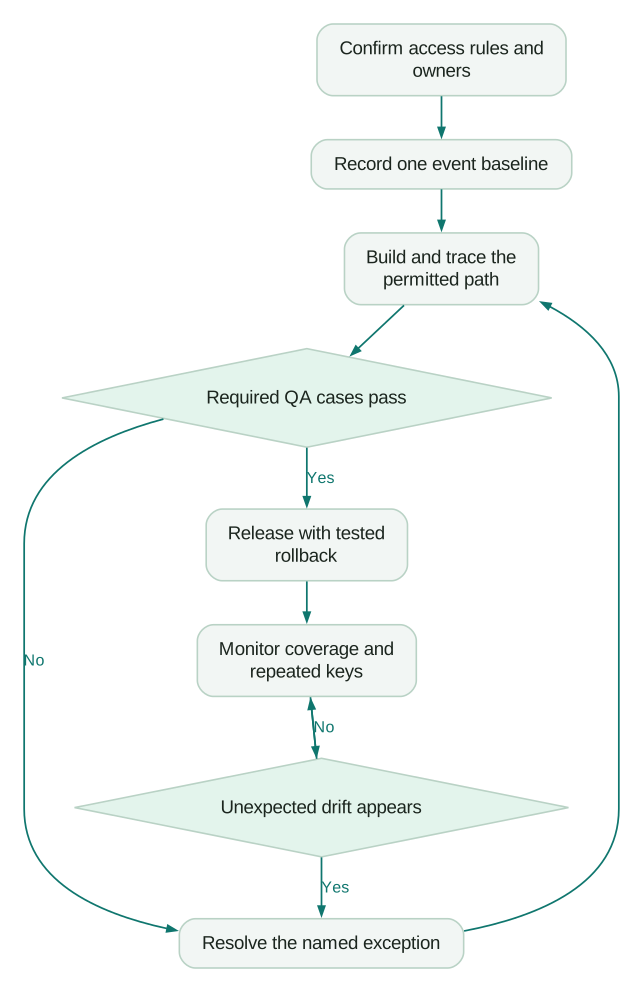
Before a parallel stream contributes to bidding, verify which conversion action is used and how the platform treats both copies. A separate test destination is often easier to reason about than hoping an extra production stream will be harmless.
Exercise the rollback with an approved test: restore the earlier route, stop the new route's overlapping dispatch and confirm that one intended outcome still arrives once under the destination's rules. Keep queued or uncertain events visible across the switch. Restoring a browser setting does not automatically settle a backend queue.
What maintenance keeps the setup reliable?
Assign recurring checks to the people who can act on the result. The schedule below is a starting operating routine; raise the frequency for critical paths, launches or known incidents.
| Cadence | Check | Owner | Evidence or action |
|---|---|---|---|
| Weekly | Delivery errors, backlog, capacity and spend alerts | Runtime owner | Incident or capacity decision tied to the affected period |
| Weekly | Unexpected repeated occurrence keys and matching trends | Measurement owner | Trace the first changed journey or producer |
| Monthly | Reconcile eligible outcomes by ID and review exclusions | Business-data owner | Coverage, duplicate and delay report |
| Monthly | Review template and tagging-server versions | Tagging owner | Version decision and regression-test result |
| Monthly | Review logging fields, retention and cost | Infrastructure owner | Remove unnecessary exposure or volume while preserving useful diagnostics |
| Quarterly | Review access, consent rules, API notices and hosting fit | Service owner | Named changes, owners and dates |
| After a relevant release | Rerun affected journey and failure cases | Releasing team | Evidence for the new version |
Google recommends updating the tagging server at least for each major version when notified. Its Cloud Run guide also warns that request logs include paths and query parameters, and can create significant cost above roughly one million requests monthly. Review logging deliberately; retaining no usable failure evidence is also an operating problem. Runtime and logging guidance.
Capacity is a design decision. The Cloud Run setup guide recommends at least two instances, while Google's broader overview recommends three for live-container redundancy. Record which deployment guidance and failure tolerance your design uses, then load-test the actual tags. Neither number is an uptime guarantee. Google's deployment overview.
Which warning signs justify a deeper audit?
Investigate a change that cannot be explained by the agreed event rules, traffic or release history. Start at the earliest failing handoff rather than changing every tag at once.
| Warning sign | First check | Useful next guide |
|---|---|---|
| Conversions jump after release | Distinct order IDs versus occurrence keys and parallel senders | Meta event deduplication |
| Acquisition context deteriorates | Client/session identifiers and actual event time | GA4 Unassigned traffic from server events |
| Matching quality falls | Permitted identifiers by source and consent state | Falling Event Match Quality |
| Endpoint responds but events disappear | Client claim, outgoing request and destination response | Diagnosing Stape delivery failures |
| Hosting usage approaches a limit | Actual request volume, plan behavior and alert recipients | Hosting plan comparison |
Checklist
- Every required check has a named owner and inspectable evidence.
- Eligibility exclusions remain separate from technical failures.
- The agreed counting unit survives retries and parallel routes.
- Test destinations and production bidding changes are explicit.
- Rollback preserves delivery state and avoids overlapping dispatch.
- Maintenance and access remain operable after the implementer leaves.
Use the server-side GTM build sequence for the implementation itself. Want a second pair of eyes on your stack? Book a free tracking audit. For a defined delivery, price a build against this checklist, including the expected evidence and handover.
Questions people ask
How should we test a hosted checkout that we cannot edit?
Use the checkout provider's supported test mode and integration interfaces, then trace a known outcome back to the permitted browser context. Record which parts of the journey you cannot instrument or inspect. The acceptance test should reflect those boundaries rather than pretend you control the hosted page. Escalate a missing required signal to the provider before adding an unsupported workaround.
What should happen when an acceptance test passes only sometimes?
Keep the test open and compare the passing and failing runs under recorded conditions. Capture the application and container versions, consent state, browser, timestamps and relevant request evidence. Repeat the suspected sequence deliberately, including timing or load differences. An intermittent pass does not establish reliability; the owner needs a reproduced cause, a bounded limitation or a verified correction before accepting it.
How should we protect the evidence shared with an implementation agency?
Prefer synthetic records and redact unnecessary customer fields before sharing traces. Keep secrets, raw authentication headers and unrelated personal data out of screenshots and exported logs. Give reviewers access to the smallest evidence set needed, with an owner and retention decision. A useful acceptance record identifies the event and result without turning a debugging attachment into another uncontrolled customer database.
What changes when purchases use several currencies?
Retain the amount and currency together for each occurrence, and reconcile in the original currency before combining totals. Agree the exchange-rate source and conversion date for any consolidated report separately. Test at least one supported non-default currency through the full path. A correct order count can hide a value defect when one destination interprets every amount as the account's default currency.
Does passing this checklist prove that historical reporting is repaired?
No. Passing the checklist establishes the tested delivery path and its acceptance period. Earlier missing or duplicated events require a separate assessment of source evidence, destination correction support and timing limits. Keep the affected historical interval visible in reports. A current configuration fix should not silently relabel old data as complete or trigger an unreviewed replay into advertising systems.
Sources
- Google: Cloud Run setup, prerequisites and operating guidance. Accessed 18 October 2026.
- Google: Introduction to server-side tagging. Accessed 18 October 2026.
- Google: Custom-domain configuration. Accessed 18 October 2026.
- WebKit: Tracking prevention. Accessed 18 October 2026.
- Google: Send data and configure CSP. Accessed 18 October 2026.
- Cloudflare: Google tag gateway zone configuration. Accessed 18 October 2026.
- Google: Server-side event transformations. Accessed 18 October 2026.
- Google: Server-side Consent Mode. Accessed 18 October 2026.
- Meta: Browser and server event deduplication. Accessed 18 October 2026.
- Google: Transaction ID deduplication. Accessed 18 October 2026.
- Stripe: Webhooks. Accessed 18 October 2026.
- Google: Measurement Protocol use cases. Accessed 18 October 2026.
- Google: Server-side debugging. Accessed 18 October 2026.
- Google: Server-side deployment overview. Accessed 18 October 2026.

Written by
Jafrin Akter AloData Engineer and Co-founder at Martechdevs and Growth and Analytics Partners
Jafrin writes practical guides to marketing technology, customer data, analytics and AI workflows. Martechdevs is a Growth and Analytics Partners company.