
Customer.io Implementation Mistakes: Events, Segments and Re-Entry
Data Engineer and Co-founder, martechdevs
Last updated 9 min read
The most damaging Customer.io implementation mistakes happen before the message is rendered: inconsistent identity, duplicate events, unsafe imports, incorrect re-entry and missing exit rules. Prevent them by specifying the business occurrence that starts each journey, the current conditions required to continue it and the evidence that proves a message should stop. Test those decisions with deliberately difficult profiles.
Last updated: 10 September 2026.
A welcome email can look perfect while the underlying automation welcomes an existing customer for the third time. A renewal reminder can contain the correct account name and still reach the wrong person because the relationship was modelled incorrectly.
Treat the implementation as a small operational system with inputs, state changes and failure handling. Our CRM and lifecycle work starts with those contracts because the copy cannot repair an unreliable audience.
Are you identifying the person consistently?
Customer.io's Pipelines documentation supports stable user IDs and email-based identification, while warning that other connected destinations may handle email identifiers differently. It also distinguishes Pipelines identity behaviour from Track API workspace settings. Choose the integration path before copying payloads from examples. Identify specification.
For a SaaS product, a stable application person ID is usually a useful design choice. Keep an email change as a change to the person's contact information. Document how anonymous activity becomes associated with that identity and what happens when the user logs out on a shared browser.
Build a short identity test using one synthetic person. Start anonymously, register, use a second device, change the email address and return to the first device. Inspect which records and events exist after every transition. Do not approve the integration merely because the welcome message arrived once.
Account membership needs a separate contract. A consultant can belong to two customer accounts. Their personal email identifies the person, but it does not determine which account's trial, permissions or renewal the message concerns. Preserve the relevant account or subscription identifier in the triggering context.
Our single customer view guide covers the wider identity model. Here, the immediate acceptance criterion is narrower: the journey must resolve to the right person and the right business context without guessing from the latest email or account name.
Do retries represent one occurrence or several?
Suppose the application records one successful workspace connection. A network timeout causes the integration to retry the event twice. The business occurrence is still one connection. If the marketing system sees three independent events, count-based segments and repeated automation entry can become misleading.
Customer.io documents event deduplication for 30 days using a stable event identifier. Pipelines uses messageId; the Track API requires an uppercase ULID in id. Reusing a person ID for every event is wrong because the identifier must distinguish actual occurrences. Event deduplication.
Persist the occurrence identifier with the event in your own system. Retry the same occurrence with the same identifier. Generate a new identifier when a genuinely new connection occurs. Treat any longer replay window as an integration responsibility rather than assuming the destination remembers duplicates forever.
For an illustrative connection event, write this contract before implementing the API request:
Business event: integration_connected
Occurrence: one successful connection of an account to a provider
Person context: actor_person_id
Account context: account_id
Occurrence identity: connection_event_id, persisted when committed
Event time: time the successful connection was committed
Retry rule: same occurrence identity and payload
New connection: new occurrence identity
Required data: account_id, provider, connection_status
Rejected data: raw credentials, access tokens, customer secrets
This is a business specification, not a ready-to-send API payload. Map it to the chosen Customer.io API and keep the mapping under version control. A reviewer should be able to tell whether two incoming records are duplicate delivery or two separate customer actions.
Could a historical import start today's automation?
A backfill is an operational change. It can alter segment membership and introduce events that satisfy live triggers. Customer.io warns that backdated events within the previous 72 hours can trigger automations. The current attribute-or-segment trigger can also admit matching historical profiles unless you add the necessary time condition. Event timestamps, trigger behaviour.
Before an import, list the automations that reference the affected fields or events. For each one, decide whether historical records should enter. “Import customers” is not precise enough. The team needs to distinguish updating their current state, restoring history and deliberately starting a new journey.
A useful migration gate is a dedicated eligibility field controlled by the migration process. For example, a new onboarding automation might require onboarding_eligible = true as well as a recent account start. Keep the gate false for established customers. Do not reuse a field that another routine integration can overwrite without knowing why it exists.
Run a small, representative batch first. Include an established customer, a recent signup, a previously unsubscribed person and someone already in an active journey. Record the expected journey entries before importing. Reconcile actual entries against that list before expanding the batch.
Also estimate the temporary profile population. Customer.io pricing explains why records counted during a cycle can affect cost even if the team later removes them. Correctness and billing should use the same migration plan.
Have you confused a trigger with continuing eligibility?
An event says something happened. A current attribute says something is true now. Both can be useful, but they answer different questions.
Consider an activation sequence that begins when an account starts a trial. At entry, the trial is active and the account has not connected its first integration. Two days later, the customer connects it. A reminder that still says “connect your first integration” is now wrong, even though the original entry event remains valid.
Specify continuing eligibility in business language: the account is still trialling, the required integration is still missing, the recipient is still an appropriate administrator and the message remains permitted. Then map each condition to a reliable current field or segment.
Customer.io provides configurable exit conditions, including attribute, event and segment criteria. Its current exit documentation describes conditions combined so that meeting any exit condition ends the journey. Removing exit conditions permits people to complete the workflow. Automation exit conditions.
Review frequency-limit retries separately. Customer.io warns that a blocked message with auto-retry enabled can still retry after the person exits the automation. For the activation example below, leave those automatic retries off and make any later reminder a fresh eligibility decision. An exit rule alone is not a guarantee that an already queued retry disappears. Frequency-limit retry behaviour.
Avoid turning every condition into an AND rule by habit. In the example, either completing the integration or ending the trial should stop the reminder. Requiring both would leave successful customers in the sequence until the trial also ended.
For a larger journey design, use key customer journey mapping. The useful unit is the customer task you are helping them complete, with a defined stopping point.
Does re-entry reflect the business event you intend?
Customer.io's attribute-or-segment automations distinguish re-matching from fixed-interval entry. Re-matching requires leaving and meeting the conditions again after the relevant journey and waiting requirements. Fixed intervals reconsider eligibility on their schedule. Object-triggered behaviour has different concurrency rules, so do not generalise one trigger's behaviour to every automation. Frequency settings.
Decide whether the journey concerns a person, an account or an occurrence. A person should probably receive a new-user welcome once. An account can have multiple renewal periods. An invoice can have multiple failed payment attempts but should still belong to one coherent recovery process.
Write an entry key at the business level even when the platform does not expose that exact key as a native configuration. Examples include person + onboarding_version, account + renewal_period and invoice + recovery_case. Use it to design upstream events, testing and reporting.
A fixed interval is not a universal deduplication rule. It might suppress a legitimate second business occurrence or repeat a message about an unchanged state. Choose it because the customer task genuinely recurs on that schedule.
What should a complete activation test look like?
Use an illustrative journey for account administrators who have not connected the first integration. A trial starts on Monday. The first reminder can become eligible on Tuesday. A second reminder is considered later only while the integration remains missing and the trial remains active.
Define expected outcomes for these six cases:
- A new eligible administrator enters and receives the first permitted reminder.
- A duplicate delivery of the trial event produces no additional business journey.
- The account connects its integration before the reminder, so the reminder is stopped.
- The person loses administrator access while waiting, so they receive no further setup instruction for that account.
- The account cancels its trial while waiting, so the activation sequence ends.
- A historical import updates an established account without starting onboarding.
Add the difficult multi-account case. The same person administers account A, which has completed setup, and account B, which has not. The message must reference B and must not infer its state from A. If the implementation cannot preserve that distinction, simplify the first launch to a supported audience while repairing the model.
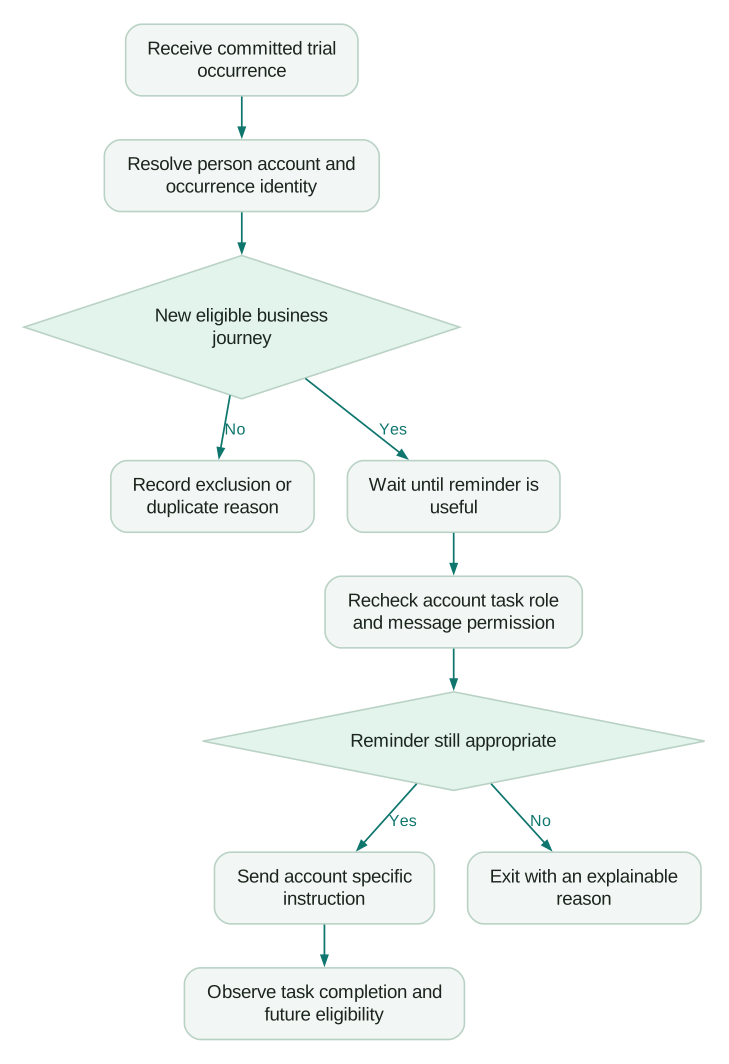
Keep the test's expected results separate from the observed results. An unchecked case is not a pass. This guide describes the tests to run; it does not claim they have been executed in your workspace.
Are subscription records actually controlling delivery?
Customer.io separates delivery preferences from consent history and open-tracking consent. Topic and channel preferences are evaluated through the enabled subscription centre, while consent records preserve evidence. A stored consent record alone does not control who receives a message. Consent and subscriptions.
Trace one preference change from the customer-facing control to the actual delivery decision. Verify the field or preference that changes, its synchronisation path, the message's classification and the resulting eligibility. Test the negative case by confirming that a disallowed message does not send.
Keep service-critical communication and optional promotion classified deliberately. A purchase or account event does not automatically justify every later campaign. If the team needs jurisdiction-specific consent decisions, get the policy settled with the responsible legal or privacy owner and implement that policy consistently.
What evidence should you require before launch?
The launch record should let another operator explain a particular customer's outcome. Store the source event identifier, resolved person and account, entry time, eligibility decisions, message state and exit reason where your reporting architecture can reconcile them. Avoid logging secrets or unnecessary personal content.
Checklist
- Identity transitions produce the intended person and account associations.
- Retrying one occurrence does not create another business journey.
- Historical import cases produce the documented entries and exclusions.
- Completing the task, losing the role or ending the trial stops unsuitable reminders.
- A multi-account person receives content for the correct account.
- Preference changes affect actual delivery, including a tested no-send case.
- The operator can distinguish no entry, early exit, suppressed delivery and failed sending.
Launch one useful automation with this evidence before expanding the library. The next automation should reuse proven identity and event contracts while specifying its own entry, re-entry and exit rules. That creates reliable reuse without forcing unrelated customer tasks into one template.
Questions people ask
Should every automation start from an event?
Choose an event when the useful response follows a specific occurrence. Use current-state or date conditions when the customer task depends on an ongoing situation or scheduled milestone. In either case, define what makes the message unsuitable later.
Can we rely on a waiting period to prevent duplicate messages?
A waiting period controls timing, while duplicate handling controls repeated delivery of the same occurrence. Design both explicitly. Test a genuine second occurrence as well as a retry so the safeguard does not silently discard valid work.
Should we import all historical events before building journeys?
Import the history that supports a clear operational or analytical need. First establish its effect on live automation and validate a representative batch. Keep history in the warehouse when the messaging platform does not need it to make a decision.
Why did a customer complete the task and still get a reminder?
Trace whether the completion reached the correct account, updated the expected state and satisfied an exit or pre-send condition. Compare the event time with processing and send times. The answer can be delayed data, incorrect relationships or missing continuation rules rather than faulty email copy.
Who should own implementation quality after launch?
Assign the lifecycle owner responsibility for journey intent and eligibility, with engineering responsible for source-event and identity contracts. Both should participate when a change affects customer-visible behaviour. Keep a named operator for investigating delivery exclusions and failures.
Sources
- Customer.io Identify specification. Accessed 10 September 2026.
- Customer.io event tracking and deduplication. Accessed 10 September 2026.
- Automation triggers, filters and frequencies. Accessed 10 September 2026.
- Automation exit conditions. Accessed 10 September 2026.
- Consent and subscriptions. Accessed 10 September 2026.
- Customer.io frequency-limit retry behaviour. Accessed 10 September 2026.
Written by
Jafrin Akter AloData Engineer and Co-founder, martechdevs
Jafrin Akter Alo is a data engineer and co-founder of martechdevs, where the team has delivered 74+ martech, data and growth stack implementations.