
PostHog Alternatives: Choose the Capabilities You Actually Need
Data Engineer and Co-founder, martechdevs
Last updated 10 min read
Choose a PostHog alternative by identifying which decisions and application behaviors depend on it. A team using only website goals needs a different replacement from one using product funnels, replay and release flags together. Compare the smallest useful replacement against a better configured PostHog setup, then test the handoffs between tools before removing the existing SDK.
Last updated: 2 September 2026.
A product catalog makes replacement look simple. Pick one analytics tool, one replay tool and one feature flag tool. The difficult work starts when a support investigation needs all three to explain the same customer journey.
This guide is for founders and product leads considering a smaller setup or separate specialist tools. The aim is to preserve useful decisions without rebuilding capabilities nobody uses. It covers selected alternatives for four jobs, rather than pretending every product is a complete PostHog substitute.
What would stop working if you removed PostHog?
Start with actual dependencies. PostHog documents product analytics, replay, flags, experiments, surveys, warehouse and other capabilities. Your installation may use only a few. Its breadth is a reason to inventory usage, not evidence that every replacement requires the entire catalog. PostHog documentation
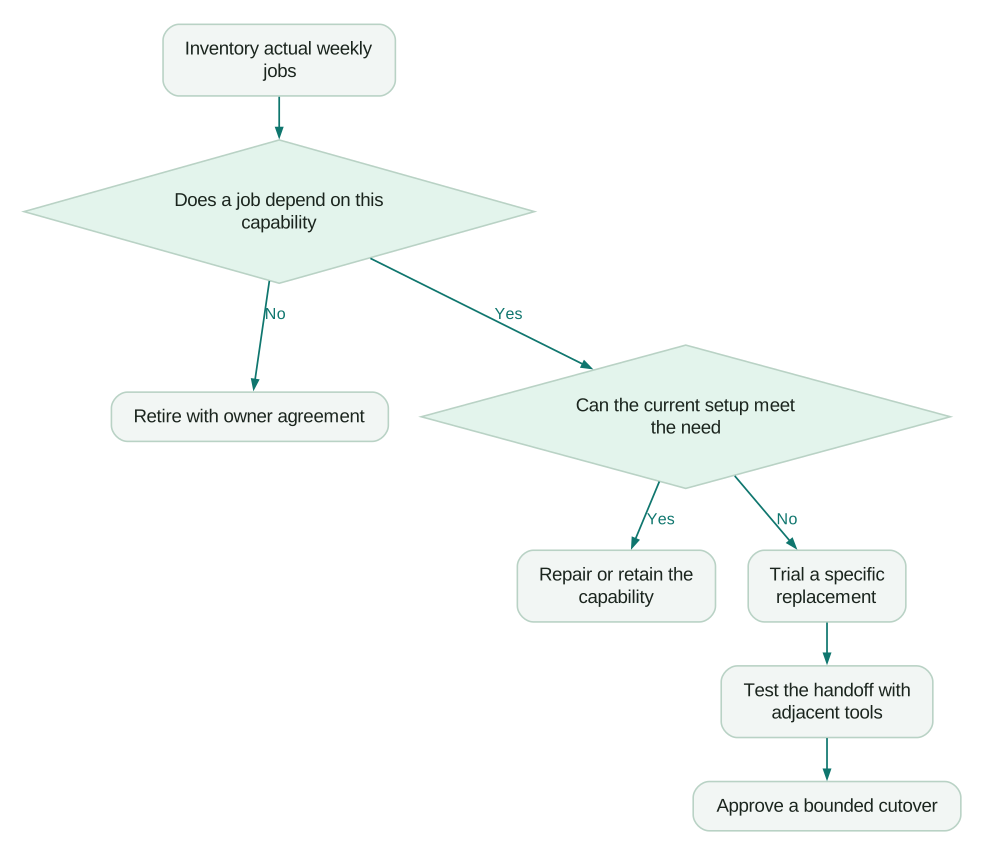
Review the previous month of work with the people responsible for it. For each decision or application behavior, record:
- The question or action, such as finding onboarding failures or enabling a new billing flow.
- The person who uses the result and how often.
- The source events, identities and configuration it depends on.
- The consequence if it disappears for a week.
- Whether an existing system can already perform the job adequately.
Separate a report people enjoy looking at from a control the application executes. Losing a dashboard may delay analysis. Removing a flag client without replacing its behavior may change what customers can access.
Our product analytics work starts with those decisions and the underlying event model. If the real problem is unreliable success events or merged identities, a new interface will inherit that problem unless the implementation changes too.
For each capability, choose one of four outcomes: retain, replace, simplify or retire. Retiring a feature requires an owner to accept the consequence. Silence from a team that has not reviewed the dependency is not approval to delete it.
Which alternative fits each job?
Plausible for website traffic and conversion goals
Plausible is worth evaluating when the core question is which public pages and campaigns lead visitors to useful website actions. It supports custom events and goals; goal names must match the events being sent. Custom events count toward its billable monthly pageviews. Plausible custom events
The important boundary is identity. Plausible describes daily visitor identifiers specific to a website and device, without recognizing the same visitor across days or devices. That makes it a different model from an authenticated customer history, not simply another interface for the same data. Plausible data policy
A practical trial should answer whether a content lead can identify pages contributing to trial requests, distinguish campaign sources and validate a completed request. Do not substitute button clicks for accepted submissions merely because clicks are easy to collect.
If the product team needs to follow a workspace from signup through its third month of usage, keep that requirement elsewhere. Do not attempt to force persistent customer identification into a tool selected for its different identity approach.
Mixpanel for event sequences and product conversion analysis
Mixpanel is a candidate when the central job is examining how users progress through meaningful product events. Its Funnels report measures conversion between events within a defined time window. Evaluate that workflow using your real activation definition, not a demo with convenient sample data. Mixpanel Funnels
The buying question is whether a product manager can investigate the failed transition without needing an engineer to rebuild the report. For example, can they distinguish an export that was requested from one that finished, filter by the account's state at the time and explain repeated attempts?
Do not classify Mixpanel as an analytics-only product based on an old comparison. Its documentation also includes replay, feature flags and experiments. Check the precise capability and plan you would buy before adding separate vendors automatically.
For a deeper comparison of the event analytics job, use PostHog versus Mixpanel. Here, the decision is whether a specialist workflow justifies another data boundary in the stack.
Microsoft Clarity for website behavior investigations
Clarity is a candidate when replay and heatmaps are the missing evidence in a website improvement process. Treat it as a way to examine interaction patterns and investigate specific failures, not as proof that a payment settled or a sales opportunity qualified.
Retention affects the operating model. Microsoft documents 30 days for playback data and nine months for labeled or favorited sessions and heatmap data. A team reviewing an old complaint needs to know whether the necessary evidence will still exist. Clarity retention
Masking also needs explicit review. Clarity's documentation distinguishes masking modes, keeps input boxes and dropdowns masked, and says masking changes affect new recordings rather than past ones. Do not wait until a recording contains a sensitive screen to decide what should have been excluded. Clarity masking
The trial should include a synthetic account with obviously fake sensitive text, a failed form interaction and the exact page state a support person would investigate. Confirm useful behavior remains visible while restricted content does not. Configure collection according to the consent and privacy requirements that apply to your site.
LaunchDarkly for release controls and flag evaluation
LaunchDarkly is worth evaluating when feature delivery has requirements beyond the analytics team's immediate needs. The proof should focus on safe application behavior: correct targeting, initialization, fallback behavior and the ability to reverse a release.
Its JavaScript SDK documentation describes context-based initialization and fallback values before the client is ready. It also documents observability and replay plugins, so a separate replay purchase should not be assumed necessary without reviewing the chosen configuration. LaunchDarkly JavaScript SDK
A successful flag migration is not a matching list of flag names. The same customer should receive the intended treatment, and the application should behave safely when configuration is delayed or unavailable. SDK versions have different interfaces; test against the version your application actually uses.
If a feature flag is also an experiment, preserve the experimental unit and exposure definition. A user assigned a variation is not necessarily a user who saw it. Changing those definitions mid-experiment can make the before and after results incomparable.
How do you select a smaller stack without creating gaps?
Use a capability deletion exercise before a procurement exercise. Imagine removing each current capability for one week and describe the specific decision or behavior that becomes impossible.
Consider this illustrative SaaS team:
- Marketing reviews which articles generate accepted trial requests every Monday.
- Product investigates where new workspaces fail to finish their first report.
- Support watches a few relevant recordings after an issue is reported.
- Engineering gradually releases a revised report editor.
- Nobody uses the current survey feature or warehouse connection.
The fifth item does not need a replacement merely because it exists in the platform. The other four need explicit owners and evidence.
The team might trial a focused website tool while retaining PostHog for the product. It might keep PostHog unchanged after repairing the event model. Or it might replace product analytics and release controls separately because different teams need different operating workflows. All are plausible outcomes; the inventory does not predetermine a migration.
A useful requirement is narrow enough to fail. “Good analytics” cannot fail a trial. “The product lead can isolate workspaces whose first report failed after a release, then locate permitted diagnostic evidence without sharing customer email” can.
What should a cross-tool acceptance test contain?
The most revealing test crosses the boundary that an integrated platform currently hides. Use a fake workspace, synthetic events and a known release variation. This is a proposed test design, not a claim that these products have been tested together.
Imagine workspace qa_workspace_41 receives editor variation new_editor. Its first report fails validation, its second succeeds and its owner then views a help article. The expected business result is one successfully activated workspace, with two report attempts and one failure.
Record a small handoff contract in your tracking specification:
workspace_idis an opaque internal reference, shared only with destinations approved to receive it.report_attempt_iddistinguishes the two attempts.release_keyandvariationdescribe the experience relevant to the attempt.occurred_atuses an agreed timestamp format and timezone.resultcomes from the application outcome, rather than a guessed button state.- The support lookup procedure explains how to find a permitted recording, or states that no recording should exist.
Not every destination needs every field. A public website analytics tool using aggregate visitor measurement should not receive customer identifiers merely to make this exercise convenient.
Then run three variations. In the normal case, the analyst should identify the failed and successful attempts correctly. In the no-recording case, the business event should still be usable without implying that replay exists. In the delayed-flag case, the application should use its intended fallback and the measurement should describe the experience actually delivered.
The gap you are looking for is a plausible but false explanation. A report that joins the failure to a variation assigned later can look persuasive. A recording from another member of the same workspace can also look relevant while showing a different journey.
How much coordination does the replacement create?
Subscription prices are only one input. Estimate the recurring work that separate tools create: SDK releases, identity mapping, access reviews, privacy configuration, retention differences, report reconciliation and incident investigation.
Use a workload budget before converting everything into money. In a hypothetical team, the current setup takes two hours a week to maintain. A proposed combination is expected to require three hours of routine maintenance and two hours of reconciliation. That is three additional hours a week, or about 13 hours in an average month using 52 weeks divided by 12.
Those hours are a planning assumption, not a vendor benchmark. During the trial, measure actual time spent answering the same question in both setups. If the new workflow saves product managers ten hours but adds three engineering hours, decide using the team's constraints and the value of the decisions, not a blended hourly rate that hides scarce engineering capacity.
Check duplicate collection too. An event sent to three destinations may create three bills, three deletion responsibilities and three ways for a schema change to break. The PostHog pricing guide helps separate products and usage units before comparing them with a replacement quote.
How should you migrate safely?
Migrate one bounded capability first. A public website report is usually a different change from a production flag dependency. Give each its own acceptance evidence and rollback plan.
For analytics, preserve a dated copy of the old metric definitions and record where historical data will remain accessible. Compare a known fixture before comparing aggregate totals. A close total can hide two errors that cancel each other out.
For feature controls, separate observation from control. Do not let two systems independently choose the live experience during a trial. One should remain authoritative while the other is evaluated through a deliberate test design.
Use the tracking plan as the shared contract for names, identities, event ownership and destination rules. Then require these checks before removal:
Checklist
- Every active application dependency has an owner and a replacement or retirement decision.
- The synthetic two-attempt journey produces the agreed business counts.
- Restricted identifiers are excluded from destinations that do not need them.
- Replay retention and masking support the actual support workflow.
- Flag initialization and unavailable-service behavior are tested in the application.
- Historical definitions and the cutover date remain accessible.
- The team can reverse the change without enabling duplicate business events.
The final decision should name the capability being improved, the evidence that improved and the operating cost accepted. “We replaced PostHog” is a project description. “Support can diagnose report failures while product retains consistent activation counts” is a useful outcome.
Questions people ask
What is the best PostHog alternative for a small website?
Plausible is a candidate when the main needs are traffic sources, pages and website conversion goals. Validate the goals you actually use and accept its different visitor identity model. A website tool is not automatically a substitute for authenticated product analytics.
Can I replace PostHog with Microsoft Clarity?
Clarity can cover selected replay and heatmap investigation needs. It does not make the other capabilities your application relies on disappear. Inventory product reports, release controls and data integrations before treating it as a complete replacement.
Is a separate feature flag platform necessary?
Only if the required release workflow justifies it. Test targeting, initialization, fallback behavior and ownership against the current setup first. A separate platform also creates a measurement handoff that needs to preserve the actual experience delivered.
Should all tools use the same customer ID?
Use a consistent approved reference where cross-system analysis requires it, but do not send identifiers everywhere by default. Some destinations deliberately use a different identity model. The contract should specify both the joins you need and the destinations that must not receive customer-level data.
How long should the comparison run?
Run it long enough to execute the required decisions and failure scenarios, rather than choosing an arbitrary number of days. A weekly reporting workflow needs a complete cycle; a release-control trial needs successful and unsuccessful initialization cases. Historical retention questions require a separate plan because a short trial cannot recreate months of evidence.
Sources
- PostHog documentation and product directory, accessed 2 September 2026.
- Plausible custom event goals, accessed 2 September 2026.
- Plausible data policy, accessed 2 September 2026.
- Mixpanel Funnels overview, accessed 2 September 2026.
- Microsoft Clarity data retention, accessed 2 September 2026.
- Microsoft Clarity masking content, accessed 2 September 2026.
- LaunchDarkly JavaScript SDK reference, accessed 2 September 2026.
Written by
Jafrin Akter AloData Engineer and Co-founder, martechdevs
Jafrin Akter Alo is a data engineer and co-founder of martechdevs, where the team has delivered 74+ martech, data and growth stack implementations.