
Salesforce Alternatives for Smaller Revenue Teams
Data Engineer and Co-founder, martechdevs
Last updated 8 min read
A smaller revenue team should consider a Salesforce alternative when the system's administration and customisation exceed the value of the processes it supports. Evaluate HubSpot for shared customer operations, Pipedrive for focused pipeline work, Attio for flexible relationships and Zoho CRM for controlled process transitions. Preserve essential permissions, history and integrations before simplifying.
Last updated: 8 September 2026.
A company can outgrow an improvised CRM and later discover that its replacement is more complex than the work requires. That does not make Salesforce the wrong product for every small team. It means the operating model and the implementation need to be examined separately.
Before switching, identify which complexity is necessary and which accumulated through old decisions. Removing unused automation may solve more than replacing the platform.
If commercial ownership and data flows are unclear, CRM and lifecycle design should produce the requirements against which both repair and migration are evaluated.
Is Salesforce the problem, or is the implementation?
Take the last five changes the team needed. Record how long each took, why it required specialist help and which business requirement drove the complexity.
Examples might include adding a field, changing lead assignment, correcting a report, updating a finance integration and altering a permission rule.
Then classify the causes:
- The requirement is genuinely complex.
- The implementation has avoidable dependencies.
- Nobody owns the configuration.
- The required capability is absent from the purchased package.
- The team does not understand the existing setup.
A new CRM may help with the second and fourth categories. It will not automatically resolve the third or fifth.
Salesforce itself offers different packages and capabilities, so do not compare a hypothetical top-tier configuration with an entry-level alternative. Use the edition, additions and support your team actually needs. Salesforce sales editions
The Salesforce implementation mistakes guide provides concrete tests for identity, automation and access. If those tests expose repairable problems, price the repair before committing to a move.
What must survive a simpler CRM?
Simplification is valuable when it removes unnecessary work while preserving essential meaning.
Write five non-negotiable outcomes:
- A seller knows the next action and customer context.
- A manager can trust the agreed pipeline measures.
- Finance receives accurate commercial information.
- Access matches each person's role.
- Integrations preserve identity and expose failures.
Add any business-specific requirements such as partner ownership, multiple legal entities, contract approvals or product usage context.
Do not translate these outcomes immediately into old field names. A field may exist because of an obsolete workflow, while the business outcome still needs a different representation.
For each required outcome, identify the smallest complete test. “Supports custom fields” is weak evidence. “A manager can report renewals by contract end date without double-counting expansions” is a useful test.
HubSpot when shared customer context matters most
HubSpot is a candidate when sales, marketing and service need to work around related customer records.
Its object model includes contacts, companies, deals and other business entities, with associations between records. Availability and connected tools depend on the subscription. HubSpot objects and associations
The evaluation should focus on whether teams can complete their work with fewer handoffs. A seller should see relevant marketing context; a service owner should understand the account; a renewal owner should know which commercial relationship is at stake.
The migration risk is assuming Salesforce concepts have exact equivalents. A custom object, campaign relationship or opportunity role may need a different design rather than a direct field copy.
Map the business meaning first, then build the destination model. The Salesforce-to-HubSpot migration guide is useful for planning that transition.
HubSpot is less compelling when the company does not need the wider customer workflow or cannot justify the relevant configuration. Confirm the required subscription and user access before treating a demonstration as your eventual setup.
Pipedrive when disciplined selling is the main job
Pipedrive is a candidate when the team needs a focused pipeline, reliable activities and practical follow-up more than extensive custom business applications.
Its current feature documentation distinguishes core pipeline work from higher-tier email, automation, reporting and team controls. Evaluate the tier that satisfies your requirements, not the entry product alone. Pipedrive plan features
Run a seller's morning routine:
- Identify neglected opportunities.
- Review the last meaningful interaction.
- Schedule or complete the next action.
- Progress a deal using the agreed criteria.
- Hand a won deal to the next owner.
The gain to measure is clarity and consistency. Count missing actions and ambiguous ownership before and after the trial exercise.
The trade-off is the scope of the model. If your Salesforce org represents several linked commercial entities, prove how the destination handles them. Do not flatten contracts, subscriptions and implementation projects into one deal simply to make an import easier.
Use the Pipedrive pricing guide to account for add-ons and non-sales access that the proposed workflow needs.
Attio when the relationship model needs flexibility
Attio is worth evaluating when your team wants to organise work around relationships that do not fit a conventional pipeline.
Its model separates objects, record attributes, lists and views. That distinction can support a design where shared entity facts remain separate from process-specific details. Attio data model
The useful trial is a relationship problem, not a pretty contact list.
For example, take a customer with two active product workspaces, a renewal and a separate partnership agreement. Ask the candidate configuration to show the responsible owner and next action for each without duplicating the customer.
The trade-off is that flexibility requires an owner. Your team still needs to define entities, references, lifecycle fields and integration rules. A smaller interface does not eliminate the modelling work.
If the goal is to avoid all administration, a flexible CRM may recreate the original frustration. It becomes attractive when the team can maintain a clear model with less unnecessary machinery.
Zoho CRM when consistent process execution is the constraint
Zoho CRM's Blueprint is a candidate for teams that need controlled progress through a defined process. It uses process states and transitions, and its official tutorial lists Professional, Enterprise and Ultimate availability. Zoho Blueprint, edition requirements
Test a process such as discount approval or proposal readiness. The system should require the relevant evidence, identify the transition owner and support a legitimate exception.
The trade-off is rule maintenance. Moving a complicated approval process into another platform does not make it simple. Remove requirements that lack a business purpose before rebuilding them.
Do not choose it because a large capability list appears to replace every Salesforce feature. Choose it if the actual process becomes easier to operate with the configuration and skills available.
A worked decision: eight sellers and a finance dependency
Consider an illustrative company with eight sellers, one sales manager and a finance lead. Its Salesforce setup contains 60 custom fields and 18 automations, but the number of components is not itself evidence that it should leave.
The assessment finds three different categories:
- Twenty fields have no active user or report dependency.
- A finance integration uses a stable customer identifier and four required commercial fields.
- Two approval paths enforce genuinely different discount policies.
The team can retire the unused fields after confirming their dependencies. It cannot safely remove the finance identity or approvals simply to make a new CRM feel lighter.
Build the same proof in each candidate:
- Create a qualified opportunity.
- Request a discount requiring approval.
- Record the authorised result.
- Close the opportunity.
- Send the correct customer reference and commercial values to finance.
- Handle a rejected finance update.
- Correct it without creating another customer.
A candidate that makes the first four steps easy but leaves the last three as an undocumented spreadsheet process has not passed.
The team might select a simpler CRM plus one well-owned integration. It might also discover that repairing the present Salesforce setup is the least disruptive route. Either outcome is valid because it follows evidence from the actual operation.
How do you preserve data without importing every old field?
Create a migration register with four categories: operational records, historical evidence, configuration and retired material.
Operational records need to work in the new CRM. Historical evidence may belong in a searchable archive. Configuration needs interpretation and rebuilding. Retired material needs an explicit decision so it is not accidentally recreated.
Salesforce's bulk tools support export and detailed import outcomes. Retain source IDs and reconcile successes, failures and unprocessed rows during rehearsals. A file download alone does not prove that history and relationships have a usable destination. Salesforce bulk data tooling
Pay particular attention to:
- Activities associated with more than one record.
- Past ownership and stage changes used in reports.
- Files and signed documents.
- Deleted or merged records referenced elsewhere.
- Currency and date interpretation.
- Preferences and suppression fields.
- Custom entities that do not have a direct destination equivalent.
Define how people will find older evidence after cutover. “It is somewhere in a CSV” is rarely enough for a live customer conversation.
What should decide the final choice?
Evaluate three outcomes together: user work, operational control and total ownership cost.
The smallest interface is not always the simplest system. A platform with fewer built-in capabilities may need more external tools and reconciliation.
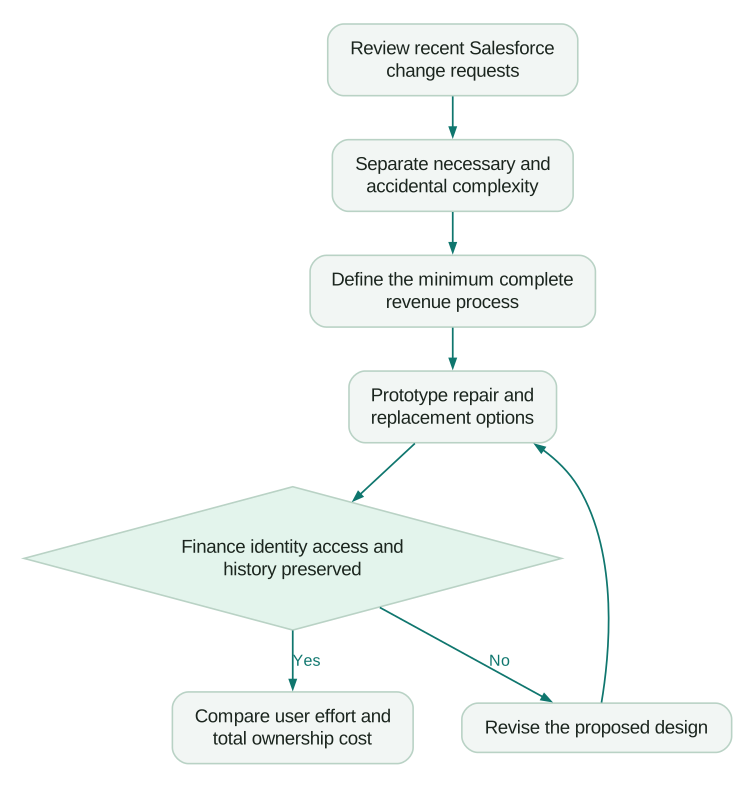
Use this acceptance record:
Checklist
- The proposed design removes a named source of unnecessary work.
- Essential approvals remain enforceable.
- Finance receives the correct customer identity and commercial facts.
- Restricted data remains restricted for ordinary roles.
- Active opportunities retain enough context to continue.
- Historical evidence has an accessible destination.
- The manager's agreed report reconciles.
- Every new integration has monitoring and a recovery owner.
- The transition cost includes training and parallel operation.
- A cutover rehearsal passes before the old system is retired.
Our HubSpot alternatives guide also explains how splitting a platform changes ownership costs. Use the same discipline here: price the complete operating design, including the work someone must do every week.
Questions people ask
Is Salesforce too complex for a small team?
Not necessarily. Complexity should be judged against the processes, controls and integrations the business needs. A small team with demanding requirements may justify it, while another may benefit from a narrower setup.
Which alternative is easiest to adopt?
That depends on the team's existing workflow and the amount of configuration required. Test ordinary tasks with real roles and representative records. A short demonstration is not reliable evidence of adoption effort.
Should we reproduce all Salesforce custom fields?
No. Identify active dependencies and the business meaning of each field first. Retire unused fields deliberately and preserve important historical evidence in an appropriate archive.
Can we keep Salesforce for finance and move sales elsewhere?
Possibly, but two systems introduce identity, ownership and synchronisation work. Specify the authoritative system for each fact and the behaviour when updates conflict or fail. Treat the integration as an ongoing product responsibility.
How do we compare migration against repairing Salesforce?
Estimate both against the same complete operating requirements. Include configuration, data cleanup, training, integrations and ongoing administration. Prefer the option that reliably supports the business with less total work and acceptable transition risk.
Sources
- Salesforce sales editions. Accessed 8 September 2026.
- HubSpot objects and associations. Accessed 8 September 2026.
- Pipedrive plan features. Accessed 8 September 2026.
- Attio data model. Accessed 8 September 2026.
- Zoho Blueprint. Accessed 8 September 2026.
- Zoho Blueprint tutorial. Accessed 8 September 2026.
- Salesforce bulk data tooling. Accessed 8 September 2026.
Written by
Jafrin Akter AloData Engineer and Co-founder, martechdevs
Jafrin Akter Alo is a data engineer and co-founder of martechdevs, where the team has delivered 74+ martech, data and growth stack implementations.