
Speed to lead: measure the real delay and build a response process that works
Data Engineer and Co-founder, martechdevs
Last updated 11 min read
Speed to lead is the time between a buyer's request and your first relevant response attempt. Improving it starts with finding where the request waits: before it reaches the CRM, before an owner is assigned, or after the notification arrives. A fast automated receipt can help the buyer, but it should not hide an unanswered sales request.
Last updated: 13 October 2026.
The useful target is a timely, informed response through an appropriate channel. A team that instantly calls every content downloader can improve its response metric while making the customer experience worse. Define which requests need sales attention before tightening the clock.
What the famous response-time statistics actually establish
HBR's 2011 article reported nearly sevenfold qualification likelihood for under-hour attempts versus an hour later; companies responding within a month averaged 42 hours. 2011 article, InsideSales' later recap.
The separate “100×” figure has a source. The 2007 InsideSales.com/Oldroyd report analysed three years of platform data from six companies, with more than 15,000 web leads and 100,000 call attempts. It reported a roughly hundredfold difference in contact odds and a twenty-onefold difference in qualification odds between five- and thirty-minute calls. The report explicitly excluded close ratios. Original report, Part 2.
Read those findings as historical evidence about response timing. They do not establish your current conversion rate, a guaranteed revenue multiplier or a universal five-minute buying deadline. The older call analysis used a small set of companies on one vendor's platform, with company-specific qualification definitions.
For an operating decision, use the studies to justify inspecting the delay. Use your own request mix, coverage, qualified conversations and eventual outcomes to decide what improvement is worth. Do not multiply your pipeline by seven or a hundred in a business case.
Define the clock before setting the target
Keep four timestamps separate:
- Request received: when the buyer's request reached the source system.
- Owner assigned: when an accountable person or staffed queue took responsibility.
- First relevant attempt: when a qualifying outbound response was actually made.
- First connection: when the buyer and team entered a two-way exchange.
Also retain when the CRM first received the request. That extra timestamp exposes integration and batching delays.
Measure an automated acknowledgement separately. A message confirming receipt and giving a realistic response window is useful. It does not show that a representative reviewed the request or that the buyer received an answer.
Choose which actions count as a relevant attempt. An email addressing the submitted question or an appropriate call can qualify. Creating a task, changing a status or sending a generic internal alert should not. Record failed delivery and invalid contact details so they are not counted as successful customer contact.
Use one request or sales episode as the measurement unit. Contact creation time is wrong for an existing customer requesting an upgrade months later. A lifetime “first contacted” field is also wrong for a second demo request after a new buying cycle begins.
Preserve a request identifier and the original received time. If several requests from the same contact need independent follow-up, keep separate request records or an event log. Do not overwrite a single timestamp and then claim to know the response time for all of them.
Find the delay that your CRM dashboard can hide
Here is an original illustrative timeline, with all timestamps in UTC:
request_id,received_at,crm_seen_at,assigned_at,first_attempt_at
demo-001,2026-10-13T09:00:00Z,2026-10-13T09:43:00Z,2026-10-13T09:45:00Z,2026-10-13T09:52:00Z
The buyer waited 52 minutes. The integration consumed 43 minutes, assignment took another two, and the owner attempted a response seven minutes after assignment. Optimising the representative's seven minutes would leave the largest delay untouched.
HubSpot's Sales Analytics lead-response report measures assignment to the current owner's first qualifying interaction. It resets after reassignment and can count actions such as marking a task in progress or complete. That is a different measure from request-to-outreach time. HubSpot's report definition.
Keep that native report if it helps manage ownership, but label it accurately. Add request-level timing for the end-to-end service promise. Inspect the activity's actual occurrence time when a call or email is logged later; log ingestion time and customer response time answer different questions.
Investigate large gaps in sequence: source receipt, integration receipt, routing decision, notification delivery, owner acceptance and response attempt. This gives each failure an owner. “Sales is slow” is not a useful diagnosis when the lead arrives in a nightly import.
Set response targets around intent and coverage
Create a small number of request classes. A pricing question, demo request or explicit sales callback normally deserves a faster response than a newsletter signup. Support requests need the support process. Partner, recruitment and vendor enquiries need their own destinations.
For a small staffed sales team, a practical starting policy could be a relevant attempt within 15 minutes for explicit high-intent requests during coverage hours, with an escalation before one hour. Treat these as proposed operating targets to test, not research-derived guarantees.
Publish the coverage assumptions internally: time zone, working days, holidays, backup coverage and the handling of requests received near closing time. If the team cannot provide overnight coverage, acknowledge the request accurately and give the buyer a useful next step, such as an appropriate booking option.
Track both elapsed time and staffed time. A Friday-evening request answered on Monday may satisfy an internal working-hours promise while still leaving the buyer waiting for days. Show that gap when deciding whether extra coverage is justified.
Do not satisfy an aggressive target by sending irrelevant messages. The first response should address what the person asked, use the context already provided and make the next step clear. Avoid asking for information the form already collected.
Build routing around accountability
Start with deterministic ownership rules: an existing account owner where appropriate, then the eligible territory or product team, followed by a named fallback. Keep a reason for each routing decision so someone can explain it later.
Enrichment can improve the handoff, but make it bounded. Set a timeout and a fallback for missing company size, region or industry. A submitted demo request should not sit unowned indefinitely because an enrichment service is unavailable.
Protect existing relationships. A new form submission from an active opportunity should not casually rotate the buyer away from the person already handling the deal. Establish when to notify that owner, when to involve a specialist and when reassignment is justified.
Use the lead-routing guide for the broader ownership design. For speed to lead, the critical checks are narrower: did this request reach an eligible owner, did someone see it, and did an appropriate response occur?
Do not confuse equal distribution with available capacity. A fair rotation can assign work to someone in meetings or away from the desk. The fallback process must handle that operational reality.
Implement the workflow in HubSpot without losing repeat requests
Begin with the actual request trigger, such as submission of an approved sales form. Avoid enrolling every new contact: imports, event attendees and service enquiries may not be eligible sales requests.
Capture the request time and identity before enrichment or assignment. Keep replay handling separate from a genuinely new request. The same integration delivery retried twice should not create two sales tasks; a new buying request next month should receive its own response.
HubSpot workflows support configurable re-enrollment, but records do not repeatedly enroll by default. Re-enrollment depends on selected triggers and the record completing the workflow. A contact-level workflow therefore needs careful handling when another request arrives while that contact is still enrolled. Re-enrollment behaviour.
Choose a request model that preserves those concurrent episodes. That might use a suitable CRM record type or an external event ledger. Confirm the account's available objects and workflow actions instead of treating a single contact property as a queue.
Use assignment or rotation only after establishing the eligible pool. HubSpot distinguishes general record rotation from lead and ticket assignment. Some availability-aware lead controls are documented as beta, and an all-away pool can leave ownership unassigned. Check the actual action version and subscription, then test the no-owner branch. Owner rotation and assignment.
After assigning, create the follow-up work and send the accountable owner a concise notification. Include the request, elapsed time, relevant account context and a link to the record. HubSpot offers task and internal-notification actions; available actions and team-recipient behaviour depend on configuration. Workflow actions.
Verify the recipient can see the record and act on it. A notification action completing successfully is not evidence that somebody is covering the queue.
Escalate against the original deadline
Use a staged process such as the following. Its five-, fifteen- and thirty-minute checkpoints are an example policy for a staffed high-intent queue, not built-in HubSpot defaults:
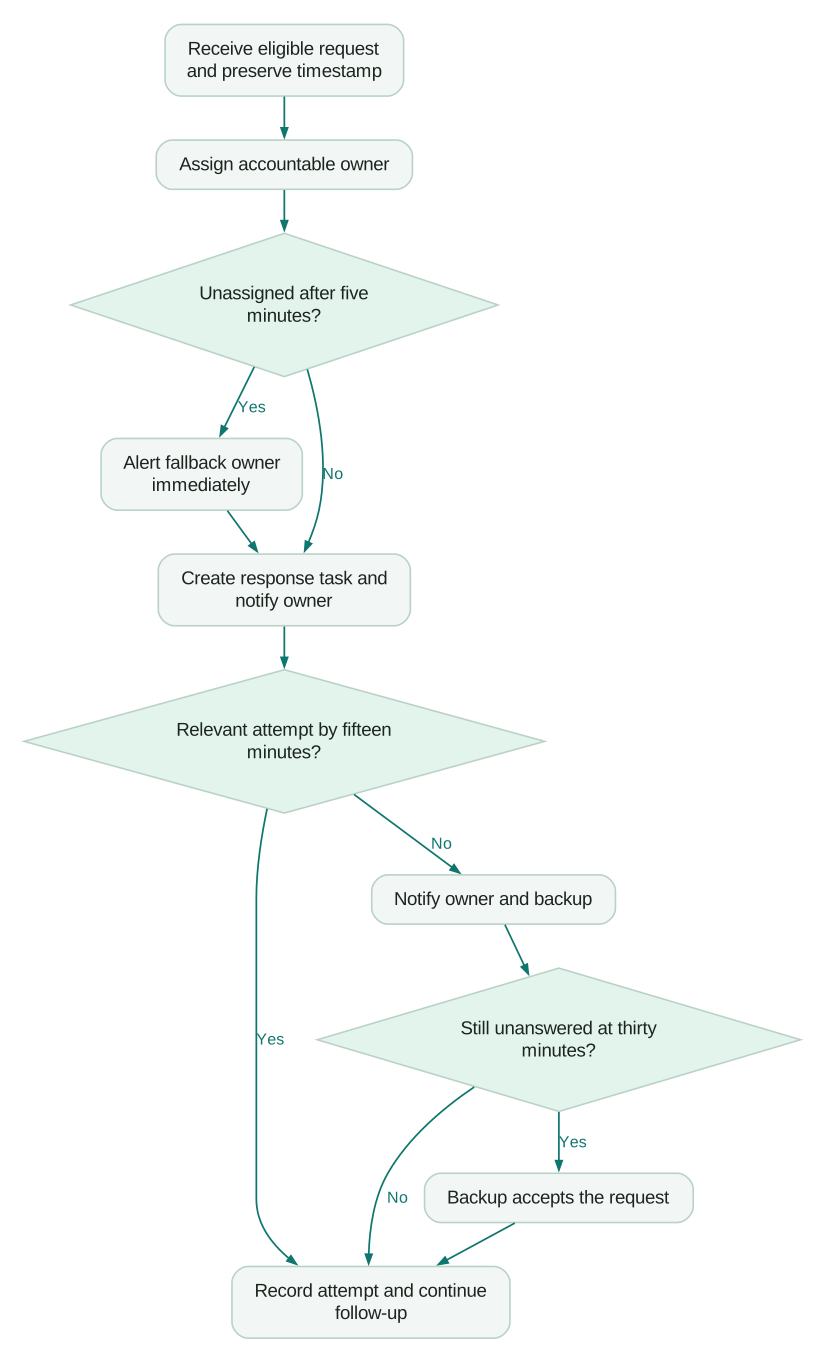
Re-check the request's state before every escalation. Stop stale reminders after a relevant attempt, a completed booking that satisfies the defined response requirement, a disqualification or a withdrawal. Record why the request exited.
Changing owners must not reset the original service deadline. A request can be five minutes old for its second representative and forty minutes old for the buyer. Keep both facts.
If a workflow starts late, calculate the remaining time from the source timestamp. Adding a fresh fifteen-minute delay after a forty-minute integration wait creates a fifty-five-minute first checkpoint.
HubSpot's “business days only” delay skips weekends and is configured in whole days; it does not accept hour or minute settings in that mode. Do not use it as though it were a fifteen-minute working-hours timer. Delay behaviour.
Design the actual coverage calendar, time-zone conversion and deadline evaluation separately. Test a request just before closing, a holiday, a daylight-saving transition where applicable and an all-away assignment pool.
Report the unanswered requests as well as the fast ones
A median among answered leads can improve while the team ignores more of the queue. Publish a small set of measures together:
- Eligible requests received during the reporting cohort.
- Requests with no attempt by the review cutoff, split into overdue and not yet due.
- Percentage receiving an attempt within the agreed deadline.
- Median and a slower-tail percentile among attempted requests, labelled with that denominator.
- Meaningful conversations, qualified opportunities and eventual wins for sufficiently mature cohorts.
For an illustrative completed cohort of 100 eligible requests, suppose 80 received an attempt: 60 within target and 20 late. The on-time rate across the eligible cohort is 60%, not 75%. The latter describes 60 of the 80 attempted requests and omits the 20 unanswered ones.
For a live queue, keep recently arrived requests that are still within their deadline separate from overdue failures. Never assign unanswered requests a response time of zero. Store their current age and status until an attempt or an explicit terminal disposition occurs.
Break the report down by request type, coverage window, source and routing destination. Compare teams on comparable work. A team handling straightforward demo requests is not receiving the same queue as one handling complex account transfers.
Estimate the value using your funnel, not a borrowed multiplier
Use a pilot with a defined eligible cohort and enough follow-up to observe the outcome you care about. Preserve the denominator before the routing change. Record changes in channel mix, qualification standards, staffing and product demand that could also affect results.
A before-and-after improvement is useful operational evidence, but it does not by itself isolate the effect of response speed. Where practical, use a controlled rollout across comparable groups without deliberately neglecting requests. Keep customer experience and response coverage as guardrails.
Here is an original scenario for a three-month pilot, using assumptions rather than promised results:
- 600 eligible requests enter the pilot.
- The qualified-conversation rate improves from 10% to 12%.
- Each additional qualified conversation has an assumed 20% eventual win rate.
- Each additional win contributes an assumed $4,000 over its first year after the costs included in that contribution definition.
- Implementation and incremental response operations for the pilot cost $6,000 in total.
The two-percentage-point change implies 12 additional qualified conversations. At the assumed win rate, that is 2.4 expected wins and $9,600 in expected first-year contribution. Subtracting the $6,000 pilot cost leaves $3,600 in expected net contribution for this cohort.
Fractional expected wins are a planning value, not a claim that 2.4 customers signed. Contribution arrives over the customers' first year; this is not immediate cash payback. Future pilot cohorts and future operating costs are outside this example.
Under those assumptions, break-even requires a 1.25-percentage-point improvement in qualified-conversation rate. A one-point improvement produces $4,800 in expected contribution and falls $1,200 short of pilot cost. If the extra conversations are weaker and close less often, recalculate with the lower win rate.
Include the cost of representative time, backup coverage, implementation and ongoing tools. If the bottleneck is a forty-minute import delay, solve that before buying more response capacity. The martech business-case guide provides the broader investment structure.
Response-process checklist
- Sales-eligible request types and exclusions are documented.
- Source receipt, CRM receipt, assignment, attempt and connection have distinct meanings.
- Each new request can be distinguished from a duplicate delivery.
- Existing account ownership and fallback responsibility are explicit.
- Missing enrichment and unavailable owners have tested recovery paths.
- Notifications reach someone with access and coverage.
- Escalations use the original request deadline and re-check current state.
- Repeat requests are handled even while earlier work is active.
- Business-hour and elapsed-time reporting are both available.
- Unanswered and excluded requests remain visible.
- The first response is relevant, and follow-up respects the person's choices.
- The value calculation uses observed funnel quality and realistic costs.
For implementation help, bring a handful of delayed requests, their timestamps and your coverage rules to Martechdevs' CRM and lifecycle service. That evidence makes it possible to scope the routing, reporting or integration change that will remove the actual wait.
Questions people ask
What is a good speed-to-lead target?
Set a target by request intent, expected customer experience and staffed coverage. For explicit sales requests, a short response target with a clear backup is a sensible starting point. Measure your ability to meet it and the quality of the resulting conversations before declaring a universal benchmark.
Does an automatic email count as responding to a lead?
Track it as an acknowledgement unless it meets your separately defined response requirement. A receipt confirmation can set expectations, but it should not stop the clock for an unanswered question. Keep automated delivery, relevant outreach and two-way connection as distinct measures.
Should we call every lead within five minutes?
No. First establish whether the person requested sales contact and which channel is appropriate. A rapid, relevant response to a demo request is different from an unexpected call after a content download. Respect stated preferences and use a process suited to the request.
Why does HubSpot show a faster response time than the buyer experienced?
The native report can use assignment as its starting point and qualifying owner activity as its endpoint. It can therefore exclude time spent before assignment. Compare the raw source, assignment and activity timestamps with your own end-to-end definition before changing the workflow.
How can a small team improve without hiring more representatives?
Remove avoidable waits first: batch imports, enrichment dependencies, unowned requests, missing notifications and unclear backups. Give the responder useful context and an appropriate next step. Measure the remaining queue by coverage window before deciding whether additional staffing is necessary.
Sources
- Harvard Business Review: The Short Life of Online Sales Leads. Published March 2011; listing and indexed primary article excerpt checked 13 October 2026.
- InsideSales/XANT: 2014 Lead Response Report. Historical research recap inspected 13 October 2026.
- InsideSales.com and James Oldroyd: 2007 Lead Response Management report, hosted by MarketingSherpa. Part 2 inspected 13 October 2026.
- HubSpot: Sales Analytics report definitions. Accessed 13 October 2026.
- HubSpot: workflow re-enrollment. Accessed 13 October 2026.
- HubSpot: owner assignment and rotation. Accessed 13 October 2026.
- HubSpot: workflow actions and notifications. Accessed 13 October 2026.
- HubSpot: workflow delays. Accessed 13 October 2026.
Written by
Jafrin Akter AloData Engineer and Co-founder, martechdevs
Jafrin Akter Alo is a data engineer and co-founder of martechdevs, where the team has delivered 74+ martech, data and growth stack implementations.