
AI SDR Tools: What to Buy, What to Build and What to Measure
Data Engineer and Co-founder, martechdevs
Last updated 9 min read
Choose an AI SDR tool around the part of prospecting that limits qualified pipeline: finding suitable accounts, researching a relevant reason to contact them, executing outreach or handling replies. Compare the complete workflow and its remaining human work. A useful pilot measures accepted opportunities, evidence quality and operating cost, rather than treating more messages or booked meetings as success.
Last updated: 8 October 2026.
An automated sales development representative can produce a full calendar and still waste account executives' time. Meetings may involve the wrong buyer, an existing customer or somebody who accepted a conversation without a problem your product solves. Faster activity only helps when the selection and handoff improve too.
Define one motion before selecting a product. Reactivating previously qualified leads is different from entering a new market. An inbound demo request is different from a cold account showing a hiring signal. The available context, expected response and appropriate next action all change.
If the workflow spans a data source, research step, sequencer and CRM, GTM engineering connects those responsibilities. The tool decision should identify which steps become simpler and which still require ownership.
What kinds of AI SDR tools are you comparing?
Assistance inside an existing sales platform
Apollo's documented agents cover lead discovery, sequence creation and sequence optimization. They run on schedules and return results or recommendations for review; the documentation describes approval before a completed sequence launches or an optimization change is applied. They are listed for Professional and Organization plans. Apollo agents
This category fits a team whose sales platform already works and whose bottleneck is the repeated analysis surrounding it. Evaluate whether recommendations are actionable and whether the team actually adopts them. An accurate recommendation that sits unread saves little time.
Research and workflow components you assemble
Claygent Builder supports account research, scoring, persona classification and copywriting agents, with business context, reusable instructions and versioned testing. Those capabilities can form a research layer within a broader outbound process. Claygent Builder
An assembled workflow makes sense when your qualification logic is distinctive. A company selling warehouse migration work may need to identify a particular combination of hiring, data-stack evidence and operational change. Generic firmographic filters may not capture that combination.
The tradeoff is ownership. Somebody must maintain source selection, mappings, prompts, error handling and the connection to the sending system. Compare that work with the flexibility gained, using the Clay versus Apollo guide when those are your main building blocks.
A product marketed to operate the outbound motion
11x documents Alice as an outbound agent covering identification, research, personalized engagement, replies and meeting booking. Its description emphasizes the ideal customer profile and knowledge base as key inputs. Treat this as the vendor's documented scope, not independent evidence of performance in your market. Alice overview
Artisan describes Ava as an outbound system with campaign-level controls including reply approval mode, escalation rules, account ownership and exclusion lists. Its product page distinguishes automated outreach from call steps queued for representatives. Ask the vendor to demonstrate the exact channels and controls included in your proposed setup. Artisan product overview
For this category, procurement is partly a transfer of operating responsibility. Establish what the vendor configures, what your team reviews and what happens when the system cannot determine the correct response.
What should the tool know before it writes anything?
Provide a compact commercial knowledge base with supported facts. Include the problem solved, qualified buyer, relevant product capabilities, boundaries, approved proof and acceptable next steps. Separate an approved claim from an example the model may use only as an illustration.
A useful evidence record for each prospect contains:
- Account identifier and the relevant business unit or domain.
- Qualification criteria met, failed or unresolved.
- Source URL and observation date for each consequential claim.
- The observed business signal, separated from the interpretation of that signal.
- Current CRM owner and existing relationship status.
- The specific problem hypothesis and what evidence would disprove it.
Suppose a company is hiring a lifecycle manager. That supports a claim about a published role if the posting is current. It does not establish that the company has poor retention, uses a particular CRM or has budget for your service. A message based on the latter assumptions should be rejected or rewritten.
Use evidence to make outreach relevant, not to decorate the first sentence. A mention of a recent announcement earns attention only when it explains why your offer matters to the recipient's responsibilities.
How do you test research and qualification quality?
Build a labeled evaluation set before a live pilot. Include obvious fits, near misses and cases where evidence is insufficient. Keep some cases separate from the examples used to tune the workflow.
For each account, record whether the correct decision is to advance, reject or request review. Require a reason. A binary score alone hides whether the tool reached the right answer through unsupported assumptions.
A hypothetical test contains 100 accounts. Human reviewers agree that 40 fit the motion. The AI advances 50, of which 32 are actual fits. Its precision is 32 divided by 50, or 64%. It finds 32 of the 40 fitting accounts, giving 80% recall on this evaluation set.
These numbers expose two different costs. Eighteen unsuitable accounts consume research, sending or sales time. Eight suitable accounts are missed. The right tradeoff depends on the motion. A small named-account market may prioritize avoiding missed fits; a broad market with limited rep capacity may prioritize the quality of accounts advanced.
The review set itself needs care. If it contains only clean public-company websites, it will not test subsidiaries, stale job postings, ambiguous company names or small businesses with limited public information. Report results by those relevant slices, rather than publishing one reassuring average.
How should replies and CRM ownership work?
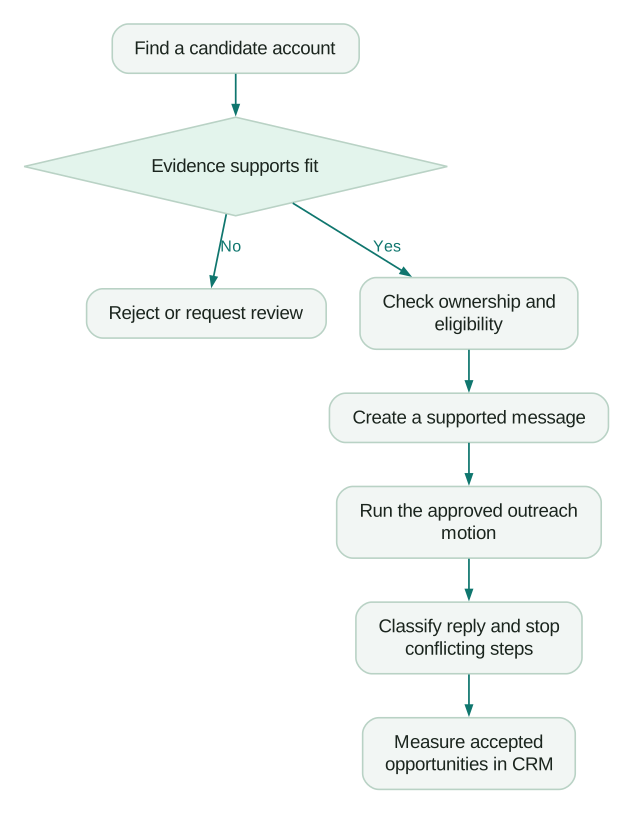
Treat replies as changes in the state of a sales conversation. A positive reply, opt-out, referral, existing-customer response and automated absence message require different handling. “Any reply is engagement” is too crude for an autonomous workflow.
Define a finite set of outcomes and their permitted next actions. For example:
- Interested and qualified: stop prospecting follow-ups and route to the correct owner.
- Interested but qualification unclear: request the missing information or assign review.
- Not now: record the stated timing without inventing permission for an arbitrary cadence.
- Wrong person: record a referral only when the reply actually supplies one.
- Stop contacting: update the authoritative suppression record and cancel queued steps.
- Existing relationship or active opportunity: hand control to the established owner.
The exact state names can differ between tools. What matters is a stable mapping to the CRM and sending system. A reply classifier is incomplete if the system labels the reply correctly but leaves a scheduled follow-up active.
Test a reply arriving while the next message is already queued. Also test duplicate webhook delivery, a CRM outage and a changed owner. Your lead-routing process should determine who receives the conversation and how unresolved cases are surfaced.
Which metrics reveal commercial value?
Use a funnel with explicit definitions. Contacted accounts, meaningful positive replies, held meetings and accepted opportunities are separate events. Preserve denominators so an apparent improvement cannot be manufactured by dropping difficult accounts from the report.
Define an accepted opportunity before the pilot. It might require a supported problem, a relevant stakeholder, a plausible use case and sales acceptance under your normal rules. Avoid changing that definition halfway through the evaluation to match the tool's output.
Compare quality and operating cost together. Here is an illustrative monthly scenario, with invented planning inputs rather than vendor prices:
- Existing process: USD4,000 total operating cost, 40 held meetings and 20 accepted opportunities.
- AI-assisted process: USD3,000 total operating cost, 60 held meetings and 15 accepted opportunities.
The second process appears cheaper per held meeting: USD50 versus USD100. Both cost USD200 per accepted opportunity. The AI-assisted process also produces fewer accepted opportunities and leaves more unproductive meetings for account executives.
If the AI workflow requires another USD1,000 of review and repair work that was omitted from the initial estimate, its full cost becomes about USD267 per accepted opportunity. That changes the decision even though the subscription has not changed.
Include research review, reply review, data purchases, mailboxes, integration maintenance and the sales time spent on rejected meetings. Count time saved only when the previous work actually disappears or the team uses the freed capacity productively.
A later revenue comparison needs a mature sales window and comparable accounts. Early pipeline values can be optimistic, and a tool should not receive credit for an opportunity that already existed before the pilot.
What can a deliverability feature actually promise?
Ask for observable behavior: authentication checks, bounce handling, sending controls, suppression and visibility into delivery errors. A dashboard labeled “healthy” does not establish that recipients want the messages or that every mailbox provider will accept them.
Google's personal-Gmail sender guidance specifies authentication and other requirements, with additional requirements for bulk senders. It also states that Google does not guarantee that messages sent through an email provider will pass its spam filters. Gmail sender guidelines
Keep this operational boundary clear in the evaluation. A tool may help administer sending infrastructure, but your business still owns the audience, relevance, contact practices and response to negative feedback. Check the rules of the actual sending and receiving services used by the pilot. Do not buy on an assumption that automation removes those constraints.
When should you buy a complete product or assemble a workflow?
Buy a more complete operating product when the motion is established, its supported workflow fits, and the vendor can demonstrate the exception handling your team needs. Ask for evidence from your own test cases before relying on aggregate customer outcomes.
Assemble a workflow when differentiation lies in proprietary qualification signals, a specialized data model or unusual handoffs. Budget for a named maintainer and a replacement path for providers that change or fail.
Start with assistive automation when the team is still learning its market. It can speed research and drafting while preserving the feedback that helps founders understand why buyers respond. Automating a weak message across more accounts can obscure that learning.
The build-versus-buy agent guide helps evaluate maintenance responsibilities. For an SDR use case, the deciding issue is whether the proposed system can run your actual sales motion with less total waste.
What should be true before the pilot expands?
Use concrete acceptance conditions tied to the failures you tested:
Checklist
- The research output distinguishes verified facts, inference and missing evidence.
- Qualification quality is measured on a held-out set containing realistic near misses.
- Existing customers, active opportunities and excluded accounts follow the correct ownership rules.
- A stop request cancels queued outreach and updates the authoritative suppression state.
- Ambiguous replies enter a visible queue with a responsible owner.
- Accepted opportunities can be traced to the originating account and pilot group.
- Full operating cost includes review, repair and unsuccessful meetings.
Expand one variable at a time, such as a new account segment or an additional channel. Preserve enough information to tell whether performance changed because the model improved, the audience changed or the team loosened its qualification standard.
Questions people ask
What is the best AI SDR tool?
The best fit depends on whether you need assistance, a research layer or a product that operates more of the outbound motion. Compare candidates on the same accounts and workflow, using accepted opportunities and total operating work as the main business measures.
Can an AI SDR replace an entire sales development team?
That is an operating-model question that a feature list cannot settle. Account strategy, qualification standards, exception handling and sales handoff still need accountable ownership, even when software performs many routine tasks.
Should we use booked meetings as the main success metric?
Booked meetings are an intermediate measure. Track attendance, sales acceptance and eventual commercial outcomes so the system cannot appear successful by booking low-value conversations.
How do we stop AI from inventing personalization?
Require source-backed evidence for consequential statements and allow the workflow to report uncertainty. Test plausible but unsupported inferences explicitly, then review the message against the underlying evidence record.
Is a custom AI SDR workflow cheaper?
It can be, but subscription comparisons omit engineering and maintenance work. Estimate the complete cost of sources, execution, monitoring, review and failures before comparing a custom workflow with a managed product.
Sources
- Apollo agents for outbound work. Accessed 8 October 2026.
- Claygent Builder. Accessed 8 October 2026.
- 11x Alice overview. Accessed 8 October 2026.
- Artisan product overview. Accessed 8 October 2026.
- Gmail sender guidelines. Accessed 8 October 2026.
Written by
Jafrin Akter AloData Engineer and Co-founder, martechdevs
Jafrin Akter Alo is a data engineer and co-founder of martechdevs, where the team has delivered 74+ martech, data and growth stack implementations.